Magic Lantern "Dual ISO" Function

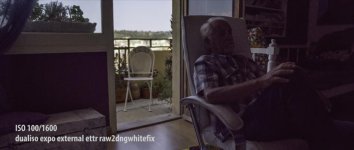
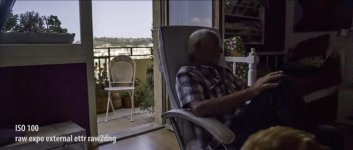
Regular raw ISO looks like video, the last dual ISO shot looks like film!


Are we watching the same clip? The dual iso clips had so much noise and red in the shadows that it look awful.... imo ofcourse. But yeah.. you gain the blue sky.

One thing is becoming sure, dual iso is not a substitute for lighting or bouncing light.
 
The video RAWs are the same as stills. The 5D3 has a great ability to lift the shadows, but he said the ISO100 shot was very underexposed, which is why he got that much noise upon recovering the shadows. Remember that we don't know the exposure settings pre recovery. If you underexpose too much to protect the highlights in a high contrast scene not even the 5D3 can recover the shadows cleanly. The 5D3 does have a native dynamic range limit after all. The ISO 100 was intentionally underexposed to protect highlights so that the ISO 1600 could give the clean shadows while retaining the highlights. Your option would have had more highlight clipping to retain the clean shadows of this particular scene.

I see and agree but I have still shots where I recovered some heavy shadows that do not have the noise. He must have under exposed the highlights as well? I have not played around with RAW video to know its limitations yet. From watching the video above it is clear this appraoch has its own issues. The magenta cast is quite noticeable. Also surprised how much noise the dual shot had as I thought ISO 1600 on the 5D was supposed to be pretty clean. I guess the RAW video stream does not have the benefit of processing to deal with the noise.

If you jump back and forth between the first ISO 100 shot and the dual exposure they are not that different - and the ISO 100 has proper color.

I've had magenta casts on shots, but personally I have never encountered a time where I couldn't remove it with grading. I don't know if just wasn't attempted or if something else is going on. I'm curious to know. Also, ISO 1600 on the 5D3 is very clean, but no noise reduction was used in the shot. It was turned to 0. So, you always have the option of applying Neat, which is amazing noise reduction software.
 
Are we watching the same clip? The dual iso clips had so much noise and red in the shadows that it look awful.... imo ofcourse. But yeah.. you gain the blue sky.

One thing is becoming sure, dual iso is not a substitute for lighting or bouncing light.

I think the magenta cast could have been fixed fairly easily given that they are RAW. I've never had problems removing color casts. It looks like the tint slider was all the way over on the magenta side. I think moving it to the left would have helped tremendously. I wonder why it was not fixed prior to upload. It looks like an easy fix to me though unless there's something else going on here.
 
I said it looks like film NOT like a film.

@.@ could you post a screenshot of your favorite dual ISO example so far? I am about upload ml, but can't test till Tuesday. Played around with regular raw yesterday. Love raw.
 
I said it looks like film NOT like a film.

@.@ could you post a screenshot of your favorite dual ISO example so far? I am about upload ml, but can't test till Tuesday. Played around with regular raw yesterday. Love raw.
 
For those saying "I can recover shadows without noise from my RAW images":
Yes, you can, up to a point; beyond that, if you try, noise creeps up, and it's a particularly nasty kind of noise. With 5D3+RAW+HDR, that point is moved at least two stops farther.
The samples you're seeing are comparing something pushed way beyond that point, in standard mode and in dual-ISO mode. So, in the "original" image, shadows have already been pushed up more aggressively than you usually do.
 
I might just be slow here, I skimmed through the white paper, but I was under the impression that RAW is independent from ISO. That since it is "RAW Sensor data", the ISO-setting can be changed in post. Now I read something that Canon does something different from Nikons in this regard, and that was why this hack works. But I'm still lost on the technical details of it.

I mean, in RED HDRx the way to reach HDR is by changing the shutter, not ISO (I know in the ML case it reduces resolution, so I know it wouldn't fit REDs style).
 
` That's not always the case. In some sensors, it works as you say; on others, it does not: when you increase ISO on a Canon DSLR, the analog signal is amplified before it reaches the ADC, so it's not the same as pushing the image in post. This analog gain gives better results than the digital gain you talk about. In any case, the proof is in the pudding!!
 
` That's not always the case. In some sensors, it works as you say; on others, it does not: when you increase ISO on a Canon DSLR, the analog signal is amplified before it reaches the ADC, so it's not the same as pushing the image in post. This analog gain gives better results than the digital gain you talk about. In any case, the proof is in the pudding!!

Oh, bring us the pudding
 
Samuel,

What is your opinion of the safety of using dual ISO? As usual there was the "sensor frying" warning from ML but what are your feelings heret?

Dual ISO has been looking better and better without an issue (a bricked camera issue that is) so far.
 
I think it won't be a problem at all, since all components are working just as they do in normal mode, except for the part that adds the analog gain.

If that part was switching on and off very fast, and was not designed to do this, it could get fried, that's why the ML guys have to put that disclaimer there. We don't really know how it works, but the normal way would be: there are even and odd ADC units (I think 4 of each), and they can be configured differently with a simple register. That's how it works on the cmv12000, for example (all you have to do is set the register according to what the docummentation tells you, and you get exactly this kind of behavior). If it works the same way, I think there's no risk in using that register.
 
Does this work on the 6D? Is it possible to record sound while using this feature? Is there a duration limit for dual iso? This is THE single most interesting feature ML has come up with for ME and I´m dying to use it. I´m wondering if it could handle a 3 hour shot without any issues.
 
Back
Top