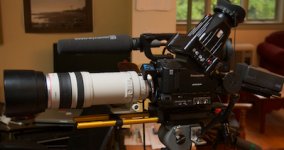
Long Glass

At those distances, it's not just optics, atmospheric distortion becomes a real issue. No fixing that, except maaaaybe shooting in very cold (dense) air.

Cold air alone - as helpful it is - may not be enough all though it helps with distortion as the air is less humid. But whenever you shoot through layers with different temperatures of air with very long focal length this can start to make the image wobble even in colder circumstances. Had shots at -20 degrees celsius with the 500 and the 1000 which started to become jelly'ish whenever something a bit warmer - the roof of a house, a river - would emit air of slightly different temperature on the way.
 
Last edited:
Down here in Miami, whether it's playing or shooting, the saying is "It's not the heat, it's the humidity..."
When I shot the Shuttle launch, it was soft- not from the glass, but from the humidity (and spray from the river).

I guess the next lens/camera test should include the vacuum of space?
See how the Voigtlander does up there??? :happy:
 
Cold air alone - as helpful it is - may not be enough all though it helps with distortion as the air is less humid. But whenever you shoot through layers with different temperatures of air with very long focal length this can start to make the image wobble even in colder circumstances. Had shots at -20 degrees celsius with the 500 and the 1000 which started to become jelly'ish whenever something a bit warmer - the roof of a house, a river - would emit air of slightly different temperature on the way.

Yes, I have some dramatic time-lapse material I did with a Sony 750 HDcam a few years ago, it was maybe -10F, zoomed all the way, total jello. Cold air is dense.

My telephoto needs for the AF100 are not so much about long distance surveillance but getting full frame "portraits" of certain wildlife species. Unless you are at the zoo, or very lucky, 300mm isn't really enough on an AF100.
 
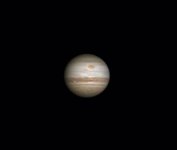
Last time FlightLine covered a launch, we were out in the middle of the desert in the middle of the night. So we turned the camera to point at Jupiter.

It was awesome. Not like the Hubble, obviously, but we got Jupiter to fill about 20% of the screen...

EDIT: I don't have the actual footage here, but this is basically what we were seeing...
jupiter.jpg
 
Last edited:
Cold air alone - as helpful it is - may not be enough all though it helps with distortion as the air is less humid. But whenever you shoot through layers with different temperatures of air with very long focal length this can start to make the image wobble even in colder circumstances.
Extremely true. With any camera. Even with the Phantom Flex we were using to shoot the space shuttle, the atmospheric distortion of shooting through 11 miles of air just really ruins the shot.

This example was from the same distance, using the GH2, on the Lumix 100-300 zoomed in to 300mm, put in 720p mode, and using ETC. The net effective focal length was about 2500mm as if used on a "full frame" camera, or about 1250mm on an AF100.

I like the 100-300 for what it is -- pretty long, super cheap, and with pretty darn good OIS and autofocus, and it's tiny for such a lot of telephoto. It's not great for manual zooming, and the sharpness suffers some at full telephoto, but it's so small and affordable (I got it for, I think, under $500) that it pretty much does the job, and it's a lot sharper than my old Zeiss 300mm medium-format lens, at about 1/10 the weight.

At those focal lengths, OIS becomes really rather important, especially on a MOS-based camera.
 
A couple of other shots from the 100-300 on the GH2. This one was (again) using ETC:


And this one was alternately using, and not using, ETC (obviously the more-zoomed-in shots were ETC):

It's not a great lens, but it's pretty decent and fairly long, and I do like the OIS and autofocus capability. You don't have to use them, but at least they're there.
 
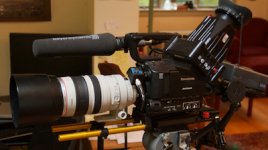
Been shooting a lot of Eagles, Pelicans and Osprey lately with these two lenses with great results. 300mm f4 EDIF Nikon with Voigtlander adaptor and Canon 70-200 f/2.8 L with a cheap Fotodiox adaptor (Birger, are you listening?). Heavy duty carbon legs plus the Sachtler 18 head.

Currently in the Netherlands with the 7D and Tokina 16-50 f2.8
 

Attachments

  • AF100+70-200 f2.8.jpg
    AF100+70-200 f2.8.jpg
    103 KB · Views: 0
  • 4 Nikon EDIF.jpg
    4 Nikon EDIF.jpg
    88.7 KB · Views: 0
Last edited:
Then there is the Canon 100-400 f4.5-5.6 L. I also like the 70-200 f2.8L.

Note, the RedRock LiveLens MFT works great on this lens.

And the Zakuto EVF is great for nailing focus.


100400Canon.jpg

100400Canon2.jpg
 
I know it is an old thread, but in case anyone else comes upon it late in the game (like I did) I thought I would mention my thoughts on it.

The Canon 100-400mm f/4.5-5.6 L has very good image quality and versatility. Bring along the Canon EF III 2X tele-converter and you have added reach if the light allows, with a little bit of a decrease in image quality. The Canon 600mm f/4 L is a thing of beauty (sharp, great reach, etc.) and looks really great even with the 2X tele-converter - surprisingly sharp. However the lens is quite heavy - in fact if you use the provided case, you'll be lugging around ca. 28 lbs. - and the price is a little over $10,000.

You probably already know this, but there is a pretty steep increase in difficulty when you go from framing with a 100-400mm or 100-300mm to framing with a 600mm fixed zoom. It was humbling, honestly and made me appreciate just how easy it was to frame with my 100-400mm f/4.5-5.6 L. Still, shooting the distant clouds at sunrise with the 600mm f/4 L and 2x tele-converter with the GH2 in Extended Tele-Converter crop mode was an experience unlike any other I have shot to date. And the video of the moon (with the same setup and settings) made the moon large enough to cover far more than a full frame of the video.
 
Very nice thread to bring up with tonight's coming SUPER-MOOOOOOON!!!!!!!!

I'll be sitting with my GH2 and Sigma 50-500 praying for a break in the clouds
 
I'm sorry to hear that. :( Last year the clouds covered the majority of the night, too, though it briefly peaked through. Here's hoping for better luck next year!
 
Has anyone experimented with this adapter which allows you to reverse your lens?

http://www.amazon.com/gp/product/B0...&pf_rd_t=101&pf_rd_p=470938811&pf_rd_i=507846


I'm always more than a bit hesitant to put cheap adapters onto my expensive camera, but it does look intriguing....


Also curious if anyone has tried this gadget:

http://www.bhphotovideo.com/bnh/controller/home?O=&A=ShowProduct&Q=&sku=87503&is=REG


I'm trying to find a decent macro that's under $2k to shoot nice jewelry...so far I'm not seeing anything that wows me. Suggestions?
Ideally I'd like to use a MFT or Nikon mount because I have a novoflex adapter.
 
Talking macro, now, is a whole other beast... but a fun beast nonetheless. One of my main gigs is scientific videography, and do a lot of very close-in macro work.

I've tried a few of the reversing rings, and they work splendid... but will get your REALLY close in. Generally, the wider lens you use, the greater your magnification. The 20/1.7 and PL25/1.4 are incredibly sharp reversed (just choose your aperture before you flip the lens, and focus by distance from lens to subject). At about 85mm, there's no benefit to reversing the lens.

Another trick is using any sharp, fast lens with either extension rings or bellows (full image quality but you lost light) or your aforementioned closeup lenses (full light sensitivity, but there will be an image quality hit).

As to more "normal" solutions, I haven't tried any of the m43 or 4/3 macro lenses.

Good choices for legacy glass include the Micro-Nikkor 55/2.8 (3.5 is OK as well, and cheaper), Leica Macro-Elmarit-R 60, Vivitar Series 1 90/2.5, Leica Macro-Elmar 100 (hey, you did say under $2K)

Here's a link to a little practice piece I did last year with the GH2, a Micro-Nikkor 55/3.5, and a Micro-Nikkor 70-210/4-5.6

http://vimeo.com/28375678
 
Last edited:
I don't have any experience with using reversed lenses, just extension tubes, tele-converters and both macro and close-up filters. Like MCBob mentioned, the extension tubes are nice because you aren't adding glass and just losing some light.

In the video below, I shot the close up of the eye at around 3:06 with a Canon 24-70mm f/2.8 L (at f/2.8 70mm) and a short extender tube (7mm) on a GH2 in EX24H mode. Using a lens longer than 50mm was important because getting too close to the eye would have been even more fatiguing for the subject.


Tele-converters can be helpful when you need to keep a distance away from the subject while getting high magnification, but unlike the extender tubes they reduce image quality.
 
Back
Top