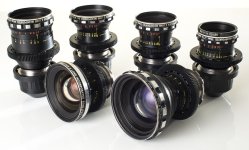
Let's talk lenses

JMtheDP

Veteran
Unless I'm being blind, it seems to me that DVXuser does not have a specific lens discussion section, as we are all DoP types I thought it would be good to start a thread relating to that.

We've had threads about optics before, although often they were about entry-level PL stuff. I'd like to broaden that here and I thought all of us could post our opinions on the lenses we have used - preferably ones we've seen on the F35/F65. It is quite important I think because the way these cameras are made (the F35 in particular) means lenses may behave differently than on other digital cameras.

If everyone can post a bit about the set they used, if it was a rental set where it came from, thoughts opinions.... I don't expect test charts and things but opinions are always great and nobody's opinion is really right or wrong. And don't forget when it comes to vintage lenses in particular there are a lot of variations between sets!
 
I would love to see a real lens forum like on reduser.

To date my only experience with F65 glass has all been rental. Cooke S4 & Optimo.

When I was shooting with the F35 I really liked the look of my old Cooke SII/III Speed Panchros. I really miss those lenses.
 
David, I think there is definitely plenty of vintage glass out there which performs well. I have no experience with pre-S4 Cookes, but my first real cinema lenses were a set of Mark II standard speeds. I originally started with just a 16, 32 and 85 because that was all I could afford - but I later added the 50mm. That combo did a lot of great work - on at least two features. One of which is just about to see cinematic release.

I have never been a big fan of super speeds - I try and shoot at a minimum of T2 as a general rule anyway, and I found that Standards are 2.1 were perfectly sharp enough for my needs. Supers were also commanding silly money. What's handy about the F35 is that being CCD based, and a normal S35 size, it does not have as many issues with portholing or vignetting as many CMOS based cameras do.

Here are some grabs from a project I shot called "Walking with the Ferryman". In a forest, very very little additional lighting (ie. an LED panel). In the other scenes, pretty basic lighting as both budget and schedule were pretty tight. As you can see the old lenses are pretty sharp.

My main criticism really is their mechanics. They are tiny lenses - not a bad thing in of itself, but the focus and iris ring are in opposite places to where you would expect. The focus ring is nearly at the PL mount and so getting a follow focus on can be tricky. On the plus side, they have a proper rotation and have markings in both imperial and metric - making them easy to build a set from different places. The wider lenses were very, very soft at the edges when wide open but overall I was very pleased with most stuff I got out of them. The 16mm was great, had a lot of character. Made me love that focal length.

945354_wwtf1.jpg

945354_wwtf2.jpg

945354_wwtf3.jpg

945354_wwtf5.jpg

There is definitely some filtration on that last shot.
 
Here is a little more standard speed material. This was actually shot a couple of weeks before the material above. This is for the project "Soldiers of the Damned", which I have shown recently. I have now been given access to a higher quality version of the UK trailer, which has a much nicer grade.

This was all shot on location, in the UK. The only lighting was done on some interiors - outside is 100% natural light. I don't think I ever went beyond a 2.8 unless the sun really came out - the majority of our stuff was in the woods which sapped our light. I didn't have an ND on for much of the shoot.

376973_sotd1.jpg

376973_sotd2.jpg

376973_sotd3.jpg

376973_sotd4.jpg

376973_sotd5.jpg
 
The high end cams will be always associated with the higher price lenses (which are high priced for a reason ... usually). However, with the camera price-for-quality ratios dropping quickly and continuously, the less talked about topic is the gap between top rated photo lenses and the high end pro gear. Let's say, for an argument sake, within two years a camera will be capable of delivering a perceived F65 quality* for $5,000 and, if so, how many shooters would use a $30,000 lens on it?

* A perceived F65 quality could have probably been achieved right now on the $3,200 A7R MK II ... had the camera had a 10-12 bit output to an external recorder. F65 will naturally remain a superior camera overall but, a normal viewer under normal circumstances is unlikely to spot that technical superiority.

PS. I am phrasing this debate on purely technical grounds, leaving aside the "it's the shooter, not the gear" premise entirely.
 
Interesting thoughts. I think there are always going to be a lot of differences between prosumer and pro gear, beyond the obvious. For example, the F35 has a 14-bit A/D converter, something no prosumer camera I know of below an F5 has. And the F5/55 are quite unusual in what they have.

Data rate is always a struggle - as well as heat dissipation. I was at an event for the AJA Cion yesterday (more on that in another thread), it ran surprisingly cool. My F65 certainly doesn't and neither do any of the REDs I have ever used.

With photo lenses though, they are getting pricier too. A 24 - 70 2.8 L Canon was just over £500 when I first bought one, now they are double that. Economies of scale play a massive part here - building a kit lens for £50 is easy because you shift millions - but something like the Zeiss Otus is probably only going to sell in the thousands, probably not tens of thousands, simply because that is the market.

A cinema lens is also designed as a set - there's a huge cost in developing just one lens, trying to build a coherent set is massively pricey. In my mind there are only two lenses I would consider on a "full frame" cinema camera, those would be the Zeiss Compact Zooms or the Schneider Xenons. But, there are reasons their bigger brothers cost money.

A modern hot hatchback will probably show a 15 year old Ferrari a thing or two round a track, that does not make it a Ferrari.
 
Bausch+Lomb Super Baltar primes

- They top out around T2.3.

- 20mm / 25mm / 35mm / 50mm / 75mm (3 inch) / 100mm (4 inch) / 152mm (6 inch) / 229mm (9 inch)
I've only seen one or two examples of the 152mm and maybe one of the 229mm on eBay.

- Coverage:

Quoted figures are according to the B+L catalog. The Sony F3 sensor is 23.6 x 13.3 and I saw no vignetting. I have also shot these on a Super 35 Mitchell NC-R and again no vignetting, so the B+L coverage figures are something of a mystery to me.

20mm/25mm/35mm/50mm/75mm/100mm cover 16mm x 22mm.

152mm covers 23mm x 52.5mm
229mm covers 2.25 x 2.25 inches


- Imperial scales

- Flare happy, but IMO few other lenses produce prettier flares. It may have to do with the coatings. The Baltars are slightly warm, but the flares are blue. Very unique look.

- Blooming. Surprisingly little which is odd when you consider how they flare.

- Contrast. Higher than expected for a vintage lens. These are not low contrast lenses.

- Occasional color fringing. I've only noticed fringing around very bright spec. Usually orange in color.

- Sharp where it counts. I've shot Kodak 5222 (b/w) on the Super Baltars and theater projected prints were razor sharp. Cinelicious recently did a scan of the negative and even at 2k the level of detail was shocking. BUT they are very kind to skin and never look clinical.

- Useable at T2.3, but we usually shoot them around F4.

- Bokeh is very smooth with few odd shapes or swirling.

- They breath

- Lens may stick if focused hard past infinity. From the factory there is no hard stop to prevent the barrel from continuing to turn. Instead the thread just continues and if you keep turning past infinity you are just screwing the focus barrel down. So, be cautious with motorized focus.

- Different front sizes on factory original lenses. I think the 20mm or 25mm are about 110-114mm and by far the biggest. The 35 and 50 are about half the size.

- Different focusing ring sizes on factory original lenses. Gear pitch 0.8

- Factory original lenses are different lengths and diameter.

- I have read that some of the focal lengths may use radioactive Lantham glass, but haven't been able to confirm this. If this is true, then we are talking about a very, very low level of radiation that should pose no harm. There were a few SLR lenses made with this type of glass (Leica, Canon, Pentax etc). Just don't store the case under your bed for years on end...


Overall these are my favorite lenses. They are sharp, but at the same time not clinical and produce a lush, round image. Very organic and they really help take the curse off digital without going soft. I would say that they have a lot more in common with Cooke lenses than Zeiss. For some reason the fingerprint reminds me of a spherical version of the anamorphic lenses used on a film like 'The Taking of Pelham 123' (1974)

P+S Technik is offering to rehousing these.
Duclos is one of the few shops that can service them. Maybe also Richard at cinemagear.com

Old B+L Sales catalog

http://www.cameraeccentric.com/html/info/bauschlomb_9.html

Two pieces I directed with the Baltars. DoP as credited.

Kodak 5222
https://vimeo.com/118926707

Sony F3L (slog 444) with custom Technicolor emulation.
https://vimeo.com/118928522

Also The Godfather and many other films from the 60's-80's. A recent example is 'Rush' by Ron Howard.

Super-Baltar-Primes.jpg
photo credit www.gulfcamera.com
 
Last edited:
Excellent Harry, that's the kind of thing we're looking for.

The Super Baltars seem very highly sought after. I believe TLS may rehouse them and I think JDC might carry a rehoused set too. It is mechanics which tend to hold these types of lenses back in a modern environment.

For a "modern" set of lenses with some classic ideas, I can't really praise the Illumina S35s highly enough. Many people compare them to Cooke Mini S4s, although I think that was a thing of convenience rather than anything else - they both cost a similar amount at one point in time.

I got the S35s with my F65, as I wanted something a little newer than the Standard Speeds - although truth be told Standards would have worked great on the newer camera too.

The build of the S35s is really nice, the focus rings have a solid feel to them and the irises are nice. They bloom a fair bit when wide open, but that is long gone by T2, and probably more like T1.5/1.6. They are sharp, certainly sharp enough for the F65. They do some odd things to backgrounds though, I believe the technical term being "spherical aberrations". It probably doesn't help that I've had a couple of shots from projects shot on these as backgrounds on my PC for a while - so I've noticed all their little defects.

Size wise they are a really nice size - big enough to get gears and things on without much issue, although the focus gears are not all in EXACTLY the same place - with a thick focus gear you don't need to move the gears.

The lenses differ in length. For some reason I never really liked the 25. My example was the stiffest to focus of all of my lenses, perhaps it just needed a re-grease. Optically I felt it was the weakest of the bunch. For some reason 25s have proven difficult before (look at the size of Optica Elite's 25mm).

All the fronts are 95mm, they do extended during focusing but they breathe very little - I'd say less than some ultra primes. With a clamp-on matte box there is a risk of binding, but I don't use a clamp on so that's not an issue.

For the price they are though - pretty hard to complain. The retail is $35,500 at FJS - that's less than two Master Primes, or two Cooke S4s. And they currently come with a set of uncoated front elements too, which open up all sorts of possibilities. Watch for the flare on them though, even with the coated front elements, they flare easily and can sometimes do slightly undesirable things if you aren't prepared. You generally have to be asking for it, though.
 
Illumina S35 material:

F65 & Illumina S35s, shot in 1080P SR Codec, MPEG 4 SStP SQ, S-Log3.Cine with the LC709A LUT Applied. For those who don't know, that LUT is designed to give a more "Alexa-like" look.

See the Glorious 4K Master Race thread for CaptainHook's re-graded shots.

893974_nl1.jpg

847812_nl2.jpg

847812_nl3.jpg

847812_nl4.jpg

847812_nl5.jpg
 
... A modern hot hatchback will probably show a 15 year old Ferrari a thing or two round a track, that does not make it a Ferrari.
Ford Focus RS that was announced yesterday has/will have a 2.3L turbocharged 350 HP engine and will probably go 0-60 in under 5 seconds. By comparison, the famed 1978 Ferrari 308 that Tom Selleck drove in "Magnum PI" had a 240 HP engine and went 0-60 in 8.4 seconds. 308 also cost around $60,000 then or ~ four times GDP/capita in the uS, whereas Ford Focus should run under $30,000 or ~ one half of the current GDP/capita.

As to lenses - let's take a look at the new Sony/Zeiss Batis 25mm and 85mm auto focus primes. Add a Tiffen filter of your choice, then a film emulation software and you will be able to get away with a $5,000 in the next year or so.

 
I think the Illumina S35 are very interesting.

Another lens on my wish list is the Cooke Varotal 18-100 T3...

The Cooke 20-100 is cheaper, but apparently won't cover the F3 or bigger sensors.


Ford Focus RS that was announced yesterday has/will have a 2.3L turbocharged 350 HP engine and will probably go 0-60 in under 5 seconds. By comparison, the famed 1978 Ferrari 308 that Tom Selleck drove in "Magnum PI" had a 240 HP engine and went 0-60 in 8.4 seconds. 308 also cost around $60,000 then or ~ four times GDP/capita in the uS, whereas Ford Focus should run under $30,000 or ~ one half of the current GDP/capita.

As to lenses - let's take a look at the new Sony/Zeiss Batis 25mm and 85mm auto focus primes. Add a Tiffen filter of your choice, then a film emulation software and you will be able to get away with a $5,000 in the next year or so.

Like with lenses it seems people will also pay a premium for the much older thing with the prestigious rep!

Here's the thing - there are loads of lenses like this Batis. The threads on REDUSER etc.... are pretty numerous. Someone goes "look at this £2k lens, compare it with a Master Prime!"

Very often there are things one could compare with a Master Prime - sharpness is usually the favourite. By all accounts the new Otus lenses are really marvellous things. But there's just a 55mm and an 85mm.

I'm gonna ignore the fact they cover full frame for a minute because at the present time basically all cinema cameras are S35 or thereabouts.

The Master Primes come in sixteen different focal lengths, ALL with very similar performance, build and operation. Ultra primes have an even larger range. The Cooke S4 range is huge too. Panavision's range of lenses is ludicrous.

I have a real issue with Compact Primes because they have such ridiculously mismatching stops as a result of their heritage. They are reasonable value for money, but I do not want to be in a situation where I'm having to light for an F4 lens when I've got other lenses that are F1.5. It makes no sense. And anyone who has worked for a director knows when they've promised you they won't make you use that wide in this scene, they will change their mind.

I don't believe Zeiss will be able to make an Otus any wider than 20-something millimetres without compromising something - probably speed. Obviously on a full frame camera, 24mm is nice and wide. Not so on S35.

Those Batis lenses are very nice optically by all accounts - I have never tried one - but I am not fond of this focus-by-wire system. Sounds like the devils work to me. No iris ring is also a no-no, in my mind, for cinema use. Of course, I'm judging a stills lens, but people will suggest them for cinema work and for my money there are better options.
 
Here's a couple of lenses I am testing now which I think bridge the gap quite well between converted stills lenses, and full on cinema primes - the ARRI Alura set.

I am a really big fan of zooms and it has been years since I have owned one - the opportunity had come up a few times to own one but it would have been my only lens and one can't have something like the Cooke 18-100 as your sole lens.

I haven't had much hands-on time at all with these Fujis, but here are my observations thus far:

Build quality is definitely more ARRI than Fujinon. They are very nicely put together. The focus marks are fairly plentiful and clear. The two lightweight lenses are both almost identical in size, weight and layout. I think it is safe to say if you can live with 2.8 as your maximum stop, these two lenses could see you through most things.

They are not especially compact, not compared to something like the GL Optics 18-35, but this does have its benefits - especially when rigging for remote control of the lens. They are genuinely compact compared to other, bigger zooms though - even the 18-80 Alura which is pretty small for what it does.

The two lightweight units are both 2.8, compared to 2.6 for the 18-80, but the lightweight units are LDS equipped. That's pretty impressive for "entry level" glass. Standard Ultra Primes are still not LDS equipped (and probably won't ever be). For some applications, this is quite handy.

I have not been able to acquire much footage with the lenses, this will be rectified soon, but what I have seen has impressed me. They don't seem to "sing" like a high end prime, but they appear to be damn fine performers and have yet to show me anything worrying.

Here's the three lenses, not the handle and lens support on the studio zoom

602403_imag0241.jpg


Here's a shot from the wide lightweight, at 15.5mm - on the move. SGamut3.Cine/S-Log3, no LUT applied, from the F55. Exposure was about T2.8 1/2

508810_bmw155.jpg


The other end of the same lens

508810_florence45mm.jpg


And the 30-80, at the wider end, interior, on the F65.. quite a bit of curves applied on this one

430201_bear1.00000.jpg
 
I think the thread is a great idea. But I was hoping it would stay with PL lenses. So many threads already discussing "affordable" lenses, still lenses, bang for the buck and low end glass in the other sections that it would be great if this one wouldn't get bogged down with that, this being the F35/F65 forum and all. It's one of the reasons I like hanging around here. It's a good change from the normal "DSLR" or stills gear for motion picture driven talks from the rest of the forum. I just think there are enough of that already everywhere else that this forum could maybe focus on the cameras the forum is intended for and in the case of lenses, definitely PL cinema glass.
 
I agree - PL or something adaptable to PL. I have two GL Optics lenses sat in front of me and I will try and get some footage soon that can show them off to the best of their abilities, whatever that may be. I think that's only fair given many people consider CP.2s to be "proper" lenses.

I am quite happy to discuss over "crossover" glass, like the Schneider Xenons but random lenses from stills companies here or there are not of any interest to me in a cine context
 
Here's a Nigerian who looks very unimpressed. Shot on the Illumina S35, F65, SR Codec Lite. Shot is handheld, hence slight lack of definition.

123076_african.00000.jpg
 
CP.2s and GL Optics are the scrap bottom of PL cinema glass, at least new. But I agree they definitely belong in this discussion. Being PL they will be used on PL cameras. I don't think many people with E-mount or EF-mount cameras would buy them in PL to use with a PL adapter. So they are basically shooting the same types of jobs as other higher PL lenses are or would if they didn't exist.

Having said that, CP.2s are not lenses I like or want to shoot with. I would much prefer a set of GL Optics converted primes if I had to choose. They are at least cheaper.
The look, the all over the yard apertures, the quality of some lenses in the set, all drive me away from the CP.2s. The Sony set have them beaten in basically everything but the brand name, which in my opinion is the strongest reason CP.2s seem to sell well.

As for Schneiders, they are definitely interesting for many reasons. But they seem to take what I dislike the most in Zeiss lenses a step further.
 
If Sony had made a lens wider than 20mm in their line up, I would have bought a set of them no question.

it is the wide end which separates the men from the boys.
 
Like with lenses it seems people will also pay a premium for the much older thing with the prestigious rep! ...
Sure, the survivors of the first pre-WWII series of BMW 328 (400 made in total) are fetching $400,000+ at auctions. In the UK, you'd know them as Bristols (some smart chap brought in the BMW factory and several engineers to England post-war).

Anyhow, I don't mean to hijack the discussion if it's deemed to be a hijacking. My point was not to discuss the "cheap", "stills", "photo" lenses per se but the absence of the middle class category where there are OEM cine primes and zooms that are being offered for substantially less than a $100,000 Fujinon zoom. (and, mind you, if I had the big ass budget, I would want an F65 and those lenses myself). Now, I don't see a separate area for that discussion but if this is not the place, then so be it.

I think the thread is a great idea. But I was hoping it would stay with PL lenses. So many threads already discussing "affordable" lenses, still lenses, bang for the buck and low end glass in the other sections that it would be great if this one wouldn't get bogged down with that, this being the F35/F65 forum and all..
Of course, the other side of the debate is that F35 quality can be had for $3,200 in August (and, in fact, with superior resolution and ISO as well) and A7RII shooters will not be seeking a $100,000 lens and will have to do with something much more affodable.
 
Last edited:
Back
Top