Sony just had it's best profit in the business since 1986, thanks to the huge shift from DSLR to Mirrorless, and with the Sony A7 III being sub $2k, it's game over for Canon if they don't act fast. In addition to videographers, many professional photographers are migrating to sony's full frame that's why their numbers are up and Canon's are down. Sony strategically chose WPPI to announce their new release, they are going after Canon and Nikon full force. Just 5 years ago Sony did not even exist in the photography market.

Navigation
Install the app
How to install the app on iOS
Follow along with the video below to see how to install our site as a web app on your home screen.
Note: This feature may not be available in some browsers.
More options
You are using an out of date browser. It may not display this or other websites correctly.
You should upgrade or use an alternative browser.
You should upgrade or use an alternative browser.
LEAKED: CANON EOS M50, 4k
- Thread starter Ken1212
- Start date
1946!
(I had to rewind after he said that to make sure I heard that right.)
I was like did he say 1946, then I was naa, but that shows you the leap Sony achieved in the past 3 to 4 years.
Last edited:

NorBro
Major Contributor
He did say 1946, lol...since their establishment. (Not 1986.)
He also said they are "on schedule" for the best operating profit, but it's likely going to happen.
---
A funny side note...the Japanese presenter whom announced the a7III after his presentation accidentally said a9III, lol. The room got a little kick out of it.
He also said they are "on schedule" for the best operating profit, but it's likely going to happen.
---
A funny side note...the Japanese presenter whom announced the a7III after his presentation accidentally said a9III, lol. The room got a little kick out of it.

brettsherman
Well-known member
Your biggest issue is the "huge hole" between $1500 and $2500? Life has got to be good! =)
The actual hole is between $0 and $7500 as Canon has no viable 4K camera below $7500. Yes there are 5D fans, but that camera has a ton of inadequacies for 4K work.

Samuel H
Major Contributor
^ 100% agree. If for some reason I had to shoot with a Canon camera and couldn't afford the C200, I'd probably go for the six-years-old 5D3+RAW, becasue at least that one has beautiful colors and no compression. Anything else is just awfully sub-par: bad codec, bad crop, and, above all, bad DR.

puredrifting
Major Contributor
We should keep in mind though that no matter how good mirrorless become though, for most of us, shooting in a professional environment, mirrorless cameras are still nuisance.
1. No internal ND
2. Limited to no time code implementation
3. Terrible audio quality
4. Terrible form factor for anything but tripod or gimbal shooting for the most part, although IBIS helps
5. Limited LCD/EVF implementation
6. Overheating issues when shooting 4K on many models
7. Many models limited to 29:59 length clips or less
8. Other than the GH5/S, 8-bit implementation
9. Many models increase sensor noise when shooting 4K as camera is used longer than a few minutes
10. Client perception of being an "amateur" as a result of body size of camera
Mirrorless cameras have come a long way and are very cool for certain applications (low key, undercover, gimbal, B-cam, crash cam, hidden cam). But as a main camera, for me, they retain all of the limitations of DSLRs and add more in certain areas. I've shot entire long form projects on DSLRs and mirrorless and most of the time I am wishing I had a video camera.
NorBro
Major Contributor
But I'd rather pay a third of the price and get better quality (or just as good) than a $7,000 - $8,000 camera.
IMO, only #1 is valid and the others aren't even considerations and/or are your opinions like the following are mine:
1. Built-in ND filters are necessary for all cameras.
2. I don't use TC.
3. No one will notice a difference between your C200's audio and my mirrorless' audio with the proper equipment and/or mic placement.
4. Absolutely amazing form factor...pick up and go.
5. I could go either way with any of the designs.
6. Not on the newer cameras.
7. Not a problem.
8. Not a problem...users all around the world prove it time and time again. 10-bit is just the thing to have in 2017/2018. No one knew what 10-bit was 2 years ago.
9. Theoretically. Cooling is cooling; eventually the noise would appear in the bigger cameras too.
10. You can build up but you can't build down.
I feel like this is definitely a generation thing as filming with a DSLR (& now mirrorless) is truly in my blood, and I can't imagine a world without using one.
Last edited:
A good list Drift, but then who would disagree? I don't think anyone is claiming mirrorless are superior to real video cameras. Wouldn't we all take an Alexa or Varicam if we could? But at 1/3 the price point of the low-end professional video camera, for some people making a living shooting, its a great option. Another take:
1. No internal ND - real professionals use a matte box and if you say that a matte box is bulky, then that counters 'the professional look' of #10.
2. Limited to no time code implementation - GH5S has timecode in/out. So we are getting there.
3. Terrible audio quality - hyperbole. Weak audio interface, yes. Terrible audio quality; no. No doubt about it, a mirrorless camera needs outboard equipment to supplement the audio. With the coming of the F4 and the Midpre6, this problem is solved. Any professional would use a mixer. So with the current audio mixers including the recorder now, there is no reason to use the camera audio. Plus these new recorders are so affordable now even for the lower budget professional. The Mixpre6 or F4/F8 are a real advantage on any set.
4. Terrible form factor for anything but tripod or gimbal shooting for the most part, although IBIS helps. Yes, having to hunt through menus to get to audio volume, and other functions is not good. But the form factor is an advantage as well, so I wouldn't call it terrible.
5. Limited LCD/EVF implementation - Yes, but the same is true of some video cameras. The EVA-1 has no EVF and the Ursa Mini Pro requires the additional $1500 expenditure. So I call this even.
6. Overheating issues when shooting 4K on many models. An issue in the past for sure. But this is going away, although I have to wonder how cameras like the GH5/s pull this off. It really makes me wonder.
7. Many models limited to 29:59 length clips or less. Many models. But not all. So not a real argument.
8. Other than the GH5/S, 8-bit implementation. And that was true of lower budget video cameras as well. All cameras used to need an offboard recorder for RAW or higher bit rates.
9. Many models increase sensor noise when shooting 4K as camera is used longer than a few minutes
10. Client perception of being an "amateur" as a result of body size of camera
1. No internal ND - real professionals use a matte box
and if you say that a matte box is bulky, then that counters 'the professional look' of #10.2. Limited to no time code implementation - GH5S has timecode in/out. So we are getting there.
3. Terrible audio quality - hyperbole. Weak audio interface, yes. Terrible audio quality; no. No doubt about it, a mirrorless camera needs outboard equipment to supplement the audio. With the coming of the F4 and the Midpre6, this problem is solved. Any professional would use a mixer. So with the current audio mixers including the recorder now, there is no reason to use the camera audio. Plus these new recorders are so affordable now even for the lower budget professional. The Mixpre6 or F4/F8 are a real advantage on any set.
4. Terrible form factor for anything but tripod or gimbal shooting for the most part, although IBIS helps. Yes, having to hunt through menus to get to audio volume, and other functions is not good. But the form factor is an advantage as well, so I wouldn't call it terrible.
5. Limited LCD/EVF implementation - Yes, but the same is true of some video cameras. The EVA-1 has no EVF and the Ursa Mini Pro requires the additional $1500 expenditure. So I call this even.
6. Overheating issues when shooting 4K on many models. An issue in the past for sure. But this is going away, although I have to wonder how cameras like the GH5/s pull this off. It really makes me wonder.
7. Many models limited to 29:59 length clips or less. Many models. But not all. So not a real argument.
8. Other than the GH5/S, 8-bit implementation. And that was true of lower budget video cameras as well. All cameras used to need an offboard recorder for RAW or higher bit rates.
9. Many models increase sensor noise when shooting 4K as camera is used longer than a few minutes
10. Client perception of being an "amateur" as a result of body size of camera
puredrifting
Major Contributor
A good list Drift, but then who would disagree? I don't think anyone is claiming mirrorless are superior to real video cameras. Wouldn't we all take an Alexa or Varicam if we could? But at 1/3 the price point of the low-end professional video camera, for some people making a living shooting, its a great option. Another take:
1. No internal ND - real professionals use a matte box
2. Limited to no time code implementation - GH5S has timecode in/out. So we are getting there.
3. Terrible audio quality - hyperbole. Weak audio interface, yes. Terrible audio quality; no. No doubt about it, a mirrorless camera needs outboard equipment to supplement the audio. With the coming of the F4 and the Midpre6, this problem is solved. Any professional would use a mixer. So with the current audio mixers including the recorder now, there is no reason to use the camera audio. Plus these new recorders are so affordable now even for the lower budget professional. The Mixpre6 or F4/F8 are a real advantage on any set.
4. Terrible form factor for anything but tripod or gimbal shooting for the most part, although IBIS helps. Yes, having to hunt through menus to get to audio volume, and other functions is not good. But the form factor is an advantage as well, so I wouldn't call it terrible.
5. Limited LCD/EVF implementation - Yes, but the same is true of some video cameras. The EVA-1 has no EVF and the Ursa Mini Pro requires the additional $1500 expenditure. So I call this even.
6. Overheating issues when shooting 4K on many models. An issue in the past for sure. But this is going away, although I have to wonder how cameras like the GH5/s pull this off. It really makes me wonder.
7. Many models limited to 29:59 length clips or less. Many models. But not all. So not a real argument.
8. Other than the GH5/S, 8-bit implementation. And that was true of lower budget video cameras as well. All cameras used to need an offboard recorder for RAW or higher bit rates.
9. Many models increase sensor noise when shooting 4K as camera is used longer than a few minutes
10. Client perception of being an "amateur" as a result of body size of camera
2. I am testing the GH5S right now and let's just say that time code is still quite limited compared to a pro camera like the C300 MKII. Also, sketchy reliability, the PC terminal has always been the worst possible connection. Kudos for including TC but it's pretty limited on the GH5S.
3. Agreed that devices like the MixPres are superb as far as audio quality, but having years under my belt with the DSLRs and outboard recording, still a huge PITA compared to plugging good mics into my C200. The actual audio quality of the DSLRs and mirrorless, if you measure it, is pretty terrible compared to most video cameras. Compare S/N ratio, Dynamic Range and noise floor. For me, totally unusable while the C200 on-board audio isn't great, but it's usable, especially for talking heads.
4. Definitely just my opinion, but I find the DSLR and mirrorless FF to be great for stills and awful for shooting video. Few of the controls are where you want/need them to be and the EVF on a GH5 or X-H1 sucks compared to the EVF on my C200. And yes, audio level controls in menus are a plague when not shooting with a pro sound mixer and you are responsible for capturing usable audio.
5. Guess it depends on which video cameras you shoot with but the FS7 EVF is usable, if not great and I love the EVF on my C200. Absence of an EVF would also preclude me from buying an EVA 1, sure you can add a good one. For $2k more, ridiculous value proposition.
6. I had some bad experiences with the Sony A7s and even a bit with the Fujifulm XT-2 overheating and shutting down. So far, GH5S is behaving with overheating. So perhaps this is going away, I guess with these new A7 variants will see if Sony has ironed out this huge issue. It's been a the major complaint on all of the Sony mirrorless, even the smaller, cheaper ones.
7. Im not even sure of clip length restrictions with the Sonys, but they seem to be the number one mirrorless camera line. Not a factor with the GH5/S. But amazingly still a factor with the X-H1. So I guess it depends on which mirrorless you buy. But the fact that you still have to decide to buy a model that doesn't have a time limitation seems dumb in 2018.
8. All I care about is for green screen. I find that in most live action, 8-bit isn't that bad. But for a LOT of users, this is a dealbreaker. Not me, but if you read discussion threads, you'd think Canon had plunged a knife into some of these people's hearts because the C200 had an 8-bit .MP4 codec. Same with the new Sony A7 III introduced yesterday, many people will NOT buy it because it lacks a 10-bit codec.
9. None of the video cameras I have shot with seem to, but almost every DSLR and mirrorless seem to. So based upon my own experience, this is a factor.
puredrifting
Major Contributor
But I'd rather pay a third of the price and get better quality (or just as good) than a $7,000 - $8,000 camera.
IMO, only #1 is valid and the others aren't even considerations and/or are your opinions like the following are mine:
1. Built-in ND filters are necessary for all cameras.
2. I don't use TC.
3. No one will notice a difference between your C200's audio and my mirrorless' audio with the proper equipment and/or mic placement.
4. Absolutely amazing form factor...pick up and go.
5. I could go either way with any of the designs.
6. Not on the newer cameras.
7. Not a problem.
8. Not a problem...users all around the world prove it time and time again. 10-bit is just the thing to have in 2017/2018. No one knew what 10-bit was 2 years ago.
9. Theoretically. Cooling is cooling; eventually the noise would appear in the bigger cameras too.
10. You can build up but you can't build down.
I feel like this is definitely a generation thing as filming with a DSLR (& now mirrorless) is truly in my blood, and I can't imagine a world without using one.
I shot almost exclusively with the 5D MKII and MKIII, then with ML during 2011-2013 so I get it and that's what formed my opinions. And to be clear, I find lots of uses for DSLRs and mirrorless still, they are wonderful tools to have available for many things but for most pros, they would not want one as their A or only camera, too many limitations.
I still have to disagree with #2, just do some measurements on your own and you'll see the audio chains inside a DSLR and mirrorless yield really sub-par performance in S/N ratio, dynamic range and noise floor in comparison to most video cameras. I was shooting a project for Sony a few years ago using a Tascam DR-40 recording interviews for a feature marketing video and the 5D MKIII with ML. Sonehow, just one of the audio files from the DR40 became corrupt and could not be rescued even with one of those pricey data recovery services. So we had to use the scratch audio track from the 5D MKIII, which had the output from the DR40 ran into it. The difference between the two was so huge and so glaring in comparison, it almost ruined the project, we tried Izotope RX-5 and the WAVES restoration bundle, it still sounded awful, just less awful. Unfortunately we had flown to Nebraska to shoot the interview so there was no budget or time to go back and do a re-shoot. A couple of years later, I did some audio tests/measurements of the audio quality on the GH4 and then the Sony A7 II and the specs are abysmal. Perhaps a few of the newest models have improved but my assertion is that the on-board recording on most mirrorless is pretty bad. The GH5S seems to be an exception because it can accepts an audio line-in signal, allowing you to bypass the sub-par internal mic pre-amps. With almost all of the others on the market, you have no choice but to run your on-board signal through their ten cent mic pre-amps.
As far as the build up/build down thing, yes, totally dependent on your clients and market segment. In mine, all of the cool kids shoot REDs and Alexa Minis, the average kids shoot FS7/C300 MKII/C200 and the amateurs shoot mirrorless. If we showed up to a gig with a rigged out mirrorless, we would not have happy clients. Our clients are the home entertainment and marketing departments of the studios and OTTs. Corporate clients either don't care or are very picky, I have one who will only shoot on REDs and have one who own their own fleet of C300 MK1s we use.
Samuel H
Major Contributor
It's definitely a matter of taste. I'd also take the a7 III form factor over the FS7 II any day. I don't use timecode, I record audio externally (with a clapper, go figure) or not at all (music videos), and I never shoot takes of more than just a few minutes. But I love putting my camera on a Zhiyun Crane and being able to do all sort of camera moves quickly and without lengthy setup changes. An FS7 would probably slow me down.
Definitely not the case if you have a bigger crew, but for me, shooting solo most of the time, that's how it is. Lots of people prefer the C300 / FS7 form factor, and I'm totally fine with that, just keep in mind that some people actually prefer the mirrorless form factor.
As others have said, internal ND filters are the only thing on that list that I truly want, followed by 10-bit but as a nice thing I could have, not as something mandatory (or even something that I'd trade for the size and weight of an a7 III).
And no, neither the a7R III or the new a7 III can send 10-bit out through HDMI. They are 8-bit cameras, 420 internally and 422 externally, but always 8-bit.
It's definitely a matter of taste. I'd also take the a7 III form factor over the FS7 II any day.
I'd take an FS7 form factor any day, except when I'm backpacking. Then I like that I can strip my Red down to dSLR sized, but the ergonomics at that point are tripod only -- which suits my F/64 Club stylistic roots anyway.
I don't use timecode, I record audio externally (with a clapper, go figure) or not at all (music videos), and I never shoot takes of more than just a few minutes.
Timecodes rock. Once you get used to them, it's hard to give 'em up. Last night on the bus I pulled up the footage from a recent shoot; 2 TB total, a 27 minute film, in Scratch. I picked one clip, pointed it to where I had the audio with sync set to use timecodes, and Scratch synced ALL of the clips, in ever construct (aka bin) without any further intervention. The whole process took only a couple of minutes.
As others have said, internal ND filters are the only thing on that list that I truly want,
I don't think that internal ND filters are a requirement for cinema cameras, since 90% of professional cinematographers will be using matte boxes anyway, but they are quite nice.
followed by 10-bit but as a nice thing I could have, not as something mandatory (or even something that I'd trade for the size and weight of an a7 III).
And 10-bit matters more to me than internal NDs.
puredrifting
Major Contributor
This thread is interesting, if for nothing else, than seeing how everyone's preferences and shooting styles are so radically different. In general, over the past few years, one of my pet peeves is how I take a relatively small and light camera like a C300 or my C200 and by the time I put all of the accessories on needed for a given shoot, I take what used to be a small, light and easy to use camera and turn it into this 18lb behemoth with a bunch of snag points all over it and it takes a long time to both rig up and break down. There would be something magical about a camera that is the size and weight of the GH5S, with not only IBIS, but state of the art motion control systems internally, using 6k or 8k, not for 6k or 8k recording but to shoot stabilized 4K footage that was so smooth and free floating that gimbals would become a thing of the past.
Pair that with a four channel Bluetooth-type receiver so that tiny wireless Bluetooth-type lavaliere microphones could be placed on talent effortlessly while the camera received all four signals wirelessly with no external microphone receivers. Add in high quality internal mic pre-amps and a high quality audio chain designed by Sound Design or Apogee Labs and then we would be getting somewhere. I shoot BTS and documentaries so a camera like this would be the dream tool. Wireless microphone receivers are cumbersome and bulky. Gimbals seem like a transitory thing, they work but are also bulky and inconvenient, even the Crane M I just bought for my iPhone is relatively bulky and heavy compared to just the phone. But for me, smaller, lighter and cheaper while retaining high image and sound quality is the holy grail. But until then, we'll keep soldiering along with what's available. Unfortunately, mirrorless cameras just don't provide the tools and workflow that I need today, but that can always change. Matte boxes are a nuisance if you don't have ACs. I agree that time code, epsecially if you edit your own stuff, is becoming less and less important with the auto sync functionality in Premiere and FCP X. But if you hand off separate audio and video to clients, it had better have synced time code.
Pair that with a four channel Bluetooth-type receiver so that tiny wireless Bluetooth-type lavaliere microphones could be placed on talent effortlessly while the camera received all four signals wirelessly with no external microphone receivers. Add in high quality internal mic pre-amps and a high quality audio chain designed by Sound Design or Apogee Labs and then we would be getting somewhere. I shoot BTS and documentaries so a camera like this would be the dream tool. Wireless microphone receivers are cumbersome and bulky. Gimbals seem like a transitory thing, they work but are also bulky and inconvenient, even the Crane M I just bought for my iPhone is relatively bulky and heavy compared to just the phone. But for me, smaller, lighter and cheaper while retaining high image and sound quality is the holy grail. But until then, we'll keep soldiering along with what's available. Unfortunately, mirrorless cameras just don't provide the tools and workflow that I need today, but that can always change. Matte boxes are a nuisance if you don't have ACs. I agree that time code, epsecially if you edit your own stuff, is becoming less and less important with the auto sync functionality in Premiere and FCP X. But if you hand off separate audio and video to clients, it had better have synced time code.
Last edited:

cpreston
Veteran
Different cameras for different markets. I started out on EX1 and DSLR's so I am a relative newbie, but I would never go back to a hybrid. Most of my income is shooting freelance for corporate work. I can't deal with not having buttons on the camera body or needing to screw on ND's. Every time I have to go into a menu system to change a setting feels like an infinite number of seconds as the client sits there waiting for me. I also do audio for video and every time I show up on set and the shooter is holding a DSLR, I get annoyed. No timecode, no XLR in, no easy way to attach a hop.
Since I am a Canon user, it would be nice if Canon would create a small camera that could shoot photos and fulfill the rare times when I need something really small. I like the EOS-M's for that purpose, and I might by the M50 if it has oversampled 1080p.
Since I am a Canon user, it would be nice if Canon would create a small camera that could shoot photos and fulfill the rare times when I need something really small. I like the EOS-M's for that purpose, and I might by the M50 if it has oversampled 1080p.

roxics
Veteran
I shoot mirrorless (GH4) for my freelance stuff right now (looking into a GH5 or GH5S) and shoot with a C100mkII for my day job.
Just yesterday I was running and gunning on a freelance job at the capital building of the state I'm in. I was stopped at the door and asked if I was shooting video and I said yes because I had a mic mounted on top. But after a quick conversation I was told I could go in if I switched my camera to stills mode and shot without a flash. So at the very least we got stills of that part of the shoot. Something I can put on screen with VO and/or text.
If I had the C100 with me, I'd be out of luck.
What we need is something in-between. Like a thicker mirrorless camera. Maybe an inch or so thicker. Enough that we can still have a shoe on top of the camera but also a EVF that's slightly bigger and can tilt. That extra thickness would probably also help with heating issues and maybe give enough room for a couple internal NDs.
Something like this, but maybe not quite as thick.
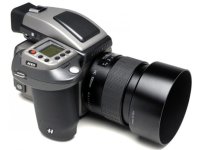
Ideally there would be an accessory vertical grip you could add that has an XLR jack or two coming off the left side of it underneath where the LCD screen swivels out. While I'm happy these companies (Sony and Panasonic) are finally giving us XLR attachments, I hate that they are mounting them to the camera's shoe so that wires are falling down at you. Plus it uses the shoe, what if you want to put a bigger LCD there?
Speaking of the shoe. We really need something with USB/HDMI pins integrated into it, so that we can mount a 5.5" or 6" monitor that has touch control to the top of the camera and not have to run any wires to hook it up. I hate wires all over the camera.
Just yesterday I was running and gunning on a freelance job at the capital building of the state I'm in. I was stopped at the door and asked if I was shooting video and I said yes because I had a mic mounted on top. But after a quick conversation I was told I could go in if I switched my camera to stills mode and shot without a flash. So at the very least we got stills of that part of the shoot. Something I can put on screen with VO and/or text.
If I had the C100 with me, I'd be out of luck.
What we need is something in-between. Like a thicker mirrorless camera. Maybe an inch or so thicker. Enough that we can still have a shoe on top of the camera but also a EVF that's slightly bigger and can tilt. That extra thickness would probably also help with heating issues and maybe give enough room for a couple internal NDs.
Something like this, but maybe not quite as thick.
Ideally there would be an accessory vertical grip you could add that has an XLR jack or two coming off the left side of it underneath where the LCD screen swivels out. While I'm happy these companies (Sony and Panasonic) are finally giving us XLR attachments, I hate that they are mounting them to the camera's shoe so that wires are falling down at you. Plus it uses the shoe, what if you want to put a bigger LCD there?
Speaking of the shoe. We really need something with USB/HDMI pins integrated into it, so that we can mount a 5.5" or 6" monitor that has touch control to the top of the camera and not have to run any wires to hook it up. I hate wires all over the camera.
Whille I agree with you, adding all of that would defeat the purpose of a mirrorless camera, who's original impetus was a compact size. Panasonic has taken the first step by making the GH5s, which is not optimized for still photography. There's a decent chance they will head your way with two GH6, where one is expanded even further towards video.
Consider this for your EVF needs. It's bigger and it tilts: https://vary-i.com/product-category/gh4/
I shoot mirrorless (GH4)... What we need is something in-between. Like a thicker mirrorless camera. Maybe an inch or so thicker. Enough that we can still have a shoe on top of the camera but also a EVF that's slightly bigger and can tilt.
Consider this for your EVF needs. It's bigger and it tilts: https://vary-i.com/product-category/gh4/
Last edited: