Key & Peele - Behind the Scenes with DP Charles Papert


This is a sketch that I think we will need in depth breakdown for since it is so gorgeous looking.

My particular questions are:
-Can you explain the location and its challenges
-Your lens selection especially for the close up of the faces.
-Global lighting vs. character lighting going from wide shots to tight shots.

Cheers!
 
Last edited:
Thanks as always for keeping this thread going Emre!

Yes, this is one of my favorite K&P sketches this season (actually a series highlight as far as I'm concerned).

The early draft of this script took place on a pirate ship, on the ocean, at night. You can imagine my response to that! After a concerted effort to find an existing location that could possibly work (theme park/dinner theater stage etc), it was re-written to take place at a tavern. Even that proved difficult to service. Finally our location team settled on the Warehouse, a nautically themed restaurant in Marina Del Rey. When we scouted, I was still pretty dubious--there were big screen TV's and speakers everywhere you looked, modern fittings and accoutrements. I did like the balcony that ringed three sides of the stage for the lighting possibilities, however there were lots of windows to contend with on both floors plus skylights in the ceiling. We established sightlines to help limit the scope of the blackout, I gave my gaffer some rudimentary notes and off we went to scout the dozen or so other locations we saw that same day!

Weeks later we arrived for the shoot. I was immediately impressed with how well the art department had done, covering the TV's with paintings, the speakers with burlap and adding period touches everywhere. Their budget was so limited and they had only 3 hours to do their work before we got there, and it was truly impressive. As the background (extras) started filing in looking perfect, I became more excited that this was going to be a great looking piece. And of course the makeup and hair work was stellar as always, important on this one because we got in so close on the actors.

My lighting game plan was actually quite simple: we ringed the balcony with bounces filled with 2K open face (blondes) that i could regulate as needed. This allows me to create an overall ambience and depending on the angle of the shot, I could favor one side over another to taste. We mostly shot from the right side of the space looking left, since there were windows along the right wall, so I had the left side bounces hotter than the right (and the frontal one even less). I also added a Barger baglight on the left balcony to pop the stage out from the crowd.

Nothing super-fancy for the camerawork. The opening shot is a bunch of risers on the dolly, driving in and booming down. We then laid track side to side and did a run with the crowd's heads in the foreground; at the same time we mounted a slider to the balcony railing upstairs and did high-and-wides. The closeups were I believe on an 18mm Master Prime, jammed in extra close. Very little depth of field as can be seen, my focus pullers were put to the test!

at 1:22, we moved off to a little section of the space under the right balcony. I used a 2x2 Fernandoflo with doubled up egg crates just out of frame right to create the effect of the lantern on the table lighting the actor and flagged as much of the ambient spill off him as I could. This is probably one of the darkest images we've had on Key & Peele!

Probably my favorite part of the sketch is at 2:06, where the hilarious Will Sasso does his verse. For the opening, our props person gave the dagger a little whack to get it vibrating in place and we simply whip panned off the actor to the dagger, with the sound design helping sell the illusion that it actually flew through space! This of course set up the later whip pans. I may have added some supplemental lighting via chimeras as Will walks through the space, but always kept the fill down on one side to keep it from flattening out.

When the Captain (Rebecca Romijn) makes her appearance, I added a leko backlight to pop her out and as she walks onto stage, we handheld a small chimera tracking with her to give her eyelight.

My DIT built the LUT on set which favors the warm tones with a lot of blue removed. This was very close to the final color grade.
 
This goes back a season or so, and I cannot find it on Comedy Central's YT, but a quick question about "Airplane Boarding": where did you all shoot the crash aftermath? That's pretty epic, but seems a lot to pull off for such a quick, single shot.
 

The plane crash scene at the end may seem familiar to those who have been to Universal Studios: it's the set from "War of the Worlds" which has been maintained as part of the tram tour. For seasons two and three we shot for a week or more at various places on the backlot and I believe the writers reverse-engineered this sketch with this set in mind. Little to no additional dressing was needed, but I had my work cut out for me as the set is designed for daytime viewing only so I had to light from scratch, and I was given about 60 minutes from nightfall to do so. Rather than bring in condors with 20Ks or Maxibrutes, I went a more budget friendly route and suggested we rent a couple of the units highway construction crews use at night, towable self-contained generator and extendable light masts. They were quite inexpensive and I had them far enough away from the action where sound wasn't an issue, and I could even place them into the shot to create some flaring (3:36). I augmented these with a number of smaller units positioned throughout and behind the plane to light the hills. In addition I had a few units replicating the police flashers, and others on flicker boxes to suggest flames, to augment the flame bars and smoke provide by effects. To make things more complicated, the director was concerned that we not see much into the open fuselage because by all rights there should be bodies in the seats, so I had to keep ambient light out of that area as much as possible! Because of the scope of the shot, I could never see all of it at once so I had to make notes with my gaffer each time the camera ran through a rehearsal. At a certain point we just had to start shooting, but I could have kept refining that shot much longer (aka: business as usual).

We used a 24' Lenny arm with a Mo-Sys remote head, and swung the arm through quite a bit of arc (my guess would be 145 degrees).

A small note on the rest of the sketch--we shot this at Air Hollywood, a specialty stage that has multiple plane sets rigged out for filming purposes (for the currently airing season we returned to shoot the "Prepare for Terries" sketch Emre posted above, plus two more yet to air). For this sketch we used their boarding lounge. I had a little bit of a tough time with the airplane translight which I found a little distracting and literal, so I lit it to near-blowout to hopefully feel more realistic.
 
Last edited:
Re: fernandoflo

I've not heard of that one, and Google doesn't reveal anything.
Drop some knowledge Charles, I can't be the only one here who's not familiar with this lingo/unit.

OK! Wasn't sure if that was what you were saying.

I talked about them earlier in this thread, but I'm not sure where. They are an LED tube made by a guy at Paramount Studios' lighting department in standard K12 size. They have a 3200/5600 switch on the end, and integrated DC conversion so you just feed them line level AC. You can use a standard household dimmer right to the tube, they dim cleanly down to about 10% or less. They aren't quite as bright as a kino tube but pretty close. And the color rendition is quite good. We used them loose or in Kino harnesses (4x4, 4x2, 2x4, 2x2) and after getting used to them, I never wanted to use Kinoflo tubes again! Tied in to our DMX system and controlled through Luminaire, I'd be able to call in super fine adjustments to a gent standing next to monitors with an iPad. It is a much improved way of working vs. "turn off one tube...now another...how many is that? Two high? Try four low--now make it three low" etc.

Unfortunately, they are rental only. There are now a couple of other options out there for the same concept.
 
Thanks! It's getting harder to keep up with all the new gear/workflows/camera threads these days.
I wasn't sure if the unit had a different name based on which coast you're shooting on.
Sounds like a great unit, will keep a look out for it.

BTW, I can't believe how you guys transformed The Warehouse. I used to dine there when I lived in the marina.
 

We shot three sketches this season in the airplace sets at Air Hollywood, as I mentioned in #126 above. This particular fuselage is mounted on a suspension system which was manually manipulated to shake the set as required. Once the turbulence begins, the wide angles are shot on Steadicam which gave us the opportunity to boom the camera up and down and roll to either side to simulate the movement of the plane. The director called out the moves, the operator went one way and the actors threw themselves the other. Pretty standard concept but, quite effective. The other camera was mounted on a longer lens on a springy head. I believe there was a certain amount of shake added in post towards the end of the scene.

Much of the lighting was practical, pre-installed in the plane. The LED's along the bulkhead did require a certain amount of color correction to keep them from going green. For the dialogue at the beginning I added some LED fill for shape.

One interesting challenge came at the end of the shoot when we moved to an adjacent cutaway set where we shot the wire work as Keegan is flying in the air. I had to recreate the light that would be coming from the other half of the plane (where the cameras now were) and on top of that, the two sets didn't match exactly. Fortunately I had still frame grabs from the earlier work and was able to switch between them and the live image to help match the color and intensity of the light falling on the seats and the bulkheads below, but it was quite intricate to make match exactly. I'm quite pleased with the results in the final cut.
 
I love the use of practicals on this one, you also chose to 2:35 on this?

The 2:39 was probably the director's choice as the compositions seemed to work better in that format. At the beginning of Key & Peele the network was a little tentative about us letterboxing and we were given a limit on how many times we could utilize it per season, but this seemed to be less of a concern as the show continued.

We started thinking about doing a Steadicam roundy-round shot and when the actors rehearsed the scene, it seemed like we would be able to shoot literally half of it in a single go. It took some finessing to think about where the pans would occur on what dialogue, but we got close enough to it to know that we would make at least one 360 which started to dictate the lighting scheme. I had already planned to light all of the greens in the background as well as the house knowing we would shoot "around the clock" eventually, with the actors seated facing each other (so, a significant number of 750 and 2K open faces set under the trees) but it was a little tricky to light the actors for the 360. The large hanging practicals seen in the opening and closing shots provided a good amount of level (and i had requested the art department to provide those along with the twinkle lights) but they were mostly on one side or the other of the action, leaving some dead spots. We were able to fill in most of it with a GEM ball mounted off a tree, but I think we also had a handheld unit walking along with the Steadicam that was dimmed up and down for the side that I couldn't rig any overhead.

After shooting the Steadicam roundy-round for a long time, we went to coverage and ran the scene from the top for insurance. Ultimately, as you can see in the edit, very little remains of that Steadicam shot as it cuts out fairly quickly, feeling more like a crane move than anything (we built a ramp for the operator to walk down from the opening frame). As we moved into coverage i was able to finesse the levels a little and added a bit of frontal fill for the actresses to give them highlights in the eyes.
 
I have a questions about time: How are you as the DP effected by the varying runtimes of the particular sketches that will all have to fit inside of the 30 min format? And how that change with a oner "high five, save the children" vs a sketch with a lot of alternates "Retirement , Turbulence". How much work do you have to do on set with coverage so that the editors can meet their time goals?
 
I have a questions about time: How are you as the DP effected by the varying runtimes of the particular sketches that will all have to fit inside of the 30 min format? And how that change with a oner "high five, save the children" vs a sketch with a lot of alternates "Retirement , Turbulence". How much work do you have to do on set with coverage so that the editors can meet their time goals?
.

Well, on my end it's all about time management on set, of course. A scene that requires a lot of coverage will usually take longer to shoot, especially if it is interior because of the lighting resets. Our simplest sketches consist of a master and two sides of coverage (with punch-ins on the lens) which the director and I made up a joke shorthand name for, "standard loincloth". Those were of course the fastest to shoot, especially if I could manage to cross-shoot them, so essentially two setups.

The oners sometimes took a good amount of time. High Five had a certain amount of lighting time and as you can imagine, a lot of takes for performance


This was pretty efficient, maybe 2.5 to 3 hours to shoot that--no lighting but a little bit to coordinate the van arrival, work out the Steadicam move and timing and get the performances down. We needed to get that done quickly so we could shoot a much more elaborate sketch, Alien Imposters:


As far as calculating the final runtime of the show, there's a certain amount of flexibility because of the interstitial segments that can be lengthened, shortened, added or eliminated as needed. And the actual composition of the shows (in terms of which sketches go in which episode) was not designed ahead of time; we shot all of the sketches in a cluster, then the interstitials, then the shows were assembled. So, it wasn't a situation where the script supervisor used a stopwatch to ensure that scenes were going to fit in a given amount of time etc.
 
Last edited:

This wasn't a notably visual sketch, but I took a pretty different approach to the lighting design. I wanted to keep it natural looking, like typical classrooms. The light was mixed between the large windows on one side (daylight) and the ceiling fluorescents (3200-ish). I needed to bump up the level in the room to keep the windows from blowing out, and also manage the color differential. I decided we would turn off the overheads and rebuild the interior level with HMI. On the scout we talked about our sightlines and I knew I had to keep the heads back somewhat to give us room to get the wider shots.

acapella lighting.jpg

I built the ambience in the room with a single M40, set way back in the room and bounced across the ceiling. By "across", I mean in a diagonal towards the door, which delivered effectively a long stripe of light relative to the actors (as opposed to aiming the head essentially towards the actors and pushing up into the ceiling, which gives more of a concentrated cone of light). You lose a fair amount of level this way but by starting with a powerful head, I had more than enough.

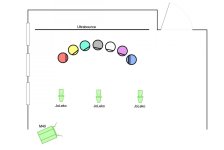
I augmented this by running ultrabounce across a header that was behind the actors running parallel to the back wall. We keep 8' lengths of ultra on "wag flags" (rolled on aluminum tubing), so you let out as much or as little as you need for the shot and then roll it back up to fight another day. The grips clipped the rolls to the ceiling and the ultra hung down making a 24' x 3' bounce. We then pushed three JoLeko 800's into the ultra. The advantage with these is that being lekos, they can be neatly trimmed to the bounce, and also being HMI, they have significantly more "poop" (and the correct color for this scene). This gave me a nice long soft backlight to suggest a row of ceiling fluorescents behind the actors.

Unfortunately--best laid plans. The sketch got shuffled in the schedule and we ended up shooting first thing in the morning, when the background outside the windows was at its brightest, and for much of the sketch they are blown out. By the end you can start to see terrain through them (I had the roller blinds down to keep the background from being too distracting, and to cut a little level).

For the improv class, we were under a heavy time crunch so I again went for a ceiling bounce (M18 this time, smaller space) and augmented with a JoLeko from the window side with a window gobo in it which created the sun splashes you can see on the guys on the right.
 
Last edited:
Yeeeeeee-up. We've known about this for a good long while now, was wondering when the official announcement would drop. So yes: the next 8 episodes are the last of it!
 
Back
Top