
Navigation
Install the app
How to install the app on iOS
Follow along with the video below to see how to install our site as a web app on your home screen.
Note: This feature may not be available in some browsers.
More options
You are using an out of date browser. It may not display this or other websites correctly.
You should upgrade or use an alternative browser.
You should upgrade or use an alternative browser.
Key & Peele - Behind the Scenes with DP Charles Papert
- Thread starter CharlesPapert
- Start date


emretufekci
Well-known member
Charles,
Are you filming the series Prorez or Arriraw? I dont have the XR module and I am deliberating whether it is worth upgrading to XR Module or purchasing a Q7 with a Arriraw license. Any recommendations?
Edit: SUP 11 was released right after I posted this with 3.2K option. Now thats a decider
Are you filming the series Prorez or Arriraw? I dont have the XR module and I am deliberating whether it is worth upgrading to XR Module or purchasing a Q7 with a Arriraw license. Any recommendations?
Edit: SUP 11 was released right after I posted this with 3.2K option. Now thats a decider
Last edited:

CharlesPapert
Director of Photography
Hi Emre, so sorry I didn't get on this earlier. We shot Key & Peele ProRes422 except for green screen work on 4444. I have yet to shoot a project on Arriraw, including a theatrical feature (back when Codex was the only way to do it, the producers didn't want to go that route).
emretufekci
Well-known member
Thanks Charles, can you talk a little about color grading the show. Do you sit in on the sessions and if so what's your process?
CharlesPapert
Director of Photography
Color starts on set, where we build a LUT for each sketch via Pomfort Livegrade. Some sketches will require multiple LUT's. Those are applied to the dailies and the offline edit. That way everyone sees the footage with a look that approximates what we have in mind. After final assembly of each episode, the director, post supervisor and I go to MTI Film in Hollywood for the color session. We've been working with colorist Steve Porter since the second season so our collective shorthand after hundreds of sketches is pretty good. We first look at the original LUT and then decide how to proceed from there. Most of the time we end up with something close to our first instinct but occasionally we'll pull things a whole new way.
Steve works on a Nucoda system which took a little getting used to--most of the grades I've supervised have been on Davinci--but the similarities far outweigh the differences. We set the look for a sketch on one or two shots, Steve goes through and applies the look and does basic balancing, and we move through the show. Then we go back to the beginning and fine-tune, laying in windows as required. I'm a bit of a power window junkie, especially since our shooting schedule forces me to leave certain adjustments to to the post suite. It takes us between 6 and 9 hours to color each episode.
Steve works on a Nucoda system which took a little getting used to--most of the grades I've supervised have been on Davinci--but the similarities far outweigh the differences. We set the look for a sketch on one or two shots, Steve goes through and applies the look and does basic balancing, and we move through the show. Then we go back to the beginning and fine-tune, laying in windows as required. I'm a bit of a power window junkie, especially since our shooting schedule forces me to leave certain adjustments to to the post suite. It takes us between 6 and 9 hours to color each episode.
emretufekci
Well-known member
Thank you very much for detailed response. I still have some more Q/A coming if you dont mind.
CharlesPapert
Director of Photography
That's what I'm here for Emre!
emretufekci
Well-known member
Do you do double system on the show and if you do do you have preferred system for timecode like ambient or timecode buddy?
Any Pro's or cons you can comment on?
Any Pro's or cons you can comment on?
CharlesPapert
Director of Photography
Double system. Sound mixer has a full rig and a boom person. They send a scratch track to the Alexas via wireless. We have Lockit boxes on the cameras full time and the time code slates are synced twice a day (I think!) Pretty standard stuff.
CharlesPapert
Director of Photography
A few more clips from the last season of "Key & Peele" have been posted on Vimeo.
"Terrible Henchman" was originally going to be shot in a windowless room and I was looking to emulate the torture scene from Casino Royale, with downshafts of light. After a location shift we ended up in a converted warehouse with windows along the side which suggested a different approach. The art department did a pass on the windows to age and dirty them up, then on the day I had them partially clean up a select few windows that I could push light through (the wide shot that opens the piece shows this). I used an M90 for each section of window, as high as possible pointing down. The result was that most of the direct light bounced off the floor rather than pushing straight into the room, while the treated windows acted as a sort of diffusion. On the actor's faces, the light is coming from a variety of angles from the same side, which required no further cleanup when we went in for closeups. When the actors were closest to the windows I did occasionally add a net to bring down the window side or a bounce for the non-window side as required. Also, for the business at the sliding door I added a Joker 800 on a floor skip to augment the low levels of light provided by the window.
"Corpse ID"
This was one of my favorite looks this season. A large part of the fun of Key & Peele has always been misdirecting the audience from thinking they are watching comedy. We built a LUT on set that weighted heavily into the cyan while the lighting on set was mostly straight tungsten with no gel. I used a medium chimera softbox over the actors and a few Dedo's hung over the sink and other areas to create small pools in the background. We added some Fernando flos (dimmable tubes) into the cabinets, and added ND and pieces of show card to shape the practical fluorescents in the shot. I used a ceiling bounce to regulate fill level in the room, just enough to see detail in the parts that weren't otherwise lit. Very little needed to be changed from shot to shot, which helped us speed through the shoot.
I'm tied up with a tough shooting schedule on another series these days but I hope to post a few more of these down the road. Meanwhile, there's one more season of Key & Peele in the can which will air sometime this year.
"Terrible Henchman" was originally going to be shot in a windowless room and I was looking to emulate the torture scene from Casino Royale, with downshafts of light. After a location shift we ended up in a converted warehouse with windows along the side which suggested a different approach. The art department did a pass on the windows to age and dirty them up, then on the day I had them partially clean up a select few windows that I could push light through (the wide shot that opens the piece shows this). I used an M90 for each section of window, as high as possible pointing down. The result was that most of the direct light bounced off the floor rather than pushing straight into the room, while the treated windows acted as a sort of diffusion. On the actor's faces, the light is coming from a variety of angles from the same side, which required no further cleanup when we went in for closeups. When the actors were closest to the windows I did occasionally add a net to bring down the window side or a bounce for the non-window side as required. Also, for the business at the sliding door I added a Joker 800 on a floor skip to augment the low levels of light provided by the window.
"Corpse ID"
This was one of my favorite looks this season. A large part of the fun of Key & Peele has always been misdirecting the audience from thinking they are watching comedy. We built a LUT on set that weighted heavily into the cyan while the lighting on set was mostly straight tungsten with no gel. I used a medium chimera softbox over the actors and a few Dedo's hung over the sink and other areas to create small pools in the background. We added some Fernando flos (dimmable tubes) into the cabinets, and added ND and pieces of show card to shape the practical fluorescents in the shot. I used a ceiling bounce to regulate fill level in the room, just enough to see detail in the parts that weren't otherwise lit. Very little needed to be changed from shot to shot, which helped us speed through the shoot.
I'm tied up with a tough shooting schedule on another series these days but I hope to post a few more of these down the road. Meanwhile, there's one more season of Key & Peele in the can which will air sometime this year.
Last edited:
emretufekci
Well-known member
Thanks Charles,
When you get a moment can you breakdown "Hall of Mirrors Killer". Love the hear behind the scenes for that as well.
When you get a moment can you breakdown "Hall of Mirrors Killer". Love the hear behind the scenes for that as well.
Last edited:
sonofaresiii
Well-known member
A few more clips from the last season of "Key & Peele" have been posted on Vimeo.
https://vimeo.com/channels/keypeele
"Terrible Henchman" was originally going to be shot in a windowless room and I was looking to emulate the torture scene from Casino Royale, with downshafts of light. After a location shift we ended up in a converted warehouse with windows along the side which suggested a different approach. The art department did a pass on the windows to age and dirty them up, then on the day I had them partially clean up a select few windows that I could push light through (the wide shot that opens the piece shows this). I used an M90 for each section of window, as high as possible pointing down. The result was that most of the direct light bounced off the floor rather than pushing straight into the room, while the treated windows acted as a sort of diffusion. On the actor's faces, the light is coming from a variety of angles from the same side, which required no further cleanup when we went in for closeups. When the actors were closest to the windows I did occasionally add a net to bring down the window side or a bounce for the non-window side as required. Also, for the business at the sliding door I added a Joker 800 on a floor skip to augment the low levels of light provided by the window.
"Corpse ID"
https://vimeo.com/channels/keypeele/121932003
This was one of my favorite looks this season. A large part of the fun of Key & Peele has always been misdirecting the audience from thinking they are watching comedy. We built a LUT on set that weighted heavily into the cyan while the lighting on set was mostly straight tungsten with no gel. I used a medium chimera softbox over the actors and a few Dedo's hung over the sink and other areas to create small pools in the background. We added some Fernando flos (dimmable tubes) into the cabinets, and added ND and pieces of show card to shape the practical fluorescents in the shot. I used a ceiling bounce to regulate fill level in the room, just enough to see detail in the parts that weren't otherwise lit. Very little needed to be changed from shot to shot, which helped us speed through the shoot.
I'm tied up with a tough shooting schedule on another series these days but I hope to post a few more of these down the road. Meanwhile, there's one more season of Key & Peele in the can which will air sometime this year.
Appreciated as always, Charles. Quick question about the torture scene, did you have a specific reason for choosing the windows to clean up that you did, or was it a fairly random process of picking?
CharlesPapert
Director of Photography
Appreciated as always, Charles. Quick question about the torture scene, did you have a specific reason for choosing the windows to clean up that you did, or was it a fairly random process of picking?
Based on the possible placement of the heads and where I wanted to hit the floor, it was then easy to determine which windows needed cleaning up. More efficient to do it that way than to wait until the heads were placed and dirty up the windows around it.
CharlesPapert
Director of Photography
Thanks Charles,
When you get a moment can you breakdown "Hall of Mirrors Killer". Love the hear behind the scenes for that as well.
https://vimeo.com/121926726
OK, yup, Hall of Mirrors. I knew going into it that I would have to light completely from above as any stands or lights on the floor would be a nightmare. We had something like 16 full size mirrors and a few that were bare frames that we could put the cameras behind and then cover with duvetyne (so the frames would photograph in the other mirrors as opposed to just having holes in the circle). Each frame got a red tube top and bottom, which both looked good on camera and provided a base illumination for the shadows. We shot this in a a 20x20 area that could barely be describe as a stage, since it had no grid, but my key grip was able to install two pipes in either direction (like a tic tac toe board) that gave enough points to mount heads. I had six Arrihead 750's pointing straight down from the grid to create tungsten pools. Once or twice I added some eye level fill from stands hidden behind mirrors, but that proved to be such a PITA to hide that I gave up at a certain point. That's it for lighting.
Dialing in the mirrors in all directions so that they didn't reflect cameras and DID reflect Jordan as the serial killer was a mammoth task. The empty frames really helped because they had the red tubes which filled out the reflections without creating new headaches to solve. Each mirror had the capability of reflecting a mirror across the way, which was already reflecting another nearby mirror...you get the picture. At a certain point I stopped trying to help and had the operators and director tackle the mirror lineup for each setup. We were all pretty exhausted by the end of that day!

Justin Kuhn
Veteran
Wow. I just discovered this thread and read the whole thing, studied your breakdowns against the sketches...not that I need an excuse to re-watch Key and Peele...hours later. Definitely my favorite dvxuser thread, ever. Thank you so much Charles for this thread.
I was wondering if you could talk briefly about the Mr. T PSA sketch since it's another retro "bad" look but a bit different than the other two you've done breakdowns on already.
Second thing, how did you pull off the interior/exterior exposure in the Mattress Shopping sketch...is it all down to the DR of the Alexa or did you sweeten it? The establishing wide shot when Jordan enters the store looks like it might have been a particular challenge.
I was wondering if you could talk briefly about the Mr. T PSA sketch since it's another retro "bad" look but a bit different than the other two you've done breakdowns on already.
Second thing, how did you pull off the interior/exterior exposure in the Mattress Shopping sketch...is it all down to the DR of the Alexa or did you sweeten it? The establishing wide shot when Jordan enters the store looks like it might have been a particular challenge.
Last edited:
CharlesPapert
Director of Photography
Wow. I just discovered this thread and read the whole thing, studied your breakdowns against the sketches...not that I need an excuse to re-watch Key and Peele...hours later. Definitely my favorite dvxuser thread, ever. Thank you so much Charles for this thread.
I was wondering if you could talk briefly about the Mr. T PSA sketch since it's another retro "bad" look but a bit different than the other two you've done breakdowns on already.
OK Justin:
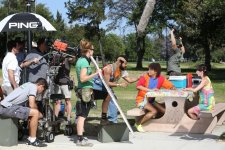
We shot the Mr. T PSA on the same 30 yr old JVC KY1900 cameras we used for several other sketches (Tackle and Grapple, Funk Show, East Bowl Shuffle). We really felt the super limited dynamic range of the old tube cameras on this one as they required tons of fill to compete with the backlit sun. You can see guest star Kate Micucci squinting all the way through the sketch. We had bare 18K's and shiny side bounces working. I think a little diffusion was used but at this point, two years on, I can't remember what it was. Here's a production still (courtesy Danny Feld) showing a closeup with bounce:
Second thing, how did you pull off the interior/exterior exposure in the Mattress Shopping sketch...is it all down to the DR of the Alexa or did you sweeten it? The establishing wide shot when Jordan enters the store looks like it might have been a particular challenge.
We alternated between very wide and fairly long lens focal lengths to give it some visual style. The opening shot and subsequent side tracking shots were done on the Alura 15.5-45, perhaps not all the way to 15.5mm but close to it. That lens is wonderfully rectilinear so I feel comfortable using it with such strong verticals and horizontals in frame, but we made sure to keep the camera dead parallel to the front wall on those shots to avoid keystoning.
The final shot of the sketch was done weeks later in a tiny room at the Herald Examiner building in downtown LA where we shot a week's worth of sketches. The dolly was fitted with the Lambda head and a long offset off the front so we could arm out over the bed. The room was small enough the the track ran out the only door, which made it a real pain to get people in and out of the room! I bounced an open face unit with double CTB for ambience and a source 4 Leko through a cookie from the left for subtle tungsten fill.
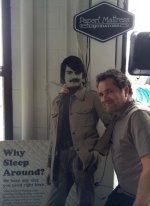
This sketch has special value for me as the art department named the store after me and filled it with signage that reflected thus, and Keegan even added the name into his welcome at the beginning!
Justin Kuhn
Veteran
Thank you! I've learned so much from this thread.
Would you be interested in talking about the Lil' Homie sketch at all? Did the puppet present any challenges lighting-wise? Really I'm just super excited to read more of these breakdowns. Is there a particular sketch you've been waiting to talk about?
Obviously no rush. Thank you for answering my other questions so quickly!
Would you be interested in talking about the Lil' Homie sketch at all? Did the puppet present any challenges lighting-wise? Really I'm just super excited to read more of these breakdowns. Is there a particular sketch you've been waiting to talk about?
Obviously no rush. Thank you for answering my other questions so quickly!
Last edited:
photochris
Well-known member
Amazing thread, thanks for sharing all the BTS info. Key & Peele is a great watch, so many different looks from sketch to sketch, not your typical series in that regard. Just saw the episode with the Mr. T PSA, I figured you just tinkered in post to make it look like an old 80's camera.
CharlesPapert
Director of Photography
Would you be interested in talking about the Lil' Homie sketch at all? Did the puppet present any challenges lighting-wise? Really I'm just super excited to read more of these breakdowns. Is there a particular sketch you've been waiting to talk about?
https://www.youtube.com/watch?v=pSDTmJtE-Bc
Well, Justin, there's not a ton to say about that sketch. I can't remember the exact setup but I think it was a Fernando Flo for key and another for backlight on Jordan's side, because the wood wall behind him was so dark I knew it needed some separation. I put a covered wagon, a homemade incandescent fixture, on the floor to the right of the sideboard behind Jordan to give a little more contrast. Didn't need a backlight on Keegan's side because I had the opposite problem--was doing everything I could to keep light off that green wall and we had to still knock it down a lot in color. I was pretty frustrated by that set (at the Herald Examiner in downtown LA--same police station set as was used for The Usual Suspects and the pilot of Brooklyn Nine-Nine) because of the totally different looks on either side of the room. I didn't do anything special for the puppet that I can remember. I think I gave it a little back edge with a Dedo when we did Keegan's side.
We set a pretty deep LUT on this, contrasty and desaturated, and the final color was more of the same.
As you can probably read between the lines, this isn't a sketch that I'm too crazy about visually. I worked through most of the compromises that the set presented but there was only so much I could do with it. I would have liked to have made the keys more toppy, but the ceiling height prevented that. We had no budget to alter the look of the room but if we did, I would have wanted the wood panelling to continue to Keegan's side as well.
CharlesPapert
Director of Photography
The first video of the upcoming season of Key & Peele has been released, as a response to the recent events in Baltimore and elsewhere:
This was one of the most ambitious sketches we tackled in the 5 season run of the show, and the only one that took more than a day to shoot (most taking between 1/3 and a 1/2 day). We shot the night work first that opens and closes the sketch on an alley set at the Disney Ranch in Newhall CA, and the day work in the adjoining street sets. We've shot those locations many times before on Key & Peele and avid fans may recognize them (the alley and brownstone street have each appeared in at least five sketches in the past). The alley has always been a little tough for me because the mouth opens out to a lovely field of oak trees, which isn't the most urban setting! I uplit the trees with a variety of 1-2K open face heads and crosslit the side walls of the alley with juniors, all gelled to a sodium vapor look (full CTO plus 1/4 green--when we have the budget I spec Urban Vapor). A variety of downlight practicals and leko crosslights pick out highlights here and there in the alley. The spotlight on the police car wasn't quite powerful enough so I recreated it with a tungsten par when we were facing into the alley. In the other direction, I let the police officer's face go dark to make him more sinister. The "portal" to Negrotown was a 5K fresnel pushed through a 4x8 diffusion frame just inside the doors.
A few days later we shot the day exteriors. We shot roughly in order, beginning with the arrival in the woods leading up the town. I had to push a lot of HMI into the shade under the trees for the shot that sweeps up to reveal the city to balance between the two. Fortunately at that point we were into the fantasy portion of the sketch and the somewhat artifically filled look was appropriate. I was in a constant battle against the sun that day--I had done extensive surveys and designed specific times to shoot out each area
of the backlot to avoid half sun/half shade situations, and once we started running late it become a real nail-biter--more on this later.
The first few shots in the fantasy section were done on a 30' Technocrane, our one and only time we were able to bring one in on the show for budgetary reasons. The Techno is one of my favorite tools since it provides so much more flexibility than a fixed-arm crane or jib, where placement of the chassis is absolutely critical. We had the other camera on Steadicam, and generally shot simultaneously with one or the other camera favored as the primary one for each section of the song. I used diffusion filters--from my notes it looks like Classic Softs and I'm sure I used the heaviest density we had, perhaps a 2.
At 2:50 you can see an example of us being behind schedule--I knew that the sun would start getting blocked by the buildings on one side of the street and start cutting into the feet of the dancers, and as we did take after take I watched the shadow line creep across the street and past the camera. We got the final take (the one used) just as their feet were getting into shade!
We were scheduled to continue shooting in order, which would have taken us to the movie theater facade and then onto the adjoining brownstone street for the finale. I realized we would run out of light at one or the other location so I asked that we switch the order and moved ahead to the finale. The street was fully in shade and I was able to finally create the soundstage/Technicolor look by frontlighting with an M90 through 250, and an 18K backlight on a 30 ft. condor. If I could have shot the whole clip under these conditions, I would have preferred to as I felt that this was closest to the old-school musical look we wanted to emulate, but our schedule wouldn't allow us to shoot each location at the optimal time, nor our budget allow for the multiple additional 18K's I would have needed to reshape the direct sun (would have been amazing to use carbon arcs, but I can't even imagine would it would have cost). Incidentally of the various times we've shot this particular brownstone street, I've always been frustrated by the oddly pastel color scheme of the buildings (well, it is the Disney ranch after all), but finally this time it worked well for the material.
We finished the day with the movie theater facade, at magic hour. These scene, at 2:58 was shot almost entirely under artifical light for daylight, which can be a tough without some serious firepower in both grip and electric. Once again the stylized nature of the piece helped out, so the slightly fake look works well enough. A few 12x12 bounces filled with 18K's or M90's and an edgelight created enough ambience and sun edge to match to the rest of the footage.
This was one of the most ambitious sketches we tackled in the 5 season run of the show, and the only one that took more than a day to shoot (most taking between 1/3 and a 1/2 day). We shot the night work first that opens and closes the sketch on an alley set at the Disney Ranch in Newhall CA, and the day work in the adjoining street sets. We've shot those locations many times before on Key & Peele and avid fans may recognize them (the alley and brownstone street have each appeared in at least five sketches in the past). The alley has always been a little tough for me because the mouth opens out to a lovely field of oak trees, which isn't the most urban setting! I uplit the trees with a variety of 1-2K open face heads and crosslit the side walls of the alley with juniors, all gelled to a sodium vapor look (full CTO plus 1/4 green--when we have the budget I spec Urban Vapor). A variety of downlight practicals and leko crosslights pick out highlights here and there in the alley. The spotlight on the police car wasn't quite powerful enough so I recreated it with a tungsten par when we were facing into the alley. In the other direction, I let the police officer's face go dark to make him more sinister. The "portal" to Negrotown was a 5K fresnel pushed through a 4x8 diffusion frame just inside the doors.
A few days later we shot the day exteriors. We shot roughly in order, beginning with the arrival in the woods leading up the town. I had to push a lot of HMI into the shade under the trees for the shot that sweeps up to reveal the city to balance between the two. Fortunately at that point we were into the fantasy portion of the sketch and the somewhat artifically filled look was appropriate. I was in a constant battle against the sun that day--I had done extensive surveys and designed specific times to shoot out each area
of the backlot to avoid half sun/half shade situations, and once we started running late it become a real nail-biter--more on this later.
The first few shots in the fantasy section were done on a 30' Technocrane, our one and only time we were able to bring one in on the show for budgetary reasons. The Techno is one of my favorite tools since it provides so much more flexibility than a fixed-arm crane or jib, where placement of the chassis is absolutely critical. We had the other camera on Steadicam, and generally shot simultaneously with one or the other camera favored as the primary one for each section of the song. I used diffusion filters--from my notes it looks like Classic Softs and I'm sure I used the heaviest density we had, perhaps a 2.
At 2:50 you can see an example of us being behind schedule--I knew that the sun would start getting blocked by the buildings on one side of the street and start cutting into the feet of the dancers, and as we did take after take I watched the shadow line creep across the street and past the camera. We got the final take (the one used) just as their feet were getting into shade!
We were scheduled to continue shooting in order, which would have taken us to the movie theater facade and then onto the adjoining brownstone street for the finale. I realized we would run out of light at one or the other location so I asked that we switch the order and moved ahead to the finale. The street was fully in shade and I was able to finally create the soundstage/Technicolor look by frontlighting with an M90 through 250, and an 18K backlight on a 30 ft. condor. If I could have shot the whole clip under these conditions, I would have preferred to as I felt that this was closest to the old-school musical look we wanted to emulate, but our schedule wouldn't allow us to shoot each location at the optimal time, nor our budget allow for the multiple additional 18K's I would have needed to reshape the direct sun (would have been amazing to use carbon arcs, but I can't even imagine would it would have cost). Incidentally of the various times we've shot this particular brownstone street, I've always been frustrated by the oddly pastel color scheme of the buildings (well, it is the Disney ranch after all), but finally this time it worked well for the material.
We finished the day with the movie theater facade, at magic hour. These scene, at 2:58 was shot almost entirely under artifical light for daylight, which can be a tough without some serious firepower in both grip and electric. Once again the stylized nature of the piece helped out, so the slightly fake look works well enough. A few 12x12 bounces filled with 18K's or M90's and an edgelight created enough ambience and sun edge to match to the rest of the footage.