JVC GY HD250 sdi out to blackmagic video assist HD to record 720p?

Yeah, for sure; very underrated company and it mostly sank because of the transition to mirrorless'.

They also came out with the first 4K camcorder (or at least for normal folk), the GY-HMQ10, and then later had a pretty nice cinema camera in the LS300 with some nice features but not all of the ones people needed at the time until a FW update a bit later.

Really should have tried for a LS300 II but I felt like they felt discouraged, and it's impossible to compete with Canon and Sony at this point.
 
They also came out with the first 4K camcorder (or at least for normal folk), the GY-HMQ10, and then later had a pretty nice cinema camera in the LS300 with some nice features but not all of the ones people needed at the time until a FW update a bit later. .

The LS300 has Variable Scan Mapping, I believe, allowing you “to choose the lens you want as it enables the camera to maintain the native angle of view for a large variety of lenses including many popular Super 35, MFT and Super 16.” Now that would be an especially neat feature to try out!
 
I used it a lot when I had the LS300. Best way to use it is in the camera's crop mode with a full frame lens so you can use a prime with a better zoom range. The range is short but it's ideal for minor adjustments in interviews where you might need just a pinch to get some uneven architecture out of the frame or adjust headroom, etc. instead of moving everything.

JVC has the knowledge and makes great cameras, but they aren't good at hype which sells cameras at times more than anything else.
 
JVC has the knowledge and makes great cameras, but they aren't good at hype which sells cameras at times more than anything else.
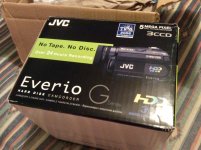
Here we are praising the innovative nature of JVC when, coincidentally, I just got home this eve to find this little curiosity was delivered by post this morning. It’s an early hard disk camcorder. I’m slightly fearful to see the video quality it produces but at least it promises to compensate me by producing many hours of it... Welcome to tapeless acquisition, 2006 style... BE43E25E-20E7-4C0D-8F29-BEA004685052.jpeg
 
Alas, no tapeless acquisition 2006 style after-all as camera is defective. Iris seems to be stuck so all I see is a black screen (and a single hot pixel!). All other functions are perfect. Common fault on these models, apparently.
 
ah! was hoping for some success!

i found an old laptop (running Vista) and bought a Sony DSR20 from a recycling center and unburied my original CD copy of Adobe Premiere Pro 1.5 and capturing miniDV tapes with success. much better than the Quicktime option shown on youtube tutorials. something about the interlacing, it goes wrong somehow when captured with quicktime. i might have been doing something wrong. in anycase, the DSR20 was cheaper than buying all the dongles i’d need to transfer to QuickTime and whatever camera body i’d have to wear out to transfer a couple hundred tapes. knock on wood the deck survives.
 
Last edited:
The two mid-80's era JVC KY1900's I picked up off eBay some years back to use on Key & Peele for period video clips. These were relatively inexpensive industrial models, certainly not prized for their picture, but coincidentally they were the first "pro" cameras I used in high school. And somehow, their Saticon tubes seem to have lasted the test of time better than the superior Plumbicon tubes of the top-end cameras of the days. This was the setup from the day I hired an old broadcast engineer to come over and tweak the cameras to get them to match, which was nostalgic for both of us. And below that, the 1900's on set.Click image for larger version  Name:	ky1900's.jpg Views:	0 Size:	92.9 KB ID:	5684714 Click image for larger version  Name:	ky1900.jpg Views:	0 Size:	125.2 KB ID:	5684715 Click image for larger version  Name:	funkynonsensebts.jpg Views:	0 Size:	105.7 KB ID:	5684716
 
The two mid-80's era JVC KY1900's I picked up off eBay some years back to use on Key & Peele for period video clips. These were relatively inexpensive industrial models, certainly not prized for their picture, but coincidentally they were the first "pro" cameras I used in high school. And somehow, their Saticon tubes seem to have lasted the test of time better than the superior Plumbicon tubes of the top-end cameras of the days. This was the setup from the day I hired an old broadcast engineer to come over and tweak the cameras to get them to match, which was nostalgic for both of us. And below that, the 1900's on set.

Fantastic! Thanks for sharing. I just searched and found that clip on Youtube! Very funny, and wonderful in all it’s 4:3, retro looking glory. Camera and indeed costume/prop department outdid themselves!
 
ah! was hoping for some success!

i found an old laptop (running Vista) and bought a Sony DSR20 from a recycling center and unburied my original CD copy of Adobe Premiere Pro 1.5 and capturing miniDV tapes with success. much better than the Quicktime option shown on youtube tutorials. something about the interlacing, it goes wrong somehow when captured with quicktime. i might have been doing something wrong. in anycase, the DSR20 was cheaper than buying all the dongles i’d need to transfer to QuickTime and whatever camera body i’d have to wear out to transfer a couple hundred tapes. knock on wood the deck survives.
Great way of doing it. Mini DV decks are still relatively expensive on auction sites anytime I’ve looked though. While almost every camera loses value exponentially over time, Mini DV decks and P2 cards still command a price! Funny old world.
 
Great way of doing it. Mini DV decks are still relatively expensive on auction sites anytime I’ve looked though. While almost every camera loses value exponentially over time, Mini DV decks and P2 cards still command a price! Funny old world.
truly! well said!
 
Great way of doing it. Mini DV decks are still relatively expensive on auction sites anytime I’ve looked though. While almost every camera loses value exponentially over time, Mini DV decks and P2 cards still command a price! Funny old world.

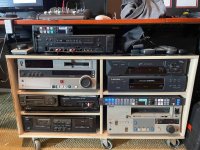
Everything seems to go through cycles. I had a notion to master all of my old SD format tapes to DVCAM some years ago and bought a couple of studio decks (DSR 1800) that were going for $150 on eBay. Amazing because they were only about 4 years out of manufacture for $18K new! They seem to have increased, but it's worth keeping an eye on because that's about the same price as the prosumer models like the DSR20 and built much better--plus, if you can find one properly equipped, they have SD-SDI output, so much easier to capture outboard--I have all the legacy decks (VHS, SVHS, Hi-8) going through a patchbay into the DVCAM deck for digital conversion. After a LOT of flailing with the interlace issue (if you capture as 29.97p, you lose the original cadence of the 60i footage), I realized the only way out to the future was to interpolate 60i to 60p. Easy enough to do in Resolve and other software, but that extra step of processing and outputting for hundreds of hours of tape...no thank you.

After a LOT of experimenting and research, I ended up with a Blackmagic Teranex Express coupled with a Blackmagic Hyperdeck Studio HD Plus, the combination of which performs the 60i to 60p interpolation on the fly, upscales to 720p and records on ProRes or H264 (depending on the importance of the given tape). Now I'm equipped to capture all that stuff direct to drive. Phew!

IMG_8472.jpg
 

Attachments

  • image_129513.jpg
    image_129513.jpg
    147.8 KB · Views: 0
Last edited:
Everything seems to go through cycles. I had a notion to master all of my old SD format tapes to DVCAM some years ago and bought a couple of studio decks (DSR 1800) that were going for $150 on eBay. Amazing because they were only about 4 years out of manufacture for $18K new! They seem to have increased, but it's worth keeping an eye on because that's about the same price as the prosumer models like the DSR20 and built much better--plus, if you can find one properly equipped, they have SD-SDI output, so much easier to capture outboard--I have all the legacy decks (VHS, SVHS, Hi-8) going through a patchbay into the DVCAM deck for digital conversion. After a LOT of flailing with the interlace issue (if you capture as 29.97p, you lose the original cadence of the 60i footage), I realized the only way out to the future was to interpolate 60i to 60p. Easy enough to do in Resolve and other software, but that extra step of processing and outputting for hundreds of hours of tape...no thank you.

After a LOT of experimenting and research, I ended up with a Blackmagic Teranex Express coupled with a Blackmagic Hyperdeck Studio HD Plus, the combination of which performs the 60i to 60p interpolation on the fly, upscales to 720p and records on ProRes or H264 (depending on the importance of the given tape). Now I'm equipped to capture all that stuff direct to drive. Phew!


Wow! What a collection! Thanks too for the tip re: BM Teranex and Hyperdeck Studio (and the many hours spent testing and researching it!)
 
Wow! What a collection! Thanks too for the tip re: BM Teranex and Hyperdeck Studio (and the many hours spent testing and researching it!)

It's funny. I have had way too many discussions regarding the look of legacy 60i and how to best move it into our progressive times (pun intended). There will always be those who claim that 60i IS 29.97p, they are one and the same. The math does indicate that--two 60i fields become a 30p frame. If you have interlace artifacts, you deinterlace. Done. But, the motion cadence is absolutely not the same. Regardless of having only half the lines of resolution, 60i footage has 60 individual frames of motion in it, and 30p has 30. You end up with a quasi-film look, it just doesn't look the same and I find it disconcerting to have my home movies and other events captured over the years altered that way. So for me, the only logical way is to interpolate each field to a frame and end up with a 60p file that retains the motion cadence.

One of the more spectacular times I had this disagreement was on a project that took place in a newsroom that I wanted to have use a broadcast look for the on-camera footage and 24p for the behind the scenes. We shot the broadcast material 60i and I spoke at length to an engineer at a high end post house about the 60i to 60p conversion. Every test he sent back had a 30p cadence to it. He would not hear me that there was a difference. I finally used a freeware converter and send him a test clip of 60i to 60p as proof of concept. His response was of course defensive. Ultimately I just converted the footage myself, cut the whole piece on a 60p timeline and that was that.

Arguably, good software will do a better job than the Teranex box performing the interpolation on the fly (especially if it uses machine learning), and if I was to convert something really important I'd still do it via software. The corporate videos I shot in the late 80's will do just fine via the Teranex!
 
Further to our earlier posts on the JVC and Blackmagic Assist, here’s a quick and dirty video I did this week with the combo. A bit of fun mini shoot which resulted in a very 720p video look that Youtube compression was further unkind to (especially rough on the transitions, I think): https://youtu.be/WdFY_MkiefU

I used the JVC GY HD 205 outputting 720p via hd-sdi out to the Blackmagic Video Assist recording in Prores LT. Biggest lesson for me is that the adjustable macro ring on the JVC’s Fujinon lens is a pretty useful feature!
 
Back
Top