LeavingTheCandy
Well-known member
….That sounds to me like a serious case of wrong priorities.
Brilliant!!

Follow along with the video below to see how to install our site as a web app on your home screen.
Note: This feature may not be available in some browsers.
….That sounds to me like a serious case of wrong priorities.

I know this isn't really the place, but seeing as there has been a lot of talk about 2k vs 4k in this thread I'll give it a go:
Andrew Reid (who is prone to spread quite suspect claims) recently wrote that 4k 8-bit 4:2:0 can be converted to 1080p 10-bit 4:4:4. I know the subsampling claim is true, but I find it hard to believe the part about bits. Can you really dig up color and luma information that was never recorded? I guess that would be through an approximation between neighbouring pixels, or what?
I guess so, but I would personally be terrified of any acquisition medium that was "4K" and 4:2:0 at 8-bit. That sounds to me like a serious case of wrong priorities. But then I'm in a minority on things like this I guess (compared with the average consumer)
 can you reproduce the test with that factor to see if the results are still the same?

The F35's sensor wouldn't be too far off 4k and 4:2:0 would it? It's only the oversampling that gives you proper 4:4:4 when the sensor is output in a 1080p container. You don't really get more information with 4:4:4 1080p over 4:2:0 4K - you just get more information 'per pixel'.
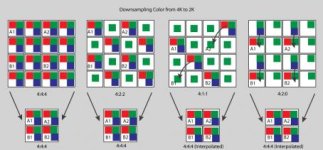
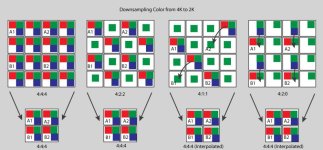
Subsampling 4:2:0 and 4:1:1 to half the original size gives you 4:2:2
Subsampling 4:2:2 to half its size gives you 4:4:4.
To get 4:4:4 from a 4:2:0 source would require shooting at 8K, not 4K!

While I agree with Macgregor that 8 bit ~4K 4:2:0 mathematically downsamples to 12 bit 1080p 4:4:4, we should emphasize the color generated is interpolated. A camera recording and encoding 8bit 4:2:0 data at 4K is throwing a lot of color away, and depending on the algorithm
If you want to test the effect of 8-bit being subsampled down from 4k to 2k, you can use Photoshop.
Just create a subtle gradient in 8-bit mode, then convert the document to 16-bit mode and resize to half it's original image size. Apply a levels layer over it, and drag your black and white pointers to each side of the histogram. Voila. Banding.
Now create a new document in 16-bit mode, the same size as the current smaller document. Apply the same gradient and levels. It should be beautiful. If it's not, it is likely your monitor. So use your eyedropper to sample the banding. In the downconverted image, the numbers don't change within the bands. With the original 16-bit document, the numbers change continuously - regardless of what your monitor may be showing. Originating in a higher bit-sample can't be duplicated by resizing an image.
And this is working with a 4:4:4 workflow.
8-bit, no matter what size you give the final image, is always going to be coarse once you start applying heavy grades to it.
I know this isn't really the place, but seeing as there has been a lot of talk about 2k vs 4k in this thread I'll give it a go:
Andrew Reid (who is prone to spread quite suspect claims) recently wrote that 4k 8-bit 4:2:0 can be converted to 1080p 10-bit 4:4:4. I know the subsampling claim is true, but I find it hard to believe the part about bits. Can you really dig up color and luma information that was never recorded? I guess that would be through an approximation between neighbouring pixels, or what?

Nonononono 4K 4:2:0 will resample to 2K 4:4:4 (or 1080p 444). Do the math!
I'm confused, isn't that what I said?
Does it look good? Shouldn't give too much of a f* after that IMO.


That said, if I have a collection of pixels in a 16x16 array, and they all measure 110,110,110 (on an 8-bit scale), how can downsampling them to an 8x8 array provide me the same information that another 8x8 array of 10-bit imaging would have? With a 10-bit recording, each pixel value could have recorded 1 of 64 different color combinations per single combination found in an 8-bit recording. On a 12-bit recording, those colors could be any one of 4,096 combinations of actual recorded information for each pixel value in an 8-bit recording.