how to power your lightis outside?

I think Chris and Guy should come on down to the White house lawn for a beer...

Actually in spite of the conflict between you two, the rest of us are gaining valuable
knowledge from it all.
 
Actually, very few cities outside of Boston, NY and California require any kind of permit to operate a generator.
 
Actually, very few cities outside of Boston, NY and California require any kind of permit to operate a generator.

Every municipality in the state of Massachusetts requires generators to be permitted - not just Boston. When it comes to matters of electrical safety speak only about what you know.

Guy Holt, Gaffer, ScreenLight & Grip, Boston Ma
 
Here is what know. I have shot just about everywhere in this country and yes the regs in Mass, NY and Cali are tough. the rest of the country not so much. And yes, I am a licensed electrician so I know a bit more than you think I do. Be a bit more careful before you toss stones. They occasionally bounce back.
 
Here is what know. I have shot just about everywhere in this country and yes the regs in Mass, NY and Cali are tough. the rest of the country not so much. And yes, I am a licensed electrician so I know a bit more than you think I do. Be a bit more careful before you toss stones. They occasionally bounce back.

Sorry, I did not mean to offend, but only to correct misinformation. You might be a licensed electrician in Arizona, but you are not licensed in the state of Massachusetts. If you were you would know that permits are required here. I'm not throwing stones, I am only suggesting that when it comes to the question of permitting you should check your facts before making such assertions. All the same I'd be happy to hoist one with Paul anytime.

Guy Holt, Gaffer, ScreenLight & Grip, Boston, MA
 
Last edited:
This little Edison break out box is not comparable to the Transformer/ Distro you pictured because the Edison Box is not capable of powering "big stuff" whereas our Transformer/ Distro creates a single 60A circuit out of our modified EU6500is that is capable of powering "Big Stuff" like HMIs up to 4k and Quartz Lights up to 6K.

Which is, in part, my point. This IS *dvx*user, after all, not the CML. You have a nice little invention there, but I think it's unlikely you're going to drum up all that much business here no matter how many times you repost your website links and verbiage about sine waves.

Most folks that frequent this forum, dare I say, are amateur and semi-pro types who probably won't be looking to have your stuff attached to a pallet and shipped via truck to them, since they are rarely if ever in a position to rent 4K's or 6K's (Just a hunch based on the prevailing threads here about CFL's, low wattage tungsten kits, and shooting with available light).

.
 
Last edited:
So I have a music video shoot coming up, and we're going to be out side at night. At an empty parking lot and city streets. Neither has a whole lot of available light. My question is: how do you power your lights when you're outside on location outside of battery powered lights? Do most people just use home-depot generators or something?

Yes, I am totally new at this whole lighting thing.


Hey Meauounji,

I don't know if this will be helpful, but have you considered extension cords? Last year I shot a two night scenes for a low-budget short film and we just ran extension cords from inside. The first was the backyard of a house, the second was a empty alley. We just spoke with the owner of a local pub who allowed us to run two extension cords out the back.

It worked really well for two 750w totas, which lit the area nicely. Not day-for-night of course, but it served our purpose. I also rented battery belts to power two sun guns for some fill as well.

Hope this helps.

Peter
 
Decent.. meaning how much time?
The rating on that Xantrex battery-inverter combo is 28 amp/hr. A typical group 27 battery out of a domestic pickup has about 100 amp/hrs.

If you take your bulb wattage and divide by volts you will get amp/hrs.

100 watts / 12v = 8.33 amps If you are powering a 100w 120v light from an inverter, remember the power source is 12v.

If you use a typical modern inverter to run a 100 watt 120v light, you lose about 10% more due to inefficiency, so call it 10 amp/hr

Theoretically you could run your 10 amp draw on your 100 amp/hr battery for 10 hours, but you can't really get the full 100 amps out of the battery without damaging the battery. A good duty cycle for a lead acid battery is around 50%, so figure 5 hours.

This is pretty simplified but will give you a few rules of thumb for inverter use.

By the way, the Honda inverter type generators are pretty quiet. Placed behind something, at 100 feet, recording something like a rock band, you would never hear them. They come in 1, 2, and 3kw versions and 2 similar units can be linked together for more power. They use a sine wave inverter technology, so they are safe for computers. Not sure about ballasted lighting or capacitor start equipment. Many rental outfits carry these units. Remember that a 100ft run on larger lighting will require heavy extension cords.

And for gods sake ground it and keep your freeking socks dry!

Best
Grant
 
Last edited:
Rent a generator. For your set ups on the parking ramp roof... Place your genny 2-3 floors below where you are shooting and run stingers(ext cords) down to it. (To help with audio) Since your set up seems gorilla( fewer lights) a 6500 generator, without the transformer, is more than enough. Rental prices vary, and I have seen this genny go from $ 50 dollars to $ 95.00 a day.
 
You have a nice little invention there, but I think it's unlikely you're going to drum up all that much business here no matter how many times you repost your website links and verbiage about sine waves. ….. (Just a hunch based on the prevailing threads here about CFL's, low wattage tungsten kits, and shooting with available light).

If as you seem to think my objective is to “market goods and services,” I would have to agree with you it is a waste of time. But I continue to post. Why? Because amateurs and semi-pros more than anyone need to understand something about electricity to avoid hurting themselves. For example take the following post:

B476534-20070423031229.jpg
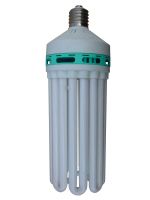
Now with TEN of these I should be able to cluster them together and produce the tungsten equivalent of a 6k balloon. It'll pull around 18 amps so you could still use it on a household circuit. You couldn't float them necessarily but you could hang the lights in a big cluster from a crane or lift of some sort. Does anyone see any reason this setup wouldn't work?

In the entire thread - http://www.dvxuser.com/V6/showthread.php?t=126714&highlight=balloon - no one once explained to Elrosten that his DIY Balloon Light was a recipe for disaster. That he would never be able to use it on a single household circuit, that the neutral in the light would overheat and melt-down, and that if he tried to power it on a portable gas generator he would have power problems (not flicker) because this set up will generate severe harmonic distortion in the power supplied by the generator. Why? Because ten 200watt 8u CFL bulbs will not draw 18 amps but 33.3 Amps.

I know you think my “verbiage about sine waves” is tedious. But, I find again and again that because of the brevity of the posts, online forums like this are filled with a lot of misinformation (case in point.) Since a little knowledge can be a dangerous thing when it comes to handling electricity (case in point), I feel it necessary to explain briefly why Elrosten’s set up as he envisions it will not work and even be hazardous. For a more detailed explanation, I would suggest you read the article I wrote for our company newsletter on the use of portable generators in motion picture lighting, and it is not for marketing purposes as Chris would have you think, but for your own safety. In it, is a more detailed explanation of the basic electrical engineering principles behind power factor. The article is available on our website at http://www.screenlightandgrip.com/html/emailnewsletter_generators.html.

What Elrosten and everyone who responded to that post is failing to take into account is that the 120V versions of the 8u CFL bulbs have a power factor of .5. Since power factor has been universally overlooked in the DIY designs that I have read on this forum, and since as you will see it can be disastrous if overlooked, I would like to take this opportunity to explain it in detail and show how it effects Elrosten’s ballon set up.

If we look at the technical specifications for this 200 watt 8u CFL bulb below (available at http://www.maxlite.com/PDFs/FocusSheets/HighMax.pdf), we find that with a power factor of .5 the bulb in fact draws 3.3 Amps. The difference between the actual current drawn by the bulb (3.3A) and the 1.66A Elrosten calculated a 200W bulb should draw using Ohm’s Law (W=VxA), is the difference between what is called “Apparent Power” and “True Power.”

200w8uCF_bulb_spec.jpg

Specifications for Maxlite 200W 8u CFL Bulbs

If, in this case, you were to measure the current (using a Amp Meter) and voltage (using a Volt Meter) traveling through the cable supplying the CFL bulb and multiply them according to Ohm’s Law (VxA= W) you would get the “apparent power” of the bulb (120V x 3.3A = 396W). But, if you were to instead, use a wattmeter to measure the actual amount of energy being converted into real work (light) by the ballast of the CFL bulb you would get the “true power” of the bulb which in this case is specified by the manufacturer as 200W. The ratio of “true power” to “apparent power” is called the “power factor” of the bulb.

A favorite analogy electricians like to use to explain power factor is that if apparent power is a glass of beer, power factor is the foam that prevents you from filling the glass all the way up with beer. When lights with a low power factor are used, the distribution system must be sized to supply the apparent power (beer plus foam), even though only the true power (beer) counts. What accounts for this discrepancy between Apparent Power and True Power?

To understand the power factor of a CFL bulb, and its’ effect on the power supply, it is helpful to compare it to an incandescent bulb. An incandescent light is a simple resistive load. The high resistance of its tungsten filament creates heat until the filament glows - creating light. As we see in the oscilloscope shot below, of a 25W incandescent bulb operating on grid power, the current is always proportional to the voltage (current is represented on the scope as the voltage drop on a 1 Ohm resistor.)

Incan_Waveform.jpeg

Current and Voltage Waveform of a ACEC 25W Incandescent bulb

If the applied voltage is sinusoidal, the current generated is also sinusoidal. That is, the current increases proportionately as the voltage increases and decreases proportionately as the voltage decreases. Since the peak of the voltage corresponds to the peak in current, the voltage and current are also in phase and so have a unity power factor (Power Factor of 1.)

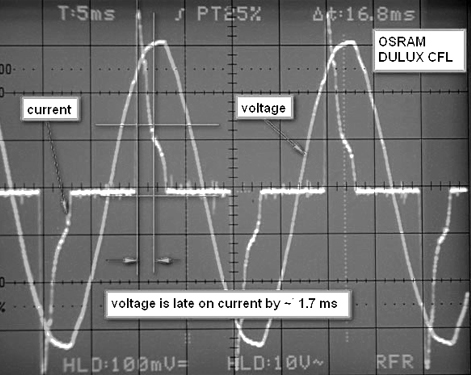
The voltage and current waveforms below of a CFL bulb operating on grid power is very different from that of the incandescent light above. The most noticeable difference is that the current, generated by the CFL bulb, no longer proportionately follows the nice smooth sinusoidal voltage waveform supplied to it by the power grid. Rather, it has been distorted by electrical components in the ballast of the CFL bulb so that it instead consists of sharp spikes in power that quickly drop off over a short duration. A second distinguishing characteristic is that the peak of the voltage no longer corresponds to the peak in current. The current now “leads” the voltage by 1.7 milli-seconds. The voltage and current are no longer in phase as in the case of an incandescent bulb, but instead exhibits what we call a leading power factor.

CFL_Waveform.jpg

Current and Voltage Waveform of a Brelight 25W CFL Bulb

The distorted current waveform and leading power factor exhibited here is caused by components in the electronic ballast which use only portions of the voltage waveform, draw current in quick bursts, and then return the unused portions as harmonic currents that stack on top of one another, creating harmonic distortion that pulls the voltage and current out of phase. This creates an opposition to the flow of current that is called capacitive reactance. Where capacitive reactance leads to an inefficient use of power (lots of foam), and the harmonic currents generated can have severe adverse effects on other equipment operating on the same power, it is worth exploring the cause of capacitive reactance and the source of the harmonic currents in more detail.

schematic_CFL_ballast.jpg

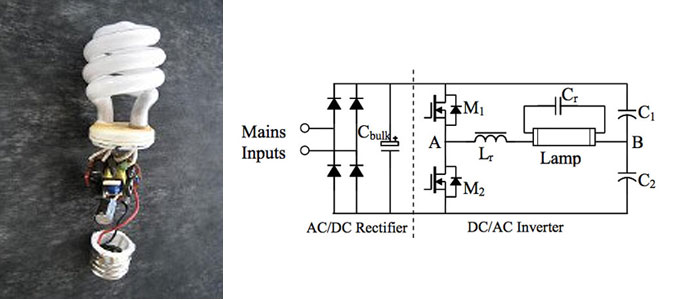
Typical schematic of CFL electronic ballast: L-to-R consists of half-bridge rectifier, conditioning capacitor, DC/AC Inverter

The electronic ballasts of self ballasted CFLs, are very similar in design to the high frequency ballasts used in fluorescent movie lights in general (Kino Flo, Lowell, etc.) All electronic fluorescent ballasts are essentially AC-to-AC power converters in that they convert line-frequency power from the utility line (60Hz) to a high-frequency AC power (20’000-50’000 Hz) to excite the gases in the fluorescent lamp so that they glow continuously. The diagram above illustrates the typical components that make up the high-frequency electronic ballasts found in most all high frequency fluorescent movie lights and CFL bulbs.

SMPS_Rectified_Power_Flo.jpg

Step 1: Rectifier Bridge converts AC power to rectified sine wave. Step 2: rectified sine wave is flattened to DC by conditioning capacitor.

They consist, first, of a diode-capacitor section that converts the AC input power to DC power, and then an inverter section that converts the DC power back to a high frequency AC power that ignites the lamp gases. The diode-capacitor section converts the AC power to DC power by first feeding the AC input current through a bridge rectifier, which inverts the negative half of the AC sine wave and makes it positive. The rectified current then passes into a conditioning capacitor which removes the 60 Hz rise and fall and flattens out the voltage - making it essentially DC. The DC is then fed from the conditioning capacitor to the inverter section which typically consists of a pair of MOSFETs (metal–oxide–semiconductor field-effect transistors) which generate the high frequency (20-50kHZ) AC waveform. Where, the harmonic currents produced by electronic fluorescent ballasts are primarily generated by the diode-capacitor section of the ballast, lets look at how this circuit works in more detail.

Where I am just about out of space, I will pick up with how the diode-capacitor section of fluorescent and HMI electronic ballast generates harmonics in my next post.

Guy Holt, Gaffer, ScreenLight & Grip, Boston
 
Last edited:
Where, the harmonic currents produced by electronic fluorescent ballasts are primarily generated by the diode-capacitor section of the ballast, lets look at how this circuit works in more detail.

As shown in the illustration below, the diode-capacitor circuit only draws current during the peaks of the supply voltage waveform and charges the conditioning capacitor to the peak of the line voltage. Since the conditioning capacitor can only charge when input voltage is greater than its stored voltage, the capacitor charges for only a very brief period of the overall cycle time. After 90 degrees, the half cycle from the bridge drops below the capacitor voltage; which back biases the bridge, inhibiting further current flow into the capacitor. Since, during this very brief charging period, the capacitor must be fully charged, large pulses of current are drawn for short durations. Consequently, electronic ballasts, draw current in high amplitude short pulses. The remaining unused current feeds back into the power stream as harmonic currents.

Working_of_CFLs.jpg

Yellow Trace: Rectifier Bridge converts AC power to rectified sine wave. Blue Trace: Stored Capacitor Voltage. Red Trace: Current drawn by capacitors once input voltage is greater than voltage stored in the capacitor (Blue trace.)

These simple diode-capacitor circuits are used in CFL bulbs and in many fluorescent movie lights because they are compact and inexpensive. However, they have a number of drawbacks. For instance, notice how big the input current spike (red trace above) of the diode-capacitor circuit is. Without power factor correction, the in-put bridge rectifier requires a large conditioning capacitor at its output. This capacitor results in line current pulses (as seen in our oscilloscope shot in the previous post) that are very high in amplitude. All the circuitry in the ballast as well as the supply chain (the generator, distribution wiring, circuit breakers, etc) must be sized to carry this high peak current (the foam in our analogy). Also notice that the line current pulses are narrow, with fast rise and fall times. Since the diode-capacitor circuit uses only the peaks of the voltage waveform, they generate high harmonic content as the unused portions of the voltage waveform are returned as harmonic currents (see graph below.)

CFL_Harmonic_Distro.jpg

Distribution of Harmonic Currents generated by CFL bulb

These harmonic currents stack on top of one another creating harmonic distortion that creates an opposition to the flow of current; and, as we saw in the oscilloscope shot in the previous post, pulls the voltage and current out of phase. When the power is supplied by a conventional generator, these harmonic currents can also lead to severe distortion of the voltage waveform in the power distribution system (see below for more details.) Finally, the fast rise time of these harmonic currents can cause Radio Frequency Interference (RFI) problems. For this reason, on their website Lowell warns about their compact fluorescent (CFL) fixture, the Lowel Ego, that: “The lamps may cause interference with radios, cordless phones, televisions, and remote controls. If interference occurs, move this product away from the device or move to a different outlet” (http://www.lowel.com/ego/lamp_info.html.) While self ballasted CFLs generate the most severe harmonics, all electronic ballasts (both fluorescent and HMI) generate harmonic currents (see table below.)

Table_THD_Flo_Ballasts.jpg

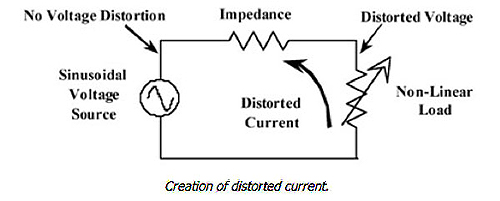
Besides possible RFI problems, you need not be concerned about current harmonic distortion producing voltage distortion when you plug an electronic ballast (fluorescent or HMI) into a wall outlet. The impedance of the electrical path from the power plant to the outlet is so low, the distortion of the original applied power waveform so small (less than 3%), and the power plant generating capacity so large by comparison to the load, that harmonic currents fed back to it will not effect the voltage at the load bus (electrical outlet.) However, it is an all together different situation when plugging an electronic ballast (fluorescent or HMI) into a portable generator. In this case, the impedance of the power generating system (generator and distribution cable) is sufficient enough that a harmonic current will induce a voltage at the same frequency. For example, a 5th harmonic current will produce a 5th harmonic voltage, a 7th harmonic current will produce a 7th harmonic voltage, etc. Since, as we saw above, a distorted current waveform is made up of the fundamental plus one or more harmonic currents, each of these currents flowing through an impedance will, result in voltage harmonics appearing at the load bus, a voltage drop, and distortion of the voltage waveform.

Creation_of_Harmonics_Flow.jpeg

Each harmonic current in the electrical distribution system will cause a voltage at the same harmonic to exist when the harmonic current flows into an impedance.

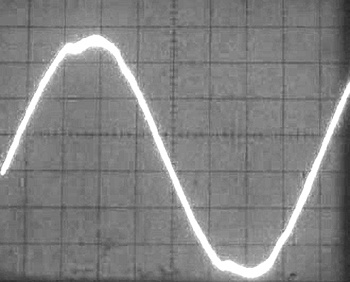
Since electronic ballasts consume current only at the peak of the voltage waveform (to charge the smoothing capacitor), voltage drop due to system impedance occurs only at the peak of the voltage waveform. In this fashion, the pulsed current consumed by electronic ballasts produces voltage distortion in the form of flat-topping of the voltage waveform.

CFL_FlatTop_Waveform.jpg

The pulsed current consumed by electronic ballasts produce voltage distortion in the form of flat-topping.

For example, the power waveform above (from my article) is what results from the operation of a 2500W load consisting of non-Power Factor Corrected electronic Kino & HMI ballasts on a conventional portable generator (a Honda EX5500 with a Barber Coleman Governor.) It is also a good indication of what would likely result from operating Elrosten’s CFL Balloon along with several small HMIs on a conventional putt-putt generator. Since the voltage waveform distortion exhibited here can adversely effect other equipment operating on the same power, the generation of harmonic currents by electronic HMI & Fluorescent ballasts should be eliminated whenever possible.

Where I am just about out of space, I will pick up with how Elrosten could mitigate the problems caused by harmonic currents and make his CFL balloon light work in my next post.

Guy Holt, Gaffer, ScreenLight & Grip, Boston
 
Since the voltage waveform distortion exhibited in my post above can adversely effect other equipment operating on the same power, the generation of harmonic currents by electronic HMI & Fluorescent ballasts should be eliminated whenever possible. Otherwise they can build to a point where they will have a disastrous effect upon other equipment. As more and more electronic components, like lap top computers, hard drives, and HD monitors, which are themselves sources of harmonic distortion (but of a lower amplitude than solid state lighting ballasts) are integrated into the typical location production package, harmonic currents begin to combine with unpredictable consequences. In fact, a viscous cycle can get started. The more harmonic orders that are generated, the more distorted the power supplied by the generator becomes. The more distorted the power waveform becomes, the more harmonic currents are thrown back into the electrical distribution system, which in turn, creates additional voltage distortion. In this fashion, something akin to a feedback loop can get started. Very often, the operation of electrical equipment may seem normal, but under a certain combination of conditions, the impact of harmonics is enhanced with unpredictable results.

makeup_squarewave_alt.gif

Sprectrum analysis of the high frequency Harmonic Currents that induce a flat-topped voltage waveform at the load bus.

The severe voltage waveform distortion exhibited above can cause overheating and failing equipment, efficiency losses, circuit breaker trips, and instability of the generator's voltage and frequency. In addition to creating the radio frequency interference (RFI) mentioned on the Lowell Light website, harmonic noise of this magnitude can also cause component level damage to HD digital cinema production equipment and create ground loops. Harmonics can also cause excessive current on the distribution system neutral (see below.) And, since the neutral conductor of a distribution system is not fused, it can cause the neutral to overheat and possibly melt down.

High_Nuetral_Return_CFL.jpg

Substituting incandescent lamps with the equivalent wattage of CFLs in a small single phase distribution system substantially increases the current on the system neutral.

For this reason, on their website Kino Flo cautions users of their older style fixtures, that the ballasts “will draw double the current on the neutral from what is being drawn on the two hot legs. On large installations it may be necessary to double your neutral run so as not to exceed your cable capacity.”(FAQ “Why is the neutral drawing more than the hot leg”.) For a detailed explanation for why harmonic currents cause unusually high neutral returns see my article on the use of portable generators in motion picture production available on our website at http://www.screenlightandgrip.com/html/emailnewsletter_generators.html.

The first step in mitigating the problems caused by harmonic currents is to eliminate the currents. Where customarily the largest source of harmonic currents in a typical lighting package are HMI and Fluorescent lights with electronic ballasts, using only ballasts with power factor correction (PFC) circuitry will go a long way in reducing the number of harmonic currents in the power stream. By simply eliminating the generation of harmonic currents, a PFC circuit realigns voltage and current and induces a smoother power waveform at the distribution bus. As a result, the ballast uses power more efficiently with minimized return current and line noise and also reduces heat, thereby increasing their reliability (see my article for a more detailed explanation on how Power Factor Correction works.)

Effect_of_PFC_in_Flos.jpg

The second step in mitigating the problems caused by harmonic currents is to use inverter generators. The combination of the improved power factor of the ballasts and the nearly pure power waveform of inverter generators makes it possible to reliably power larger lights, or more smaller lights, than has been possible before on a small portable gas generator. For example, the power waveform below, is the same 2500W load but with power factor correction operating on our modified Honda EU6500is Inverter Generator. As you can see, the difference between the resulting waveforms is startling. Even though the load is the same, the fact that it is power factor corrected, and the power is being generated by an inverter generator, results in virtually no power waveform distortion. For this reason, sensitive electronic production equipment will operate reliably and without damage on the same power. And, the generator is capable of operating larger, or more smaller, lights than has ever been possible before on a portable gas generator.

waveform_Inv_PFC_kino.jpg

The nearly pure voltage waveform of Power Factor Corrected ballasts operating on an inverter generator. Note: No Flat Topping

The extremely low line noise exhibited in the inverter generator power waveform above creates a new math when it comes to calculating the lighting load you can put on a portable generator. Where before you could not operate more than a couple 1200W HMIs with non-PFC ballasts on a conventional generator because of the consequent harmonic distortion, now you can load an inverter generator to capacity. According to this new math, when you add up the incremental savings in power to be gained by using only PFC HMI ballasts, add to it energy efficient sources like the Kino Flo ParaBeam fixtures (which are also PFC), and combine it with the pure waveform of inverter generators, you can run more HMI and Flo lights on a portable gas generator than has been possible before. For example, the 7500W capacity of our modified Honda EU6500is Inverter Generator can power a lighting package that consists of a PFC 2.5kw HMI Par, PFC 1200, & 800 HMI Pars, a couple of Kino Flo ParaBeam 400s, a couple of ParaBeam 200s, and a Flat Head 80. Given the light sensitivity of HD cameras, this is pretty much all the light you will need for a low budget HDV production. Use this link - http://www.screenlightandgrip.com/html/emailnewsletter_generators.html - for more information about the benefits of low line noise.

Unfortunately for Elrosten, according the table at the outset, power factor correction is only available in the high voltage versions of these 200watt 8u CFL bulbs. So his best bet is to beef up the neutral in his CFL head so that it doesn’t overheat; split the load of the bulbs over two Edison plug ends that he can plug into separate circuits; and use an inverter generator when he needs to power his balloon light on locations without grid power. If he takes these precautions he should have no problem. Chris, I hope you can see now why amateurs and semi-pros, who are building DIY light fixtures using CFLs, need to understand my tedious “verbiage about sine waves” more than anyone, and why I keep reposting links to my website. Now, let’s give it a rest and hoist a beer.

If a reader of this post still doesn’t entirely understand power factor, I would encourage them to read the article I wrote for our company newsletter on the use of portable generators in motion picture lighting before attempting to build their own lights. In it, is a more detailed explanation of the basic electrical engineering principles behind harmonic distortion and it’s adverse effects. The article is available on our website at http://www.screenlightandgrip.com/html/emailnewsletter_generators.html.

Guy Holt, Gaffer, ScreenLight & Grip, Boston
 
To answer to nejuicer's multiple posts with his lengthy explanations, complete with photos.
Let me say, BRAVO.
A number of newbies to this site never use the "SEARCH" portion of this site to ask questions.
How many times have we read "Which light kit should I get?"
Guy's explanations of power distribution, safety, Power factor, sine wave, HMI's and ballasts are all very welcome, and frankly I learn something new from most of his posts.
I ended up buying one of his genny and transformer packages, to stream line my grip package and lessen my need for renting a big, pull behind genny, just to fire up a 4k par.
 
Back
Top