Help me light a low light scene

davidschmaus

Active member
I am shooting a short for FictionFest. This scene is being shot on Feb 5th. Its a single character scene. I went over last night to the location to do a initial test with lighting. Its a night scene in a small one room apartment. I want it dark and moody.

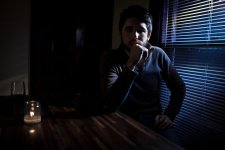
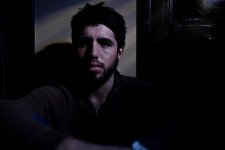
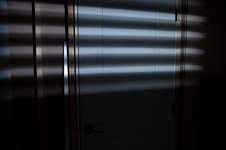
I gelled (Blue) a 500W light and shot it through the window with some mini blinds. The plan was to use a softbox on the opposite side for fill but even my small softbox was overpowering the light from the window.

I like the mood that these test shots have but would like to light up the eyes a little more.
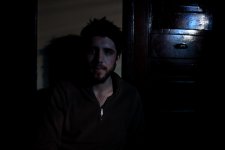
IMG_6691.jpgIMG_6701-2.jpgIMG_6695.jpg

Here is my thoughts. For the close up face shot. I could move the light inside and make a "mini blind cookie" out of foam core to emulate the window. I have a 750 Lowel I could use for this. That would increase the overall light then I could use a soft box to light the other side of the face.

Would the softbox be the twinkle in the eye or do I need something else for that?
 
I do. I have this.
pro_light.jpg


I need to get a handle on controlling the light.
 
Yeah, a large white bounce card catching the light spilling thru the window placed left of camera might be all you need. Might place a second fixture outside the window to do just this.
 
Hi
I shot some test shots for a similar scene and my solution for the eyes (I had the same problem) was to use a LED flashlight.
I might have broken some rules but it worked well. I wanted a slash of light accross the eyes.
I had a double blue gelled Arri 250 watt shooting through some mini blinds (held up by C stands off camera).
The mini blinds were acting as a cookie to light the scene with light and dark stripes of "moonlight through blinds".
Just throwing this in on top of lots of good advice above.
Good Luck.
 
I see what you're up to with the backlit blinds and the hard-ish light on his face; the giveaway here is his face isn't striped with shadows, but not the kind of thing that's noticed if the character/story (and the audio) is engaging.

If you want to soften that key even more, try:

Black felt with a circle cut into it, clipped to the front of your softbox - try different sized circles.

Large black foam board, circle cut, sheet of diffusion on the back - aim a fresnel on "spot" at the circle. Play with the subject - board - light distance relationships.

If you need to go too wide for the small-diffusion techniques above, try a fresnel on spot with a snoot - use as much wire screen as needed to dim it. (Sometimes just a scrim won't do - keep a roll of screen in your kit, it's cleaner than ND and doesn't fade with heat). Sometimes, you can diffuse the light at the lens, and then add a snoot - this can soften things a hair.

A tiny amount of haze/smoke in the air can be really nice, just don't overdo it (unless the character is smoking). This will lift your blacks a bit, but gives you room to crush a bit in post.


Wow, great advise. Not just Michael but everyone. (for the shot when the window is out of frame) It looks like I am going to a combination. I am moving up to a 750w Lowel double blue gelled - moving the light source inside the room - got a 32-48 black foam core. I'm going to cut slits in it to simulate the blinds. That should jack up the light at least 4 stops - plus will give me a more defined lines across the face. Then I am probably going to use a rita 44 SB 16" and use felt with a hole cut in it to softly light just the face from the opposite side. For a third light I bought this at Lowes. I am going to make some cones and such to control it.
022011611280lg.jpg

I will post updates
 
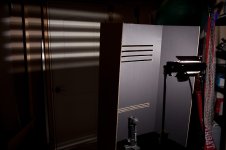
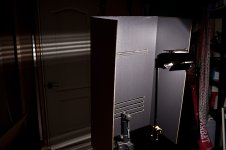
Here is what I ended up with. I bought this black "presentation board" at a craft store for 3 bucks. cut slits in it on two different ends with different sizes. It will work great for my project. They are like laser beams. Now I can add some fill light and not lose the light from the window. (hopefully)
IMG_6704.jpgIMG_6702.jpgIMG_6707.jpg
 
Last edited:
I very much like your original look, including the close up. Notice that your first pic has perfect catchlights in the eyes. I think you lost these in the following shots because the actor's eyes can't pick up the light from the window and reflect it to the camera -- in other words, you can't see the window in the eyes from the camera. If you just change where the actor is looking or has his head turned slightly, more to camera right, toward the light, you should get what was working for those nice reflections in the first pic.

You don't necessarily have to have catchlights even if the eyes are the mirror of the soul, or your artists are telling the story with their eyes. I study at a lot of stuff shot by great DPs and they often let eyes go dark.

For my money, the subtlety of the original blinds really beats the foamcore. Just a gentle reminder, blinds like this are seriously cliched. (Not that I don't do it sometimes, I have a blind I can put on a stand and a cookie with slits in it, but it's usually with a wince.) In fact, I'd put a tree branch outside the window, open the blinds, and put a harder light through the branch, then move the branch slightly once in a while such as the wind would do. The dappled light and irregular shadows from this gag look better to my eye and it won't call attention to itself as, "Oh, a film noir blinds shot."

I'm a busy small time gaffer, and here I'm just offering advice on the art. Your film is all about your look, your taste, your eye. So go for it.

Thanks for the input. Being new to this I don't always know what things are cliche. I guess my ultimate goal is to have a few working options for the day we shoot so I am not stumbling around.

The cookie I made was intended to be used on the close ups only with the intent to be able to increase exposure across the scene. I think now that I have a controlled "base" for the blinds I can modify the look by turning the cooking at different angles to make them more subtle. I am going to test the full lighting setup this evening with my son.

As far as the window shot. I am pretty darn happy with those. I will switch out the light source to get a consistent color across the light source. More to come
 
Great.

One thing about movie cliches. Though they are to be avoided if they take you out of the illusion, they are to be used if they create or maintain it. I can illustrate this idea to define it.

We are all so accustomed to blue moonlight (or streetlight) pouring through dark windows at night in our movies that for all of us that light in a scene cues the unconscious buy-in of time and place. But DPs and gaffers know that moonlight isn't blue, in fact, it's about 4100K. Never mind that, the cliche is so ingrained it works and we play our HMIs and gel our tungsten heads out there to keep that color looking right, not true.

Ditto outside night lighting. Did you know that it is not the case that every street has a Condor at the end of it firing some 18K HMIs from on high? :) It is not the case that real front yards and alleys and the woods are lit with daylight-colored light all over the place including from the ground up into the tree canopies. But we've gotten that for so long in our movies, it's been placed there so we can see what is going on and to give the scene visual texture, that the untruth does not faze us and the cliche works.

There are coutless of these visual cliches from fogger haze to huge rimlights to Venetian blind shadows and all of them, used deftly, help us make believable movies even when, if we stop and think about it, they can't be true. Next time I put a light through some blinds I'll think of you LOL
 
Great post :)

Great.

One thing about movie cliches. Though they are to be avoided if they take you out of the illusion, they are to be used if they create or maintain it. I can illustrate this idea to define it.

We are all so accustomed to blue moonlight (or streetlight) pouring through dark windows at night in our movies that for all of us that light in a scene cues the unconscious buy-in of time and place. But DPs and gaffers know that moonlight isn't blue, in fact, it's about 4100K. Never mind that, the cliche is so ingrained it works and we play our HMIs and gel our tungsten heads out there to keep that color looking right, not true.

Ditto outside night lighting. Did you know that it is not the case that every street has a Condor at the end of it firing some 18K HMIs from on high? :) It is not the case that real front yards and alleys and the woods are lit with daylight-colored light all over the place including from the ground up into the tree canopies. But we've gotten that for so long in our movies, it's been placed there so we can see what is going on and to give the scene visual texture, that the untruth does not faze us and the cliche works.

There are coutless of these visual cliches from fogger haze to huge rimlights to Venetian blind shadows and all of them, used deftly, help us make believable movies even when, if we stop and think about it, they can't be true. Next time I put a light through some blinds I'll think of you LOL
 
Did you know that it is not the case that every street has a Condor at the end of it firing some 18K HMIs from on high? :) It is not the case that real front yards and alleys and the woods are lit with daylight-colored light all over the place including from the ground up into the tree canopies.

Director to DP during night shot: "So where will the audience think all that blue light is coming from?"

DP: "Same place as the music."
 
Director to DP during night shot: "So where will the audience think all that blue light is coming from?"

DP: "Same place as the music."

<ROAR!> Exactly! Perfect! You nailed it. Motivation and reality is great but when the story needs a light or the camera does, we put one in there and if we do it right they never even think about it.
 
did some more testing today with the cookie.

Here what I ended up with. minus all the crap on the bed


Looks good. I'd get right up close to the face with the camera though. the contrast on the face is good enough for emotion, no need for any of the background IMHO.
 
Director to DP during night shot: "So where will the audience think all that blue light is coming from?"

DP: "Same place as the music."

Epic, Epic Win! These forums never cease to be a source of amazing, helpful info!

If I was single and the DVXuser forum was a woman, I'd be a stalker!
 
Back
Top