"HD LEGAL" What exactly does this mean?

Bentleysuper8

New member
The following was posted on another site:

"For myself, around that price point, I’d look to the Sony EX series. Larger Sensors, better glass, and a more updated (not to mention HD legal) compression algorithm.
If you’re working @ all for some HD networks (discovery) the HVX, and I’d bet my dollar HPX, are not really useable. This is just my thoughts, of course.
Also, P2 won’t get cheaper. It’s proprietary to Panasonic and not licensed out, so the price is fixed. That’s the downside to it. . as well as it’s short record time (in DVCProHD100, which is also only 100 @ 60p, but that’s another story. . )
All in all, I’d honestly admit the Panasonic offerings are currently lackluster in the tapeless HD department."

Is the HD legal algorithm true? Isn't the EX a long GOP format? I've cut with Canon XL H1 footage and while it looks ok I hate editing with it.

Any comments?
 
I have no idea what that means.

The EX series has a more updated codec than HDV, but it's still not acceptable to the BBC as "HD". Maybe some networks accept it, others don't. There is talk that the Discovery channel allows the EX1 for Silver level acqusition, which would be more "HD legal" than HDV (which is never allowed above Bronze level).

The HVX is classified by Discovery as Bronze. I don't know if the HPX170 has been classified. The HPX500 is classified as Silver. I don't know if the HPX300 has been rated yet.

Saying P2 "won't get cheaper" is just silly. When P2 first came out, it cost $1,000 per gigabyte. Today it's $15 per gigabyte (64GB "E" cards). I would think a price drop from $1,000 to $15 qualifies as "getting cheaper".

To say that the Panasonic offerings are "currently lackluster" in the HD department... well, everyone gets their own opinion, I guess, but with 80% of the world's broadcasters (who have converted to tapeless) having gone with P2 gear, I don't really get that assessment.

So: is the "HD legal algorithm" true? Depends on what network you're talking about. If it's the BBC, then no -- EX is not acceptable for HD delivery. If it's Discovery, maybe -- people say it's accepted, but I've never seen the documents to support it.

But unquestionably, the EX is better than any HDV camera.
 
I guess I thought that post referenced the HVX200/170.

As far as HD quality goes, which camera is superior? I love working with DVC PRO on my Mac, not so much HDV and I've never worked with EX.

I'm thinking of upgrading from my HVX200 to a 170 due to the better operation in low light, wider angle lens and especially HD SDI out.

Should I even consider a Sony camera?

Neither camera is "superior". One is better at some things, the other is better at others. You have to choose what you want.

Should you consider a Sony camera? Why not? Consider any camera that gets the job done. Unless someone is paying you to use a particular camera, keep your options open.

If you are going to use and SDI out on any of the cameras, then a lot of things open up. Personally, I think the 1/2" chips on the Sony play a larger role when you take the long-GOP compression out of the mix. But that's just me. I like the waveform monitor on the Panasonic, and wish I had one on the Sony.

So again, you have to choose what works best for you, and go with it.
 
The following was posted on another site:
"For myself, around that price point, I’d look to the Sony EX series. Larger Sensors, better glass, and a more updated (not to mention HD legal) compression algorithm.


This is obviously someone that has little experience in the industry. HD Legal compression?, oh please. Go tell that to Fox, ABC, NBC, Discovery, History Channel, HBO, etc...


If you’re working @ all for some HD networks (discovery) the HVX, and I’d bet my dollar HPX, are not really useable. This is just my thoughts, of course.


Right and the Discovery channel didn't run the 6 part series on the Iditarod last year which was shot on the HVX200.


Also, P2 won’t get cheaper. It’s proprietary to Panasonic and not licensed out, so the price is fixed. That’s the downside to it.


And that is why you can get them from FujiFilm and Maxell. And the P2 cards did get cheaper, so he obviously is pretty clueless.

. as well as it’s short record time (in DVCProHD100, which is also only 100 @ 60p, but that’s another story. .
)

And XDCAM Ex is 35Mbs and XDCAM422 is 50Mbs so what is his point? I mean show me the SxS card that can record an hour? Or a spinning disk?


All in all, I’d honestly admit the Panasonic offerings are currently lackluster in the tapeless HD department."

Well perhaps if he knew the real workings of a File-based workflow and how the metadata will play into what will be the most important part of a serious archive, he may not have said this as the competitive offerings don't compete as well. The perfomance of the Panasonic line stands up well against the Sony product line.

Is the HD legal algorithm true? Isn't the EX a long GOP format? I've cut with Canon XL H1 footage and while it looks ok I hate editing with it.Any comments?

The HD Leagal algortim comment is hoohaa, the XDCAMs are all long GOP, and your experience with the H1 footge would be mirrored in the XDCAM domain.
 
Would that be because there are less mbps using that acquisition codec?

Because a 16 GB p2 card will hold about 42 minutes of 720/24pn at about 40 mbps.

And the E series runs about $400.00
 
The 16GB card won't record an hour, they record 50 minutes... unless you go to the HDV-style SP mode, they can do an hour in that mode.
 
The 16GB card won't record an hour, they record 50 minutes... unless you go to the HDV-style SP mode, they can do an hour in that mode.


I record on my EX1 with 16GB cards at least once a week and have for over a year. I do a LOT of long-form conference recording. I can say without question that I have put more than 50 minutes of video on my cards.

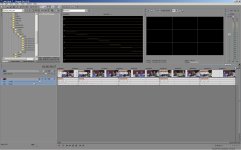
In fact, I shot a job 2 weeks ago that spanned 2 16GB cards, so as a test, I just laid all footage from Card1 on my timeline. It is exactly 01:00:30;17.

You'll note from the file I left highlighted that these are 1080/30p files.

Screenshot attached:
 

Attachments

  • timeline_screenshot.jpg
    timeline_screenshot.jpg
    102.1 KB · Views: 0
Would that be because there are less mbps using that acquisition codec?

Because a 16 GB p2 card will hold about 42 minutes of 720/24pn at about 40 mbps.

And the E series runs about $400.00

Yes, the EX1 is recording ~35Mbps VBR. So the bitrate can vary a bit based on material. In some modes, it can shoot up to 70 Mbps, but I don't think we've seen it drop below 30 Mbps.
 
I would take issue with Jan's statement,

"your experience with the H1 footge would be mirrored in the XDCAM domain."

My experience is that HDV footage is more CPU-intensive (as indicated by the Windows Task Manager showing CPU utilization) to play in an editor than XDCam footage.

I had speculated that this was because XDCam uses a square pixel, the same as a computer--thus eliminating the need to rescale pixel aspect ratios for display... whereas HDV is a rectangular pixel and requires extra processes to display on a computer with the correct aspect.

Another thought on this is XDCam is less compresses, and thus easier to decode than HDV, which is probably the largest factor.

I do know that HDV footage bogs down our editing systems, but we can run four streams of XDCam with some color correction, unrendered, at full frame rate and CPU utilization is only 60%.

On the image quality aspect, I recently installed a projection system in my studio and a 154" screen, which my first row of seating is only 96" from. A Blu-ray player is hooked up to the projector, as well as one of the editing workstations. This gave me a unique opportunity to compare XDCam footage to some of the finest cameras Hollywood can put to the task of shooting motion pictures. I expected the XDCam to fail miserably on a screen this size. I was stunned to see that, not only did it look great, but it retained more detail than any of my Blu-ray movie collection that was originated from film. Even the quality of the lens had nothing to worry about from Hollywood. I was seeing more chromatic aberration on the movies than on the XDCam footage. I was seeing much more noise and grain on the movies than the XDCam footage. I noticed some of Hollywood's movies lacked full sharpness to the corners of the frame. And I noticed more severe barrel distortion on a number of films.
Then we get to lattitude... I'm still baffled at why my XDCam footage, shot with CINE1 gamma, retains ALL of the information from dark shadows like under the fenders of automobiles, to the highlights, like sunlit silver linings of clouds in the sky, and everything in between, whilst Hollywood movies always have crushed blacks and blown highlights. If film has such great lattitude, then why do the directors ALWAYS prevent us from seeing the full dynamic range?
On my 154" screen, the XDCam footage is the best-looking image I have been able to project. It's cleaner than anything transferred from film to Blu-ray, and it's more detailed than 90% of the Blu-ray movies we've rented and shown in the last 45 days in this new theater.
Frankly, I can't imagine any camera with less than a full-frame 1920x1080 sensor being capable of holding its own against cameras costing $250,000. The EX series is probably an accident that, by the industry goals, should NOT have happened. But there it is. Too good for the price. And I'm a believer, after seeing the image on a large projection system, up close. It's like having 20/20 vision. What more can anyone ask for?
 
Another thought on this is XDCam is less compresses, and thus easier to decode than HDV, which is probably the largest factor.
Just for clarification: it's only the tiniest bit less compressed. As far as actual compression ratio, they're almost exactly the same.

HDV = 1440 x 1080 @ 25 megabits, or 62,208 pixels per megabit
XDCAM EX = 1920 x 1080 @ 35 megabits, or 59,246 pixels per megabit

The actual compression ratio is basically the same. EX footage has 33% more data to compress, and 35% more bandwidth to handle it. However, the compression engine seems significantly more efficient than that used for Sony's first-generation HDV, so the gain in quality is substantial even if the compression ratio is the same.
 
Then we get to lattitude... I'm still baffled at why my XDCam footage, shot with CINE1 gamma, retains ALL of the information from dark shadows like under the fenders of automobiles, to the highlights, like sunlit silver linings of clouds in the sky, and everything in between, whilst Hollywood movies always have crushed blacks and blown highlights. If film has such great lattitude, then why do the directors ALWAYS prevent us from seeing the full dynamic range?
I guess this is part of "film color correction" as some see it. I hate crushed blacks, so I calibrated my TV set and it really helps to get back some of those near-blacks, because they are usually not completely crushed after all.
 
Long GOP was designed to improve quality compared to I-frame-only at a given bitrate. Implemented correctly, long GOP will always provide a better image than I-frame codec AT THE SAME BITRATE. Whether it is easier/harder to edit is another question.

I don't remember anyone reporting the long GOP is easier to edit, or holds up better in post than intraframe.
 
Implemented correctly, long GOP will always provide a better image than I-frame codec AT THE SAME BITRATE.
Only when all other things are equal. If you're comparing an i-frame MPEG-2 against a long-GoP MPEG-2, then yes, you're correct. If you're comparing long-GoP MPEG-2 against i-frame AVC, that's a perhaps different scenario.
 
Just for clarification: it's only the tiniest bit less compressed. As far as actual compression ratio, they're almost exactly the same.

HDV = 1440 x 1080 @ 25 megabits, or 62,208 pixels per megabit
XDCAM EX = 1920 x 1080 @ 35 megabits, or 59,246 pixels per megabit

The actual compression ratio is basically the same. EX footage has 33% more data to compress, and 35% more bandwidth to handle it. However, the compression engine seems significantly more efficient than that used for Sony's first-generation HDV, so the gain in quality is substantial even if the compression ratio is the same.


This would support my theory that it's the pixel aspect ratio that is friendlier to computer editing than HDV's rectangular pixel.

Another forum member suggested it's because "of the lower compression", but I myself was aware that the increase in real pixels was close to the increase in bitrate. But who knows for sure? It may be that the way in which XDCam is implemented puts less burden on decoder hardware/software.

Indeed the gain in quality is VERY significant over HDV. I found a way to squeeze even better quality, by shooting with Detail Off and applying the sharpening in post. I did A-B comparisons of the same scene, shot with in-camera sharpening and without. Sharpened the latter in the editor and rendered both out one after the other on the same timeline. The details were a bit watery in the in-cam sharpened footage, but fine detail was superior in the post-sharpened footage. Even a sign on a business 1/4 mile away was much clearer and easier to read in the post-sharpened clip. Details in the tree foliage across the other end of the block was clear, as opposed to a green mud in the in-camera sharpened footage. It's become my new shooting style. Less stress on LongGOP and a better, more solid looking image with more real details (gained back by not having Crispening smoothing out texture in the detail enhancement).

I may achieve still higher quality by taking the HD SDI output directly off the camera, but unless I'm shooting a feature movie, I don't see the need for that effort.
 
Well, it's kind of hard not to, since the EX1 (and identical EX3) are the only models (model?) which record XDCAM-EX. So -- how do you separate them?

I would feel extremely comfortable saying that the compression displayed by XDCAM-EX (from an EX1) is profoundly superior to HDV from a Z1U.

Don't know about the later models like the Z7, if Sony's updated their HDV to offer more EX-level performance.
 
Back
Top