GH4 GH5 resolution from Photokina PR doesn't make sense with current MFT sensors?

Shenan

Well-known member
I've been wondering for a while how the previous GH5 press release (from Photokina?) fits in with currently available MFT sensors.

Here's the excerpt from the previous GH5 press release with some concrete numbers on the resolution (from https://www.panasonic.com/global/consumer/lumix/gh5.html):

In the LUMIX GH5, the conventional '4K PHOTO' function is dramatically advanced to form '6K PHOTO'*2 which lets the user cut a still image out of ultra high-quality 18-megapixel video with approx. 9 times the pixel count than Full-HD. Taking advantage of its high-speed, long-time burst shooting capability, spur-of-the-moment shots can be saved in beautiful photos with higher resolution that complies with larger-sized printing by substantially increasing the resolution from approx.8-megapixel (4K PHOTO) to approx.18-megapixel (6K PHOTO*2) Furthermore, approx.8-megapixel 4K PHOTO can be captured at 60 fps.

*2 "6K PHOTO" is a high speed burst shooting function that cuts a still image out of a 4:3 or 3:2 video footage with 18-megapixel
(Approx.6000 x 3000 effective pixel count) that 6K image manages.
The name '6K PHOTO' is tentative.

Well, there's no current MFT sensor from Sony or Panasonic with that resolution on the width. The Sony 20MP MFT sensor supposedly in GX8 and E-M1 II, currently the highest resolution MFT sensor, seems to max out in the low to mid-5000s in the wide resolution. Also note that 6000x3000 is 2:1 aspect ratio (if the pixels are square, which is a given). Keep in mind that a theoretical MFT sensor with 6000 on the width would total 27MP (6000x4500), which seems rather unlikely. I have some ideas of various possibilities of what this could mean, but it's wild speculation and highly unlikely to happen so I will keep it to myself for now. I'd like to hear what you think about this apparent mismatch between the press release and current (or even theoretical) MFT sensors.
 
Seems this is likely a mismatch between the marketing and the actual specs for the camera (which aren't known for sure yet). My best guess is that the "6K PHOTO" mode (quotes theirs) is actually an 18-megapixel photo mode that will allow for extracting photos from video footage that measures something less than 6000 pixels horizontally.

If I remember correctly, one of the slides in the Panasonic GH5 presentation had a chart showing how Panasonic is working toward 8K video capture for the 2020 Olympics and highlighted 6K as an intermediate step. Now typical broadcast resolutions are 16:9 aspect ratio, rather than the 17:9 aspect ratio of something like DCI 4K. Which means that "4K" for broadcast and television often ends up meaning 3840 x 2160 resolution and "8K" ends up meaning 7680 x 4320. Technically, of course, 3840 x 2160 resolution is Ultra HD and can't be considered true 4K since it has less than 4000 pixels horizontally. But from a marketing standpoint the term 4K has been used somewhat loosely and at times interchangeably with Ultra HD.

So, sticking with the 16:9 aspect ratio world (rather than 17:9) would mean that "6K" is midway between "4K" and "8K" with a resolution of 5760 x 3240. Maybe not quite true 6K, but kinda close. And this would result in a 18.6 Megapixel frame, which is about what is suggested by the GH5 marketing materials (if you ignore the strange 6000 x 3000, 2:1 aspect ratio stuff).

But even capturing 5760 x 3240 would require a higher spec sensor than we have seen in any Micro 4/3 camera so far. Since Micro 4/3 sensors are typically 4:3 aspect ratio, this would suggest a sensor resolution of at least 5760 x 4320 which would be a 24.9 MP sensor. I suppose it's possible the GH5 will debut a new higher resolution sensor not seen before, but we'll have to wait to know for sure.

If we instead assume the same 20 MP sensor as in the OM-D E-M1 Mark II, then the maximum frame size is 5184 x 3888. Which would yield a 3:2 aspect ratio frame size of 5184 x 3456 (about 17.9 MP), or a 16:9 aspect ratio frame of 5184 x 2916.

Obviously, the final GH5 specs haven't been published yet, but if this ends up being accurate and the GH5 uses an existing M4/3 sensor rather than something new, then we may be looking at something more like a 5K Photo mode than the "6K PHOTO" mode advertised. But hey, at least they admitted the name "6K PHOTO" was tentative, right?
 
Ya, it looks like 5.2 is rounded off to 6.

Or ... Olympus has that pixel-shift technology (the same that delivers the on-sensor 5-Axis stabilization), which lets it claim a 50 MPX stills image off eight combined frames when used on a fixed mounting. Maybe/possibly there's some sort of a smaller pixel shift with a correspondingly lower resolution that GH5 can produce in a photo mode to attain the currently bandied about specs.
 
I had thought of the possibility that the marketing department had just pushed it a bit too far and claimed 5.2k as 6k. If they had just said "6k photo*" (* name subject to change) and no more details, I wouldn't have thought twice about it. But they went on and on about specifics: an 18MP frame of 6000x3000 (although it finally sunk in after multiple readings that they say "approximately"). If they go back on that it seems like a major blunder on their part. I also thought of some kind of pixel-shift concept, and still think this could be it, but I'm probably just reading too much into an ambiguously-worded footnote in a press release.

My crazy idea was what if they used a Sony 24MP APS-C sensor (6000x4000) as the basis of a "MFT" multi-aspect ratio sensor, where the shorter, wider 2:1 ratio frame would reach further out horizontally into the image circle of some predetermined set of MFT lenses that they tested? They have a history of using multi-aspect ratio sensors in the GH line, and also have a history of making some features only compatible with certain lenses (like Dual-IS). There are also the 28MP Samsung NX1 sensors (6496x4336) sitting around unused, and that would make a 6000x3000 frame even smaller to fit in the image circle, and at the same time give BSI capability.

I do recognize that that's a crazy idea. In the end I think it will end up having been just a marketing blunder and they just mean that the camera is capable of taking video bursts from the full 20MP resolution (or 18MP of it). Pretty lame misstatement for a major press release though.
 
Last edited:
Less than a week to go until the official announcement.

I do think that the pixel-shifting for photos make a lot of sense for them, as many deemed GH4 only so-so for the stills use. I suppose that, at some point, one could do pixel shifting for the videos as well. A high priced JVC projector - ~ $5,000, I believe - had a live/real time pixel shifting for their pseudo 4K resolution. After everything was said and done, the final image difference was closer to 1080p though.

A three year old Red Shark article, itself referring to another site.

http://www.redsharknews.com/technology/item/549-what-exactly-is-pixel-shifting
 
For sure, the impending full information release on the 4th (at least according to rumors) is what got me thinking about this again. I thought it would be interesting to speculate, but let's see what actually happens!
 
if marketing did not completely screw up then the only way to make sense of it is a multi aspect ratio sensor. i'm going with marketing screwed up.
 
if marketing did not completely screw up then the only way to make sense of it is a multi aspect ratio sensor. i'm going with marketing screwed up.

What threw everyone was the "approx. 6000x3000MP" res. of 6K - but I interpret this to mean the approx. total pixels in a 6K frame (actually 18.7MP) - not the GH5's actual sensor res..

Panny specified that 6K Photo would be available only in 3:2 and 4:3 AR's, and this 18.7MP works entirely for the 4:3 version, and almost for the 3:2 with 17.9MP given the known 5184 pixel width of the 20MP sensor in the new Oly E-M1 II (with killer 4K specs!).
 
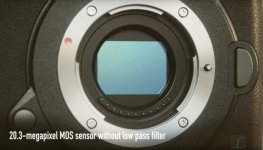
Hmmm... that chip is way larger than MFT??? Edit: Nevermind, the product photos at B&H show a normal-sized MFT sensor that fits inside the mount circle.
gh5-sensor-702x401.jpg
Also, from the DPReview preview:
However, don't go assuming that '6K Photo' mode is taking images from an area of the sensor 6000 pixels across: it isn't. Instead it's capturing images with the roughly the same number of pixels as a very widescreen 6000 x 3000 video clip would have. It's not the most misleading marketing statement we've ever seen, but be aware that 6K may not mean quite what you might expect.
What does that even mean? Marketing is going to have quite a bit of explaining to do.
 
Last edited:
This slide from Panasonic seems to indicate that 6K Photo mode means 4992 x 3744 resolution (4:3 aspect ratio) or 5184 x 3456 resolution (3:2 aspect ratio):
http://www.newsshooter.com/wp-content/uploads/2017/01/gh5-22-6k-photo.jpg

Although in a note at the bottom, they repeat the "approx. 6000 x 3000 effective pixel count" nonsense, despite the fact that the sensor itself has less than 6000 pixels horizontally and they have seemingly given the actual pixel counts elsewhere on the same page.
 
Yeah, dave, I still don't understand what they mean by 6k photo. Like I said earlier, the marketing department has a lot of explaining to do for why they are calling approximately 5k "6k photo" (quotes indeed - they need a few asterisks as well). Why couldn't they have just said "hey, it's 5k photo and it's amaaazing, so much better than 4k photo!" (and they would be right)?
 
Well, from the numbers Dave posted, it's either 17.7 MPX or 18.6 vs. 6000x3000 /18MPX. To me, it's kind of a tomayto-tomahto kind of a thing. It is made for the anamorphic photo and video. Horseshoe. Close enough.
 
Who cares? Its a higher resolution than 4k is all you really need to know. Are we really going to get hung up on the semantics of what 6k should mean in terms of numbers? It's a mode unique to Panasonic and the GH5 and they could call it Fred if they wanted to. Yes its a bit of a fudge of the numbers but it's really just a name and thats all. 5184 pixels wide would be about 5.2k so calling it 5k would not be accurate either. Really it doesn't matter, it is what it is and we have a very high resolution video mode on the GH5 while many other cameras are still struggling to manage 4k.
 
Are we really going to get hung up on the semantics of what 6k should mean in terms of numbers?

Yes! I don't know about you, but I would prefer 6 to mean 6, and K to mean kilo.

6K is a lie. The sensor is 5,184 pixels across, which is 64 pixels more than 5K (5,120 pixels, if you insist on it being a multiple of 2 like 2K [2,048] and 4K [4,096]).

From some article I read, they are calling it 6K because of the extra vertical pixels in 4:3 mode. That is, 16:9 6K would have been 6,144 x 3,456 = 21.23 megapixels. Panasonic's 5K in 4:3 mode is 5,184 x 3,888 = 20.15 megapixels --- still less! But some marketing bimbo looked at that and saw a chance for some extreme marketing limbo.

The problem is that the whole K thing comes from the world of 35mm movie film and often was 4:3. In the case of anamorphic it was 4:3 as you know physically (even though later it was stretched to 2.39:1 --- non-square pixels, anyone?). In the case of "scope" or "flat 35" it was still probably scanned at 4:3, because the whole Academy frame was exposed and simply cropped by a plate in the film projector. (The cool thing about flat 35 was that for television you could simply not crop it. That is, 4:3 television actually showed more, not less, of the original negative. I know one film they did this for was Air Force One. They made sure to frame for theaters and for television while shooting.)

Anyway, if you're asking me whether 5K is enough, I say of course! Anything beyond 2K is invisible to most people in most situations. I would have much rather had a 2K camera for $2K. With bigger photosites it could have added global shutter while preserving dynamic range and low light. However, if you're gonna say 6K, I think it should mean 6K. If you're gonna call it Fred Resolution, and the industry has not yet adopted a definition for Fred, then that's fine, as far as it goes. But 6 should mean 6, and K should mean K. This will just lead to endless confusion.
 
Last edited:
Yes! I don't know about you, but I would prefer 6 to mean 6, and K to mean kilo.

6K is a lie. The sensor is 5,184 pixels across, which is 64 pixels more than 5K (5,120 pixels, if you insist on it being a multiple of 2 like 2K [2,048] and 4K [4,096]).

From some article I read, they are calling it 6K because of the extra vertical pixels in 4:3 mode. That is, 16:9 6K would have been 6,144 x 3,456 = 21.23 megapixels. Panasonic's 5K in 4:3 mode is 5,184 x 3,888 = 20.15 megapixels --- still less! But some marketing bimbo looked at that and saw a chance for some extreme marketing limbo.

The problem is that the whole K thing comes from the world of 35mm movie film and often was 4:3. In the case of anamorphic it was 4:3 as you know physically (even though later it was stretched to 2.39:1 --- non-square pixels, anyone?). In the case of "scope" or "flat 35" it was still probably scanned at 4:3, because the whole Academy frame was exposed and simply cropped by a plate in the film projector. (The cool thing about flat 35 was that for television you could simply not crop it. That is, 4:3 television actually showed more, not less, of the original negative. I know one film they did this for was Air Force One. They made sure to frame for theaters and for television while shooting.)

Anyway, if you're asking me whether 5K is enough, I say of course! Anything beyond 2K is invisible to most people in most situations. I would have much rather had a 2K camera for $2K. With bigger photosites it could have added global shutter while preserving dynamic range and low light. However, if you're gonna say 6K, I think it should mean 6K. If you're gonna call it Fred Resolution, and the industry has not yet adopted a definition for Fred, then that's fine, as far as it goes. But 6 should mean 6, and K should mean K. This will just lead to endless confusion.

My point is why does it matter what it is called or what it actually is. Marketing spin or not it really doesn't matter what it is unless it falls short of some sort of spec. If there was a 6k standard and Panasonic said yeah hey we have that 6k standard and then it wasn't then there would be a problem. Where the GH5 stands right now however is the 6k feature is just a made up Panasonic feature. I agree they should have named it something else but honestly it really isn't worth expelling any energy to worry about. It is what it is.

Why get so upset over it just because of a name? It isn't going to affect your life in any way.
 
I don't think anyone is upset, at least I'm not. I think it looks like a wonderful camera and the ""6K photo""***2+ looks like a wonderful feature, and I will likely get one when I can afford it, but the name they gave this feature seems like a marketing exaggeration that just feels a bit, umm, I don't know, unbecoming of Panasonic and some of us expected better from them (not better as in better feature, but better behavior). I don't think it would have hurt their sales in the least to call this "5K Photo", and give themselves room to grow in the next generation.

Following combatentropy's calculations above, even if we went with the "multiples of 960" to mean K, as seems to have become popular in the marketing of UHD cameras in the last few years, this still falls short of "6K", which would be 5760. Calling UHD 4K was already a stretch but it was close enough so most people gave it a pass, but this feels like a slippery slope now as the exaggeration gets bigger and bigger. What will be next? Anything greater than 5,000 is 6K (seems like this is already the phase we're at)? Anything anywhere close to 5,000 is 6K? Heck, might as well call our 4.6K camera 6K. Just wait for the random small Chinese camera manufacturers to get a hold of this idea and see how far they can push it.
 
Yes! I don't know about you, but I would prefer 6 to mean 6, and K to mean kilo.

6K is a lie. The sensor is 5,184 pixels across, which is 64 pixels more than 5K (5,120 pixels, if you insist on it being a multiple of 2 like 2K [2,048] and 4K [4,096]).

Funny that you seem to have to issue with 4K meaning 4096 :-)
 
Keep in mind at one point we called 1440x1080 HD in the case of HDV and HDCAM. DVCPROHD was only 1280x1080 and was a broadcast shooting HD standard. 1280x720 was and still is a form of HD. These are just names. DCI is a strict cinema standard and that has to be 2048 for 2k and 4096 for 4k but everything else is really just a name.

I do agree its stupid to call it 6k but we also don't have all the facts yet. The Panasonic data sheet PDF clearly says 6000x3000 pixels in the frame. I'm not sure where and how they are getting that but lets wait and see what the 6k photo mode actually does. There are no published specs yet of what resolution the 6k mode actually is. Maybe they are doing a form of up sampling. I watched a video yesterday where a guy from Panasonic Japan showed how they are processing each pixel on the GH5 with 9 surrounding pixels on the sensor. Maybe they can leverage that as a form of pixel shift to bump the resolution a bit.
 
Back
Top