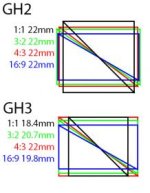
GH3 GH3 GH2 multi-aspect ratio sensor explanation

atarijedi

Well-known member
Greetings folks,

I had asked around here for an explanation about all the hub-bub relating to the GH3 not having a multi-aspect ratio sensor, even though it listed as having multiple aspect ratios. I got a few explanations, but none of them were any good. So I did some digging around the interwebs and I finally get it now, and I made a diagram! Unless I am wrong, then ignore everything!

First a simple explanation. It is as simple as this, a multi-aspect ratio sensor can give you multiple aspect ratios while keeping the same effective sensor size. This is the key part which seemed to elude people when trying to explain it to me. Sensor sizes are measured diagonally. The GH2, when choosing an aspect ratio, will always keep an effective sensor size of ~22mm, whereas with the GH3, only the 4:3 aspect ratio is ~22mm.

Here is a diagram I whipped up. As you can see, the effective size of the sensor for the GH3 is variable, but still quite acceptable. Hope this helps!

rchr7.png

​
 

Attachments

  • rchr7.jpg
    rchr7.jpg
    13.6 KB · Views: 0
This site has a good explanation as well:
http://m43photo.blogspot.com/

The multi aspect sensor feature means that the sensor is over-sized. At any one time, the whole sensor area is never used. But various parts of the sensor area can be used, to enable 4:3, 3:2 and 16:9 aspect ratios, while retaining the same diagonal field of view. This uses the lens imaging circle more efficiently, especially in video mode.
 
@ErikTande Exactly.

@atarijedi

Now this next part is based on the above estimated data.

GH2 sensor in 4:3 = 17.3x13
GH3 sensor in 4:3 = 17.3x13

GH2 sensor in 16x9 = 18.8x10.6
GH3 sensor in 16x9 = 17.3x9.7

So the crop factor with the lenses you use will be different in video mode now.
 
You're right, all my numbers match Bjorn Utpott's, but my diagram doesn't seem to line up, and I didn't save the psd. Oh well. I blame my slow computer...
 
GH2 doesn't keep the same angle of view with 1:1 crop is the only mistake.

Kind of sucks that your lose some of your wide end on your lens if you are used to the GH2, but that also presented some problems since certain lens would vignette more heavily on the GH2. Kind of disappointing they didn't keep the design.
 
Eh, I understand why some people are worrying about this because I too felt that little pang of anxiety when I heard this, but I've since chilled out. What percentage loss is that going to be in diagonal frame size? Let's see, based on Per's estimations of the 16x9 dimensions above:

GH2 16:9 diagonal: 21.58
GH3 16:9 diagonal: 19.83

A loss of 1.75mm, or ~8.1% diagonal frame size. I think it will be barely noticeable in practice, and easily adjusted for in most cases. There may be some advantages too, like bradleyg5 mentioned, of reducing vignetting and unsharp corners on certain lenses.

If someone can come up with the 16:9 dimensions of a full-frame sensor, we can come up with the exact crop factor for the GH3 (depending on accuracy of estimations and calculations so far). I couldn't find those numbers on a quick search.
 
I did some more digging and found the diagonal dimensions, thanks for Abel Cine's field of view comparator:

5D (most similar to full frame "135" 35mm still photography film: 41.3mm (crop factor: 1x)
Super 35 motion picture film: 28.5mm (crop factor: 1.45x)
7D and D3100: 26.8mm (crop factor 1.54x)
GH2: 21.58 (crop factor 1.91x)
AF100: 20.1mm (crop factor 2.05x)
GH3: 19.83 (crop factor 2.08x)

My numbers are a little off from what I traditionally have heard (i.e. 1.5x for Super 35, 1.6x for APS-C, 1.86x for GH2), but that could be due to rounding errors somewhere. The point though is that all the m4/3 cameras are right around the neighborhood of 2x crop factor, give or take a few hundreths.
 
@Shenan Looks right.

According to that, the difference between the GH2 and GH3 is 0.17x crop factor. That's just about a 12mm difference at the telephoto end of my 24-70mm and a 4mm difference at the wide end.
 
Basically I think the difference is that "you will notice it but it won't ruin your day". I am much more concerned about aliasing and moire than the loss of the multi-aspect ratio sensor.
 
Facinating to see basic camera discussions unfold. Old School here. Life begins with an image circle and a sensor dimension. I'd think everyone knew that but not everyone goes to 'photo school'.
Camera companies' marketing people ought to be shot for failing to properly educate their customers, but I've seen this before in other domains.
The Bjorn Utpott diagram tells the whole story in a single snapshot.

One observation of mine if I may....
While it is a fact that the angle of view is the same in all ratios except 1:1, the perceptual visualizer in me wishes to remind that perceived angle is different from absolute angle of view with respect to the optics on the sensor. In other words, the 16:9 crop will appear comparably WIDER and camera reoriented for a vertical, TALLER than 3:2 and that, wider and taller than 4:3.
The significance of this is tremendous when one is seeking to convey expansiveness or 'height' (in the case of stills.)
I simply never bother with anything other than 16:9, unless I'm shooting for a square layout.
 
Last edited:
Yes, it is about 16 percent less surface area. You have 199.28 surface area compared to 167.81, estimated, of course. But since the sensors are of a different design, it is hard to compare them. For example, m43 is smaller than APSC, but it still has good IQ. What's important is the IQ, and we shall see.
 
7D and D3100: 26.8mm (crop factor 1.54x)

This is incorrect. Nikon and Canon have slightly different APS-C's. Worse, they've given you Canon's diagonal but Nikon's typical FLM. Even worse, they've cited a Nikon with somewhat a-typical FLM. I applaud Abel for building a great app but do not trust the numbers they've fed it (although I feel the problem is precision rather than accuracy [ie rounding errors]).

D7000 - 23.6 x 15.6 (28.29 diagonal, 1.529x FLM)
D3100 - 23.1 x 15.4 (27.76 diagonal, 1.56x FLM)
7D - 22.9 x 14.9 (26.82 diagonal, 1.61x FLM)
 
Last edited:
For example, m43 is smaller than APSC, but it still has good IQ. What's important is the IQ, and we shall see.

m4/3 is mildly smaller than APS-C and generally has mildly lower IQ. I think there's definitely at least a loose size/IQ correlation.

However, your broader point ("just because it's a little smaller doesn't mean it sucks") is absolutely true.
 
m4/3 is mildly smaller than APS-C and generally has mildly lower IQ. I think there's definitely at least a loose size/IQ correlation.

However, your broader point ("just because it's a little smaller doesn't mean it sucks") is absolutely true.


??

Show me an aps-c camera with nicer Video quality than a GH2.......
 
m4/3 is mildly smaller than APS-C and generally has mildly lower IQ. I think there's definitely at least a loose size/IQ correlation.

For stills... Yes in most cases.
Not for video.
The small GH2 hacked or not has better IQ than most full frame and APS dslr's.

There is so much more than size when IQ is viewed.
 
Back
Top