
Navigation
Install the app
How to install the app on iOS
Follow along with the video below to see how to install our site as a web app on your home screen.
Note: This feature may not be available in some browsers.
More options
You are using an out of date browser. It may not display this or other websites correctly.
You should upgrade or use an alternative browser.
You should upgrade or use an alternative browser.
GH2 GH2 Power - specs, tests, DIY
- Thread starter keylight
- Start date
8.4 is borderline in my opinion. If voltage drops to 8.37V you will get the mesages that the battery cannot be used on the camera. Anything from 9v to 10v is better and will last longer. I connected 8 NiMH cells in series that produces 10.6V without load. It drops to 10.1 when connected to GH2 with 100-300 lens attached. It drops to 9.7 for a few seconds after firing the built-in flash. I use the following voltmeter with that battery pack:Hey, guys! I'm new here on the forum, and I just got a brand new GH2. I'm thinking that for the type of shooting I will be doing, powering off of Tamiya connector R/C batteries would be ideal from a size and weight standpoint. (also, I already have a charger.) What is the recommended setup for this? 8.4v battery, DCC8? What about adding something like this to make battery level monitoring possible?
http://www.alphasportrc.com/index.php?main_page=product_info&cPath=2_27&products_id=1468&language=en
http://cgi.ebay.com/4-5V-30V-Blue-S...914?pt=LH_DefaultDomain_0&hash=item27ba712d6a
Good luck.
The output of the power adapter for GH1 is stated as 9.3V. I have no doubts that the power circuitry in GH2 is the same as in GH1.good to know. I thought 10v was pushing it, no?
It does not make sense to make it different. Normally such circuits are designed to at least 5% (but usually 10) + or - tolerances.
The fact that at 8.37V the camera refuses to work clearly proves that 8.4V is not the nominal value despite the fact that Panasonic's own adapter produces the output close to it.
Assuming 5% tolerances at 9.3V nominal voltage gives us 9.765 safe upper limit. With 10% tolerance we get a value of 10.23V.
With this in mind I will continue to use my 8-cell battery pack. For the faint of heart I would say "stay below 10V if possible:.
Good luck.
I use an 8.4v like you see in the very first post. Timed out at 8 hours.
What was the capacity of the battery? I don't think you have told us. Is it 4500 mAh, similar to the one used in the video you linked to?
Roberto Hapsad
Active member
Messing with this expensive camera is too risky unless you have a wrecked GH2 to experiment with! When you see a battery with four terminals you can expect smart (logical) circuitry to be involved, not just charging circuitry, volts, and amp hours. Maybe some Panasonic tech will tell us how this works - but powering this camera involves more than basic electronics. I haven't read all the posts in this thread but I haven't even seen any reference to VA - possibly required by the camera during special functions or at startup. If someone does manage to solder something together that works I'm scared it might be something pretty brutal - only appearing to work because it has somehow bypassed the camera's sophisticated protective circuitry routines! I'd say the best power solution will indeed come to us via China. Until then, let's all take beautiful pictures and not look this gift horse in the mouth.

g.l
Well-known member
but powering this camera involves more than basic electronics.
No it doesn't, plenty of people are running this stuff, some for a long time. The extra pins on official batteries are only there to authenticate the battery is genuine, an attempt by Panny to lock our 3rd party batteries.
Roberto Hapsad
Active member
Hi g.I,The extra pins on official batteries are only there to authenticate the battery is genuine, an attempt by Panny to lock our 3rd party batteries.
Where did you source the information about the extra pins?
Last edited:
g.l
Well-known member
Hi g.I,
Where did you source the information about the extra pins?
Well known fact, bourne out by many experiments and those of us using our DIY DCC8 adapters with only two pins. I think 3rd party battery sellers have now cracked the protection scheme.
EDIT: from a quick (non-comprehensive) Google, it seems the pins may also be used to report the battery level, as 3rd party batteries apparently don't. Doesn't affect powering though.
EDIT2: reading a bit more, those 3rd party batts just pretend to be DC (that's why no battery level is shown), so they probably just output more voltage on the 2 power pins.
Last edited:
The extra pins on official batteries are only there to authenticate the battery is genuine, an attempt by Panny to lock our 3rd party batteries.
That's absolutely untrue.
The extra pins are serial communication for SBS battery status alerts and for the thermistor (tracks cell temperatures for safety and proper charging). 3rd party batteries do not handshake with the camera body nor provide GasGauge functionality. That's why you don't get the battery life indicator on screen, because the battery life info is coming from the authentic battery, not the camera. The charger is not a smart charger as per SBS specifications. It's just a columb counting circuit that watches charge rates and temperature over time. that's why it will charge a dumb battery like the 3rd party batteries.
3rd party batteries offer nothing more than a DC source and rudimentary safety features(over/under voltage and temperature cutoffs). That's it. Because of this, I'd expect their functional lifetimes to be lower than an authentic battery due to rather poor (dis)charge cycle regulation.
Now for some interesting information:
A lot of the 2nd and 3rd level Smart Battery charging ICs use the presence of the thermistor to sense if there is a battery installed. It would be interesting if someone would measure power consumption with and without 10k ohms between the T pin and ground to simulate battery presence to see if the camera changes power conservation modes or not.
Last edited:
Why not open up a panasonic battery, take out the cells, and hook a larger battery into the circuit where the original cells were? Would this not provide the correct functions on the "extra" pins (whatever their function is)? Use an SMPS to tune the larger battery to what the original internal cells output. An expensive adaptor (cost of original battery plus a cable, SMPS, and whatever lipos/nimh/etc. you were using), but it would be "doing right" by the camera, no?

keylight
Veteran
Why not open up a panasonic battery, take out the cells, and hook a larger battery into the circuit where the original cells were? Would this not provide the correct functions on the "extra" pins (whatever their function is)? Use an SMPS to tune the larger battery to what the original internal cells output. An expensive adaptor (cost of original battery plus a cable, SMPS, and whatever lipos/nimh/etc. you were using), but it would be "doing right" by the camera, no?
Since Panasonic batteries are so hard to come by, I think it's a tough thing to sacrifice a functioning battery for this. I'm also not sure how one would hook up a larger battery (with 2 leads) to the four pins on the case, or how you would then go about safely charging the battery.
I have yet to see a photo of the pins on a DCC8, but I seem to recall reading somewhere (on this site?) that there were only 2 pins on the adapter. If anyone has a DCC8 and can take a photo the pins (and as a bonus, would be willing to crack it open and take a photo of the internal wiring) I think we might be able to answer some of the remaining questions.
What I don't get, is why some of those big ebay vendors don't make and sell their own version of the DCC8 - other than legal issues of course (not that this stops them from making batteries).

adolgin
DVXuser Sponsor
Hmm, the problem of using large capacity external batteries (DV batteries, 12-14V, etc.) is already solved, we are shipping the Power Plate which can be ordered in different flavors depending on what kind of a DC power source you want to use. Getting a hold of a DCC8 adapter off course is still a problem at this poing :-(
keylight
Veteran
What was the capacity of the battery? I don't think you have told us. Is it 4500 mAh, similar to the one used in the video you linked to?
The battery is 4500 mAh. I'm updating the first post with this info too. Can't believe I forgot to include that bit of info!
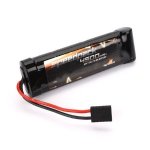
http://www.amazon.com/Speedpack-450...e=UTF8&s=toys-and-games&qid=1306180452&sr=1-2
Last edited:
Why not open up a panasonic battery, take out the cells, and hook a larger battery into the circuit where the original cells were? Would this not provide the correct functions on the "extra" pins (whatever their function is)? Use an SMPS to tune the larger battery to what the original internal cells output. An expensive adaptor (cost of original battery plus a cable, SMPS, and whatever lipos/nimh/etc. you were using), but it would be "doing right" by the camera, no?
You could take out the old cells and replace them with higher amp capacity cells but you have many limitations that are based on the controller IC's design. Many watchdog/GasGauge ICs are designed for specific numbers of cells, either 1, 2 or 3 cells(mostly 1 or 2 cells for these small packs). Some will allow you to parallel up cells but you still have to conform to the max/min charge/discharge currents and voltages. If it's a panasonic IC, we may not have the ability to get those details since they commonly design ICs for their own use and do not publish specs at all.
Also, LI-ion charge controllers monitor each cell group for load. that means if your battery contains 2 cells, it monitors both cells. If you try to hook up an external LI-ion pack to the charge IC in the panasonic controller IC, it will not work.
Last edited:
keylight
Veteran
Hmm, the problem of using large capacity external batteries (DV batteries, 12-14V, etc.) is already solved, we are shipping the Power Plate which can be ordered in different flavors depending on what kind of a DC power source you want to use. Getting a hold of a DCC8 adapter off course is still a problem at this poing :-(
I really like your solution, and if I had a ton of peripherals to use with my camera I'd consider getting it. But for the camera alone, it's just too pricey. That's not meant to knock your product or pricing model. Your gear is in a fairly specialized market which translates to higher production costs....
But there's nothing quite like putting a $10, 1 hour, DIY adapter into the camera and slipping 8 hours of power into my pocket.
g.l
Well-known member
Very useful info Svart.
I'd already updated my post before your reply (after a bit of Googling).
Anyway, my point was that the additional pins are not required to simply power the body, as Roberto claimed.
That's absolutely untrue.
I'd already updated my post before your reply (after a bit of Googling).
Good to know. The GH2 body of course doesn't charge batteries, but thermal monitoring (if used by the body) is of course a good idea.The extra pins are serial communication for SBS battery status alerts and for the thermistor (tracks cell temperatures for safety and proper charging).
Are you sure that's true of the GH2 specifically? It already does voltage monitoring to implement it's software-enforced 8.4V PSU cutoff point, so it may well monitor the battery V directly. And of course it wouldn't do this (or display it) if it thinks a PSU is connected.3rd party batteries do not handshake with the camera body nor provide GasGauge functionality. That's why you don't get the battery life indicator on screen, because the battery life info is coming from the authentic battery, not the camera.
Anyway, my point was that the additional pins are not required to simply power the body, as Roberto claimed.
adolgin
DVXuser Sponsor
Fair enough  It all depends on what gets you excited. The only thing I wanted to mention for everyone's benefit, is unless you have solid electronic background, and direct experience working with Li-Ion cells, batteries, and chargers, do not risk your camera by experimenting with the components and cells. It is just very easy for the things to go wrong in an instant. I do not mean to come across in the negative way or to talk down. If somebody has a specific question, please send a PM, I will try to answer. One general comment: Panasonic obviously designed the camera in such a way to prevent a common 8.4V DC power source from powering the camera externally. There is no way a 2 cell Li-Ion battery can deliver more than 8.4V DC power due do its electro chemical properties (Panasonic engineers know this too well). While many here experiment with the Ni-Mh RC batteries, unless you know what a freshly charged voltage is, you are risking the camera by potentially stressing its electronics with too high voltage.
g.l
Well-known member
While many here experiment with the Ni-Mh RC batteries, unless you know what a freshly charged voltage is, you are risking the camera by potentially stressing its electronics with too high voltage.
I totally agree. We need to know what regulator is used so we can find out the safe upper voltage. Check out the circuit board Svart, can you spot the part? I tried but the scans aren't high-res enough.
EDIT: Few more pictures here.