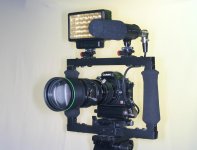
Fujinon 12X video lens mod to Panasonic GH-1

Winston Vargas

Well-known member
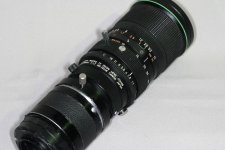
I just finished modifying one of my Canon 12x 2/3 inch video lens (10-120mm F/1.7 ) to use it on my GH1. I removed the zoom motor handle and modified a Leica to GH-1 lens adapter,by cutting it and using the camera mount part, which I attached to a Nikon 2X tele converter on the other end of the converter is a 2/3 inch lens mount which I salvaged from one of my old cameras.

The surgery, which included cutting , drilling, measuring and some headaches along the line lasted a few days, but finally finished it and the results are great. No vignetting along the full focal length, full frame coverage and I am able to focus at a 120mm and pull back to 10mm and maintain focus.

The lens is a bit heavy and I don't recommend using it without a lens support I have it mounted on my bracket but will attach rails to it.
 

Attachments
  • IMG_0713.jpg
    IMG_0713.jpg
    159.6 KB · Views: 0
  • IMG_0679.jpg
    IMG_0679.jpg
    119.7 KB · Views: 0
Last edited:
Wow! If only Panasonic would release a native m43rds lens with those specs, I would snap it up in an instant.
 
Winston, so the Nikon 2X tele converter 20-240mm lens is that correct, does the addition of the converter change the value of the aperture (f1.7) ?how about the image quality?thanks
 
It doesn't appear to change the image quality. There is a 2x light loss which is 1 stop due to the tele extender. Both the lens and the converter are high quality glass. The reason for the tele-extender is to cover the full frame, without it, it covers just the center of the frame.
 
Wrong! a 2x extender is one stop. So it's a constant F/2.8

A 1.4x extender costs you one stop, a 2x extender costs you two stops.
Plus, your math is wrong. f/1.7 x 1.4 (one stop) = f/2.38, not f/2.8.

In this case, it's f/1.7 x 2 = f/3.4.
Or: f/1.7 x 1.4 x 1.4 = f/3.332 (but you usually round 1.4 x 1.4 = 1.96 to 2, which would give you f/3.4)

Don't blame me, I don't make the rules.
 
Last edited:
I have the 35-100mm and, although large and heavy, it is a fantastic lens. If only it were parfocal!

password = constant2

 
A 1.4x extender costs you one stop, a 2x extender costs you two stops.
Plus, your math is wrong. f/1.7 x 1.4 (one stop) = f/2.38, not f/2.8.

In this case, it's f/1.7 x 2 = f/3.4.
Or: f/1.7 x 1.4 x 1.4 = f/3.332 (but you usually round 1.4 x 1.4 = 1.96 to 2, which would give you f/3.4)

Don't blame me, I don't make the rules.
I guess you're right. I am glad that I am a photographer and not a mathematician because when my exposure is between, lets say 8 and 5.6 I don't really care if it's 5.3 or F/5.2 as far as I concerned its between 8 and 5.6. If film had zero latitude I would be concerned, but it does, and so does the electronics. I am from the old school, which is when filming make sure you have lights. I have yet to see the first film shot in the dark.

More is made of how fast the lenses are and how much light loss one has, however everyone is looking for ND filters to cut back 2 -3 or 4 stops when filming outdoors in order to get shallow DOF. I am glad I studied film and not mathematics in college. So with my light loss I will use less ND filtration and still have the DOF that I need. However I do acknowledge that your calculations are correct.
 
Hey, I'm a photographer, not a mathematician. This is simple math here, just because you don't care if it's f5.3 or f5.2 is fine, but it's not making me nit-picky. With this focal range, there is a massive difference between 1 stop and 2 stops in terms of how worthwhile a lens like this would be. A constant f/2.38 20-240 lens would be extraordinarily worthwhile, whereas a lens like this at f/3.4, while still reasonably fast, is less so because of very inexpensive lenses available at all of those focal lengths at the same speed or faster.

Now, if a 1.4x nikon extender would also fill the entire m4/3 sensor in video mode with this lens, yielding a 14-168 f/2.38 constant lens with good optical quality, then that would be something else entirely, but at f/3.4 it's just less interesting, although still a cool setup, for sure.
 
I have the 35-100mm and, although large and heavy, it is a fantastic lens. If only it were parfocal!

password = constant2


I am very curious about the 14-35mm f/2 - and if its anywhere near as nice as what you have just shown with the 35-100, well that will be one heck of a lens. I think I may just have to go ahead and rent one!
 
I guess you're right. I am glad that I am a photographer and not a mathematician because when my exposure is between, lets say 8 and 5.6 I don't really care if it's 5.3 or F/5.2 as far as I concerned its between 8 and 5.6. .

Actually you get a zoom with f1.7 @ T3.8. The depth of field calculated for a f1.7 lens but with lower light transmission of 2 stops. Kind of a ND6 filter.

Do you have any issues with CA? This lens is designed for three chip cameras.
I have a similar beast (for a 2/3") camera, wraped in plastic, in a box, in the garage. Looks promissing.
I see no difference in operation or quality. I used this lens on a Panasonic 900 DVCpro camera. This is considered an industrial lens. I also have a broadcast lens on that camera which I attached to the GH-1 but it's ridiculous because it's about 14 inches long with an 86mm front element and a 2x extender. It worked but why bother.
 
Back
Top