Fuji X-T3 released

Post a ProRes screenshot and if it has the same artifacts it's also macroblocking related to compression (ProRes is basically Apple's MJPEG: it can macroblock too). HLG, film simulation (noise) all show it's compression related to limited code values (lack of variance/noise). Try getting F-log noisy- NR off, and add noise manually via higher ISO. It will reduce this 'magenta banding' issue. Sky naturally has magenta (R+B); your complaint sounds like it's the banding (quantization) vs. the magenta color.

Yeah I know what you are saying but it only happens with F-log and not related to compression. ProRes HQ is visually lossless so the artifacts come from the source signal, before being encoded.

It's all 10bit recording, and the magenta banding shows up in all ISO values. I believe F-log mode might involve a different demosaic algorithm that introduced magenta banding before being compressed in HEVC or 10bit 422 YUV signal.

There have been complaints regarding this strange magenta artifacts since X-T2. Fujifilm might be looking into this but no idea if there's gonna be a fix.
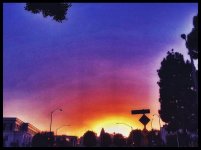
 
Yeah I know what you are saying but it only happens with F-log and not related to compression. ProRes HQ is visually lossless so the artifacts come from the source signal, before being encoded.

It's all 10bit recording, and the magenta banding shows up in all ISO values. I believe F-log mode might involve a different demosaic algorithm that introduced magenta banding before being compressed in HEVC or 10bit 422 YUV signal.

There have been complaints regarding this strange magenta artifacts since X-T2. Fujifilm might be looking into this but no idea if there's gonna be a fix.

OK a bug/design-issue is always possible, however the sky does naturally have magenta in it (from my iPhone-X- natural colors brought out (not painted etc.)):
MagentaSky.jpg

If you can record in F-log with added noise (NR off, higher ISO), it could help with banding (but not the magenta color itself). Your example isn't 'bad' IMO if it's a bug.
 
Last edited:
Exposure is an important one. From my tests the other day, the camera appears to be 2/3rds of a stop slower than Fuji rate it (when shooting FLOG at least)

You can probably put this down to the fact that not all manufactures use the same ISO standards. Fuji ISO calibration is based on Standard Output Sensitivity (SOS), objectively the more accurate. Cameras from Canon, Nikon and Sony use a more liberal ISO standard named Recommended Exposure Index (REI). These two measures are the Saturation-based and Standard Output Sensitivity standards. CIPA, the technical association of the Japanese camera industry in 2006 introduced two new measures of the sensitivity of a digital camera, recommended for use instead of the ISO speed rating. They are standard output sensitivity (SOS) and recommended exposure index (REI). These new measures are also covered, as alternatives to ISO speed, by the 2006 version of the ISO standard itself. Standard output sensitivity (SOS) is an objective measure defined in essentially the same fashion as ISO speed (for one of the two bases of ISO speed), but which normally will have a value about 0.71 of the ISO speed. Recommended exposure index (REI) is the value the camera manufacturer recommends be used as the exposure index setting. It is not specified to be determined in any specific objective way, but may be chosen empirically to give what the manufacturer feels will be the best exposure results for most users in most cases.

A good technical explanation here:

http://www.imatest.com/docs/sensitivity_ei/

and a simpler to understand version here:

http://www.openphotographyforums.com/forums/showthread.php?t=18387

Chris Young
 
Is the banding/F-log possibly a handling/developing issue with the X-Trans sensor (as opposed to a standard CMOS Bayer sensor)? Many still photo RAW developers have problems with the X-Trans sensor of Fuji APS-C cameras.
 
Is the banding/F-log possibly a handling/developing issue with the X-Trans sensor (as opposed to a standard CMOS Bayer sensor)? Many still photo RAW developers have problems with the X-Trans sensor of Fuji APS-C cameras.

Nope, the magenta banding only happens in F-log and is completely absent in all other picture profiles (film sim, HLG)
 
Various banding has been happening in LOGs in different cameras for quite some time. I first remember seeing it in the 1DC. Back then, it was advised not to exceed a certain ISO. Not sure if that practice applies to the X-T3.

http://philipbloom.net/blog/canon-1dc-mjpeg-compression/

https://www.thehurlblog.com/cinematography-camera-tests-outside-the-studio/

Today, the 5D Mark IV's manual mentions using a higher ISO than 400 may produce artifacts (I'm paraphrasing).

Yeah but what's strange about Fuji F-log is:

1. The banding is always tinted magenta.

2. It happens in 10bit AND ProRes HQ recording!
 
One thing I have learned over the years (as I'm sure you and many others have as well) is all cameras have super weird quirks for reasons all of us (or most of us) truly don't know.

Making a camera is already difficult enough, but providing a perfect picture at all settings in all environments sometimes seems like it's near impossible.

We always hear of ARRIs being the gold standard (and they very well may be), but some people share having issues with them too (not here as DVXuser isn't really an ARRI forum).

Given all the crazy color issues I've seen (and had to fix in post) from various cameras over the years, in 2019 the quality of the latest cameras is impressive (1DX II, A7x III, X-T3, GH5x etc.). For higher end team production (with at least an AC), ARRI is still king, for smaller productions, these comparatively light & tiny cameras are pretty amazing!
 
Given all the crazy color issues I've seen (and had to fix in post) from various cameras over the years, in 2019 the quality of the latest cameras is impressive (1DX II, A7x III, X-T3, GH5x etc.)

So which camera would you personally choose to match the color of the other three? The Canon?

You have 4 color sciences in there, haha.

Z6/Z7 should have a spot.
 
So which camera would you personally choose to match the color of the other three? The Canon?

You have 4 color sciences in there, haha.

Z6/Z7 should have a spot.

Yeah the Nikon's are looking pretty good too lately (only listed brands I've personally used). I need to test the X-T3 for stills quality to choose which color science to use as the reference (vs. Canon (Nikon has always been great for stills too- kind of the budget Canon)). Canon / Nikon / Fuji could all be a reasonable choice for color reference (raw stills). Canon's default color for video (DSLRs and the Cx00 cameras) can all be significantly improved with custom picture styles. Still waiting for the A7S III spec announcements- Sony could really rock the market if they give the A7S III VENICE (or better) color and 10-bit to match the little Fuji.

Even without a 'top camera' color reference, all of these cameras can produce acceptable color now, when using the right settings and with good light (e.g. high CRI/TLCI lights) and light set up.

Mixed lighting will still be challenging, where ARRI-like cameras do better, with good content/story no one will ever notice (except perhaps the kind of people reading this thread ;) ).
 
Last edited:
You once said you don't like RED colors but the 8K Helium is looking beautiful.

NOT SAFE FOR WORK:

https://www.youtube.com/watch?v=gl1aHhXnN1k

Yeah, still something a bit off there, similar to Panasonic- kindof orange-y skin, plus in that video they did some kind of NR/smoothing on the skin, looks very android-ish (kinda sparking Uncanny Valley).

I used to think this was pretty excellent for skin tones:

Sure it's better than Red. Watching the Alexa video again now generates a "kinda desaturated" response.

This still holds up pushing the limits of usable saturation and maximum possible 4K detail:
 
ARRI can look very orange. The teal and orange look was perfected on their cameras!

The studio skin tone test is just neutral as it should be (it's very nice).

As far as the Sony...beyond boring. Looks like it could have been shot with an a7III. Probably one of the worst examples of an expensive camera I've ever seen. The X-T3 videos in this thread look better!

(P.S. AG's video was shot in 8K in anamorphic with '74 Hawks. Quite the recipe that probably contributed to the "skin smoothing".)

Lol the Sony video was noted for saturation and detail (without aliasing!); music and (lack of) story are a separate topic.

Here's a better example for skin tones / color and perhaps more entertaining:


Red is fine for what it is; I'd pick an ARRI or VENICE at that price point.
 
Lol the Sony video was noted for saturation and detail (without aliasing!); music and (lack of) story are a separate topic.

Here's a better example for skin tones / color and perhaps more entertaining:


Red is fine for what it is; I'd pick an ARRI or VENICE at that price point.

For client work as a DP, I'd pick whatever suits the production style, the director's vision and whatever I knew I could make sing, working with a great colorist. I'd also be heavily influenced by input from my 1st and 2nd AC, which camera in which configuration would streamline their jobs to help me make beautiful images. I agree with what was said earlier about working with a camera like the Amira. There are a lot of users who don't have much experience in medium to high end production where crews don't want to be on the bleeding edge all of the time, they want to use tools that let them get the work done with a minimum of compromises. While I know the XT-3 is capable as a high end cinema camera, like in the rig that Grug showed off, I also know that the camera op and ACs would gnash their teeth having to work with the compromises to workflow of a mirrorless prosumer camera. I'm not the biggest fan of RED cameras, I think they are very capable, can definitely make beautiful images. But they are kind of quirky, finicky and make you jump through a lot of hoops to get them to do things that are commonplace in normal TV and feature production at times. For traditional higher end production, Arri and perhaps lately, the Venice, seem like pretty desirable choices.

OTOH, making a documentary, I would be a camera slut if the manufacturer gave us the camera to own or loaned it to us for the duration of shooting. Documentaries are too hard to finance, having camera bodies and lenses provided means I can actually pay crew, shoot more, have a sound mixer or a gaffer on crew, perhaps a few PAs to help, always a nice bonus on a lot of documentaries ;-) Cameras now are good enough where I could make excellent looking images with almost anything out there. On DVX User, there is often too much technical nit picking sometimes about hairs on the flea, dancing on the head of pin. Stuff gets obsessed about here that really nobody will ever notice or be capable of seeing. I will probably be finishing the last two thirds of our distilled spirits documentary on the XT-3, it's so good for the money and size and the images look great and we will be traveling on planes quite a bit where not hauling a C200 or Amira is a huge asset. Sure it may exhibit some Magenta fringing under certain circumstances, but that doesn't stop it from looking amazing on the 99.8% of shots we need to capture.
 
Dan kinda hit it on the head there. Pretty much all cameras are capable of good images today, whether in-camera or post. It’s just the journey with it. Or how comfortable is the journey with it to get there.
 
Just updating this thread so it doesn't drop down the list too far or worse yet, off the front page.

Doing a big shoot on our documentary tomorrow with the XT-3. Will be following one of our main subjects all morning, tracking her and her mom going to breakfast, then for her second to last chemo appointment (She was diagnosed with Stage 2 Triple Negative Breast Cancer in October). Will be flying the XT-3 on the Zhiyun Crane 2, I think I am going to use the 18-55 f/2.8-4/0 OIS as there will be a lot of walking and following and I still think the OIS gives me better results than the 16mm f/1.4 without OIS on the gimbal. I love the 16mm f/1.4, it's beautiful but I am coming to the realization that for the gimbal and lots of walking, I may need to buy the 10-24mm f/4.0 OIS. The 16mm is so killer in low/no light but the results I am getting are just not as smooth with OIS. The 18-55 works well on the gimbal but at 18mm, it's a little tighter than I like, especially when we are in cramped spaces. I thought about adding the Glider Pro 3 4th axis setup to the Crane 2 but I am trying to avoid doing so as it just makes the whole thing big and bulky and holding the 4th Axis arms, you lose use of the joystick on the Crane 2 so no tilting. I have the Canon 10-18mm f/4.5-5.6 which I can use with the Fringer adapter but this lens is just not a very sharp lens compared to the Fuji glass. I find on the gimbal, on a S35 imager, I really like 12-14mm FOV. Not too wide but wide enough where you get a lot of the environment around talent.

The Tentacle Sync Es I ordered are not arriving until tomorrow while we are shooting so we'll be putting a Tascam DR-10L on each talent and just letting them go. Not ideal but we don't have a sound mixer and I can't mount two wireless receivers to the Crane 2 very well. My producing partner will be using my iPhone 8 Plus on the Crane M as second camera, but if I had the Tentacles, I would have him doing sound, running around with the Mix Pre 3 and two wireless and possibly a boom although we have to keep this shoot very low key as we will follow them into a restaurant and then into the Chemo office so we can really have a boom in either situation. Story of this documentary, how do we get good sound when shooting in places where you really can't have a sound mixer?
 
Last edited:
The 10-24mm f/4.0 OIS is a sharp lens.

Great glass.

I will be sending my XT-3 in for service to replace the HDMI port.

My fault for not having a cable lock for it.
 
Did anyone find a solution to the banding issue in skies with this cam ? Will running external in 10bit 422 help ?
 
Back
Top