Focal Reducers - Squeeze all your FOV and Light on your GH1 Sensor

Focal Reducer Test

Focal Reducer Test

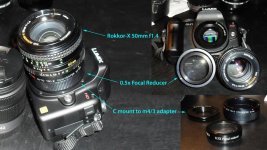
So, I finally got my focal reducer: Antares 0.5x 2"

The lens of the reducer is about 40mm wide, to not be the limit for the nearly 30mm wide back lens of the Rokkor.

- GH13 ;-)
- Antares 0.5x 2" focal reducer
- Minolta MD Rokkor-X 50mm f1:1.4
- (cheap) C-mount to m4/3 adapter
- metall housing (was 2x Tele Converter)

Setup.jpg

Left part shows the final setup (the Lumix lens is only holding all in place - while taking the actual pictures everthing was hold in place by sticky tape).


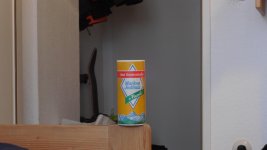
First, two pictures without the focal reducer, only the Rokkor with a proper MD/MC to m4/3 adapter - sorry for the boring subject ;-)

EDIT: The images I can post here are very small - not enough to see much difference. How can I post bigger images?

Rokkor @ f1.4, 1/80s:
50mmF14s.jpg

Rokkor @ high f-stop, 1.3s:
50mmFhighs.jpg

Now with the reducer - all pictures taken in automatic exposure mode.

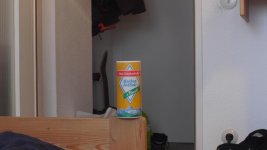
Rokkor @ f1.4, 1/100 WITH focal reducer:
50mmF14_w_Reducers.jpg

Rokkor @ medium f-stop, 1/25 WITH focal reducer:
50mmFmid_w_Reducers.jpg

Rokkor @ high f-stop, 1.3s WITH focal reducer:
50mmFhigh_w_Reducers.jpg

I can't remember the exact f-stop (medium/high), but it was just enough to take a picture with no extra light.


Results with focal reducer:

1) the FOV gets wider by about 20%
2) the image gets brighter by about 25%
3) the image quality is reduced with low f-stops

The good news:

It works - sort of...


The bad news:

The FOV is only about 20% wider than before - not enough to count for the reduced image quality. It is possible to get a sharp image, when stoping down, but the gain in brightness doesn't compensate for that.

With the aperture wide open, the image gehts sharp but everthing gets a bright white aura.

Any ideas to improve the picture quality with low f-stops? Otherwise I will drop the idea and by a Lumix 20mm Pancake :(
 
Last edited:
Apologies for being AWOL.

Psyco, that was a fascinating experiment! Your experience with F1.4 lenses matches my own.

Here is what I realized... There is more than one possible configuration with these reducers. The setup can be done in two ways:
1) Bring the reducer closest to the sensor. Then, adjust distance to the lens accordingly for focus.
2) Bring the reducer closest to the lens. Then, adjust the distance to sensor accordingly for focus.

#1 yields better quality/contrast at the expense of FOV (less wide, less coma).
#2 yields bigger FOV at the expense of contrast (more wide, more coma).

At the heart of all this is the reducer's diameter. Psyco, you are correct to say that (in theory) wider reducers yield better images because you get more of the center portion of the image. By better, I mean less vignetting and less distortion, but not necessarily sharper.

I bought the Antares 1.25" 0.5x focal reducer and struggled a bit more to get the same FOV (field of view) as with my Vixen C-mount 0.6x (I succeeded using configuration #2). I later learned from browsing an astronomy forum that the Antares reducer is not a true 0.5x, but more like 0.6x, so it makes sense that it matched the Vixen. By the way, the Antares was not even close to being as sharp as the Vixen. With Vixen, I didn't feel that I lost any sharpness, just a little contrast. With the Antares, I had okay contrast but less sharpness. The "glow" that you are referring to is called "saggital coma flare", or simply "coma", and it is annoying. It is present to some degree in ALL fast lenses, except for one: The Noct NIKKOR 58mm f1.2 lens.

http://imaging.nikon.com/products/imaging/technology/nikkor/n16_e.htm

That's a little bit of history for you. Nikon designed that lens specifically to battle coma. VERY expensive lens. In fact, it's legendary!

So, we have 2 problems:
1) How can we increase FOV to get true "full frame" focal length?
2) How do we get rid of the glow?

Here are some possible solutions:
1) The light travels through a focal reducer in shape of a cone. The larger the reducer's diameter, the less focal reduction we'll receive on our m4/3 sensors. We need a WIDE focal reducer, with FASTER speed. I got very close with my Vixen 1.25" reducer (almost APS-H coverage but not full frame). You chose a 2" reducer and got even less coverage than I did! That means that we need something like a 2" 0.3x focal reducer to get full frame! Both Optec and Meade make 0.33x reducers for SCT Schmidt–Cassegrain telescopes (SCT). The Meade is *much* cheaper option though. The problem with those SCT reducers is that they are optically resigned to provide a flatter field, correcting distortion on the telescopes that they were designed for. I cannot find an uncorrected reducer with that speed.
2) Larger reducers generate less coma. There is always least coma in the center, and the most on the edges or in the periphery of the focal field. Just as I said in #1, we need a larger reducer. Another solution is to attach a coma corrector like this one: http://www.optcorp.com/product.aspx?pid=10026

I'm actually planning on trying both (as soon as I find a suitable reducer for #1)!

Finally, one last note. I mentioned before that fast lenses will not be any faster. Olympus made 4/3 lenses with focal reducers, but they were always choked at F2. That seems to be the limit with focal reducers. An f4 lens becomes f2, but f1.4 stays f1.4 (with decreased quality). I just want a 50/1.4 to be a 50/1.4, with the same FOV, same speed, and same quality. Is it possible? Who knows! But I also wouldn't mind having a cheap way to make any zoom lens f2! You win some, you lose some. At least we'll know what's possible :)
 
Last edited:
Hi hopeless_4_ever,

thanks for all this information. Interesting stuff about this "coma".

You are right, a 2" 0.3 (or even 0.25?) focal reducer would be a good point for further testing. Where did you find one?

What kind of distortion correction does this 0.3 reducers do? Will it really distort our images that much - or is it to minor to see with the naked eye?

The coma corrector is no option, as we don't have enough space for another piece of glass between the lens and the sensor.

Finally, one last note. I mentioned before that fast lenses will not be any faster. Olympus made 4/3 lenses with focal reducers, but they were always choked at F2. That seems to be the limit with focal reducers. An f4 lens becomes f2, but f1.4 stays f1.4 (with decreased quality).
I thinks thats not correct. Maybe Olympus limited there lenses at f2 to preserve image quality. My own test showed an increase in light with the reducer even at f1.4. It was what I expected it to be, when getting a 20% wider FOV. But to get this, you need a focal reducer big enough to catch all the light from the lens and the rear glass element of a f1.4 lens is huge!

It is interesting what you mention about Olypmus. So it looks like its possible to design focal reducers exactly for what we have in mind. Good news!
My dream would still be an anamorphic focal reducer (squeeze factor 1.5x) - that would be a must have tool ;-)

Hmmm, why has no company developed some kind of adapter with a focal reducer in it? They would make a lot of money with the success of the GH1, GH2 and AG-AF100 and all this 35mm glass out there.

So, the next part of the test program would be to find a focal reducer with stronger light bending (0.3 or 0.25) and try if we still be able to focus.
After that, we are back at the problem ob coma... (what does a coma corrector do?).

Cheers
 
Decided to try an experiment. Took out the rear lens group of a broken Tokina FD zoom lens and stuck it backwards in a FED INDUSTAR-61 55mm F2.8. The idea was to use the backwards lens group as a focal reducer. Changing the FED to a wider lens and giving me a faster f stop.

It works but the IQ derogation is extreme. Still a lot of fun to use.
 
Last edited:
I like this topic and come back from time to time to see if there is any progress. Is there anything new? or does anyone else have any experiments pending?
 
Back
Top