walkaboutcamera
Active member
...
Last edited:

Follow along with the video below to see how to install our site as a web app on your home screen.
Note: This feature may not be available in some browsers.
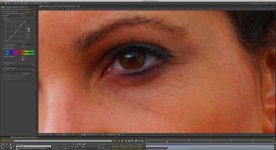
I just checked the Shogun clip released from back then, and the magenta blocking is present and accounted for:

Since we know this was Shogun footage, and since my own PIX-E5 testing shows the same macroblocking in 10 bit 4:2:2, I have to conclude that the artifacts are embedded in the signal no matter which option you choose to record it with.
Both recorders appear to be faithfully recording the image presented to them through the 10 bit 4:2:2 HDMI output.
Which means my earlier post holds regarding my theory that the image is being degraded before we have a chance to record it.
Cheers,
Paul

Either other testers are somehow making mistakes with their external recorders, or the beta testers flat out didn't have this issue.
Which means Panasonic can fix this.
Wondering if the V-LOG L in DVX200 will have the same issues.

Interesting! I just tried that same clip in After Effects CC 2015 and you are right - no blocking to speak of.@ visceralpsyche are you sure your editing app is set to 16bit? I don't get those macroblocking artefacts when pushing the Driftwood footage in AE.
Added: V-Log to Rec 709 Lut, S-curve and boostet colors +50
View attachment 105286


Interesting! I just tried that same clip in After Effects CC 2015 and you are right - no blocking to speak of.
All my research so far has been using Adobe Premiere CC 2015. So now my next question is, where do I find out or change what bit depth Premiere is working at?
The plot thickens....
Thanks for that pointer anti12. Always happy to be proven wrong and learn
Cheers,
Paul
As you suspect, the image below shows magenta/green color casts and blotchy gradients due to inadequate bit depth. It does not show evidence of macroblock artifacts. The output of the GH4's internal 8-bit H.264 encoder is used only to produce video files; it is not decoded and routed to the HDMI output during scene capture. The 10-bit 4:2:2 HDMI output is not processed with any type of H.264 encoding that would produce macroblock artifacts; it is converted directly from the camera's high-precision tone curve processing into uncompressed HDMI format.It seems to me that the video encoder is not processing the image with a high enough bit depth before sending it for internal or external processing. I say this because in my 10 bit 4:2:2 testing yesterday, I still noticed the macroblocking. Given that I was supposedly using the uncompressed, 10 bit 4:2:2 output, and recording in ProRes, I shouldn't be seeing such processing artifacts.
Thanks for the additional infoAs you suspect, the image below shows magenta/green color casts and blotchy gradients due to inadequate bit depth. It does not show evidence of macroblock artifacts. The output of the GH4's internal 8-bit H.264 encoder is used only to produce video files; it is not decoded and routed to the HDMI output. The 10-bit 4:2:2 HDMI output is not processed with any type of H.264 encoding that would produce macroblock artifacts; it is converted directly from the camera's high-precision tone curve processing into uncompressed HDMI format.
Are you sure Premiere isn't transcoding?Thanks for the additional info
Currently my investigation is leading me in a new direction - as you can see on page 7, if I load the 10 bit 4:2:2 footage into Speedgrade or After Effects, the macroblocking disappears entirely. So it appears that the problem lies with Adobe Premiere CC 2015 in not processing the ProRes files correctly.
In fact, with Speedgrade and the Varicam LUT, it looks like it should. Sure, the bit depth is still reduced thanks to bad mapping of the bit data to the full 0-100 IRE output of the HDMI stream, resulting in only using 10-80 IRE, but the 10 bit 4:2:2 image holds up pretty well within that limitation, IF I don't use Premiere Pro to look at it or process it.
So I'm keen to hear from anyone who may know how to fix this within Premiere. I've tried Sequence Settings and switching to Maximum Bit Depth etc, but the problem is still there.
anti12 suggested it's a fundamental problem with Premiere CC, and I'm inclined to believe him based on what I'm seeing. The question is - can it be fixed?
Yep, I'm seeing that too.Even worse news - during a shoot today I decided to see just how deep the magenta blocking issue goes, and used focus assist on a wall, punched in 6x. ON THE LCD, BEFORE ANY KIND OF RECORDING, I can see the macro-blocking.
Fortunately I've found some FilmConvert settings that seem to reduce it (it involves film grain and the GH4 CineLike D Low Contrast profile with no prior LUT applied), but that's not going to work for everyone. I'm always going for a "film" kind of vibe and enjoy FilmConvert's grain... but this has pretty much reduced V-LOG L to when I'm looking for that feel. Most of the time I'm going to stick with Portrait I think.
Yep, I'm seeing that too.
What's interesting is that processing 10 bit 4:2:2 footage recording from the HDMI out in Speedgrade doesn't show any macroblocking.
So I wonder whether the camera's display code is doing something similar to the way Premiere is decoding ProRes, that's introducing macroblocking into the image stream?
This is certainly becoming quite the investigation!!
Here's a couple of samples from my GH4 screen. Apologies for the quality, but it's really hard to get focus on the screen without the moire from the LCD pixels!Okay, hold on -- Paul tested and declared that there was blocking in everything. Then, when pointed out that his software was to blame, he then showed that yes indeed the software was the problem and there was no blocking to be seen. Am I understanding this correctly? Is this entirely a case of operator error, and the footage is not to blame at all? If so, we should really go delete all those posts, because it's scaring people for no valid reason.
Second, Brandon says that there's blocking in the LCD. I don't have a GH4 and cannot test that. I just pointed the DVX200 at a wall and door similar to what was shown earlier. I used the Odyssey 7Q+ (in both 8-bit 4:2:2 and 10-bit 4:2:2) to check. There was zero evidence of any magenta or green blocking, at all. I varied the exposure up and down the scale, I swapped between 8-bit and 10-bit, and I magnified the display to 2x, then 4x, then 12x. No evidence of it at all on the live feed. I then recorded (internal), played it back out to the Odyssey, and checked at 2x and 12x magnification. No evidence of any blocking.
Paul, can you please verify whether you have an issue or not, by using the original footage in Speedgrade or something else?