
Navigation
Install the app
How to install the app on iOS
Follow along with the video below to see how to install our site as a web app on your home screen.
Note: This feature may not be available in some browsers.
More options
You are using an out of date browser. It may not display this or other websites correctly.
You should upgrade or use an alternative browser.
You should upgrade or use an alternative browser.
Experiments in SLog
- Thread starter paulcurtis
- Start date
Here's a quote from Art Adam's presentation on the FS700 dynamic range "I count 14 stops from clip to the last visible step. Those last few stops are most likely not usable and shouldn't be counted on." (Emphasis mine).
To be honest, I'm not sure Paul is saying anything different, except that he's only counting the usable stops. So the camera has a maximum range of 14 stops, but those last 2 1/2 are so noisy they're not usable (because it is hard to differentiate true detail from noise).
Given that Art's presentation is pre-slog2 I'd be very surprised if slog did increase the DR of the camera, as that would mean it would be able to resolve more than 14 stops (which is a little pie in the sky for a 6k camera, don't you think.)
So, given that DR is the same, the difference between Slog2 and the previous cinegammas seems to be purely on how it records that range: shadow detail is pulled and highlight detail is less compressed. So it handles overexposure a lot better, at the cost of creating extremely noisy and compressed mids and shadow details.
Which probably explains why, in my experience, slog2 footage looks a lot better over exposed by 2 stops then pulled back, than it does exposed 'correctly', as those noisy mids are pushed back into the shadows where they belong.
Practically speaking, you seem to get better highlight handling, compared to the cinegammas, but at the expense of noisy mids and the need to apply a LUT.
if you have a look at this image stolen from Arri it might make more sense what's happening:
View attachment 76912
The the slog gamma (ISO 2000) and Cinegamma 1 (ISO 500) record the same range, but the former is biased towards highlight derail and the latter is more balanced.
Colin Elves,
DP, London
www.colinelves.com
I have to say, SLOG2 really does have more dynamic range, it's night and day, not just like a slightly different cinegamma. If we've got a 14 stop image in there (which I think we have) , cinnegamma4 truncates both ends and leaves you with a 11.5-12 stop useable image, SLOG2 opens it up and leaves you with a 13.5 stop useable image (at a guess). Even the noise is reduced and the noise structure itself is better (i have no idea why) in SLOG2 and this is at ISO2000, compared to cinegamma4 at ISO640. It's easy to throw numbers around and not really get anywhere but take a look at this real world direct comparison test I did at around 18 seconds when I switch from protecting the highs in cinegamma4, to protecting the highs in SLOG2, there's less noise and much more detail in the lows: https://vimeo.com/69415608 If you tried to push up the cinegamma4 shot to look like the SLOG2 shot it would look awful, just black very noisy sludge in the shadows, no detail hiding in there.
paulcurtis
Veteran
Art Adams measured 14 stops (of that usable 12) and Paul measured 12 stops ( of that usable 10). And Paul is using Slog while Art was using a cinegamma. What's going on here? I'm finding it hard to belive that the FS 700 has 14 stops especialy because it's 12bit.
I'm not saying that just 10 is usable, i'm saying 11 to 11.5 but you ought to decide for yourself based on the image and waveform i posted, it's up to you where you want to say you no longer see differences in the shadow wedges. I've certainly not seen 14 stops though. I altered the images on the blog to hopefully make that clearer too.
cheers
Paul
paulcurtis
Veteran
I have to say, SLOG2 really does have more dynamic range, it's night and day, not just like a slightly different cinegamma. If we've got a 14 stop image in there (which I think we have) , cinnegamma4 truncates both ends and leaves you with a 11.5-12 stop useable image, SLOG2 opens it up and leaves you with a 13.5 stop useable image (at a guess). Even the noise is reduced and the noise structure itself is better (i have no idea why) in SLOG2 and this is at ISO2000, compared to cinegamma4 at ISO640. It's easy to throw numbers around and not really get anywhere but take a look at this real world direct comparison test I did at around 18 seconds when I switch from protecting the highs in cinegamma4, to protecting the highs in SLOG2, there's less noise and much more detail in the lows: https://vimeo.com/69415608 If you tried to push up the cinegamma4 shot to look like the SLOG2 shot it would look awful, just black very noisy sludge in the shadows, no detail hiding in there.
Personally i really don't think there's 14 stops to start with i can't see any evidence of that in anything or any tests i've shot.
The test i did was as simple as switching from one profile to another and adjusting the clip point. Both running at their base ISO in the same conditions. The fixed exposure tests at the end are simply changing the gamma curve everything else identical.
The curves produced are the ones i posted. I'd love to see other people trying the same thing. Maybe the wedge is wrong (unlikely), maybe i balls'd up the post workflow (pretty sure i didn't) or maybe my camera is duff (the amount of times it's been into Sony and i'm pretty sure they've scrutinised the output now, so probably not). I'm going to be speaking to an engineer next week so i will pose the ADC question see whether i can get a definitive answer.
In your example which was really useful when you did it, did you measure what the exposure range was from outside to inside, what kind of range was there that you were testing? I'm under the impression (and that's always a dangerous place for me to be) that an overcast day to indoors is no more than 10 stops of range. Direct sunlight and speculars is where you start getting out of the bounds of our cameras. Can anyone confirm or deny that? If your range was 10 stops then you're well within the really good part of Slog and not digging into the blacks so much.
I'd agree with Colin as well.
Both cinegamma and Slog will be sourcing the same data and just putting a different curve on it, why on earth would Sony do anything else and then not give us 10bit! I don't understand the motivation for Sony to give us a much better range in Slog (which from their own interviews is for monitoring RAW) but in 8bit.
But i would say you get more workable ranges in SLog and i think it's great in some situations. I've used it and have been very happy with the results.
cheers
Paul
Colinelves
Well-known member
I have to say, SLOG2 really does have more dynamic range, it's night and day, not just like a slightly different cinegamma. If we've got a 14 stop image in there (which I think we have) , cinnegamma4 truncates both ends and leaves you with a 11.5-12 stop useable image, SLOG2 opens it up and leaves you with a 13.5 stop useable image (at a guess). .
Your test images are ungraded - you'll realise the difference once you put them into resolve or something and grade the Slog to fit within a rec709 range (or after applying the LUT). A lot of that mid and shadow detail is both very noisy and heavily compressed in slog2. If you like the 'log look' sure, it's great - but if you want the more contrasty look of normal film and TV you'll see the problems. Of course it very much depends upon how much noise you can accept in your mids as to whether or not you call it 'useable'. I think cine gamma 4 deliberately crushes the shadow stops to hide some of the noise - and in doing so it loses some of the highlight headroom.
All of my comments relate to my experience of using Slog2 in the real world, not charts.
Colinelves
Well-known member
Art Adams measured 14 stops (of that usable 12) and Paul measured 12 stops ( of that usable 10). And Paul is using Slog while Art was using a cinegamma. What's going on here? I'm finding it hard to belive that the FS 700 has 14 stops especialy because it's 12bit.
Sanjin, I'm not sure why you think the number of bits in the recording system is at all relevant to the DR of the camera. You can record 14 discrete stops in 4bits, hell you can record 16 stops as 2x2x2x2 = 16 discreet values - it's just that your images will look like a screen print poster as there will be no gradation in tones between stops.

cuervo
Veteran
I have to say, SLOG2 really does have more dynamic range, it's night and day, not just like a slightly different cinegamma. If we've got a 14 stop image in there (which I think we have) , cinnegamma4 truncates both ends and leaves you with a 11.5-12 stop useable image, SLOG2 opens it up and leaves you with a 13.5 stop useable image (at a guess). Even the noise is reduced and the noise structure itself is better (i have no idea why) in SLOG2 and this is at ISO2000, compared to cinegamma4 at ISO640. It's easy to throw numbers around and not really get anywhere but take a look at this real world direct comparison test I did at around 18 seconds when I switch from protecting the highs in cinegamma4, to protecting the highs in SLOG2, there's less noise and much more detail in the lows: https://vimeo.com/69415608 If you tried to push up the cinegamma4 shot to look like the SLOG2 shot it would look awful, just black very noisy sludge in the shadows, no detail hiding in there.
hmmmm....empirical evidence vs. controlled measurement....well, in the end, it's the observing viewer that counts. I guess, for the more scientific method inclined, I believe the measured data over the empirical evidence.
SergeSmArt
Well-known member
...I don't know much about "How many stops" is it.. but it is have "more dynamic range".. and this is important ... If I've got it right, your video-test is NOT in RAW.. only in 1080p, right ? :huh: ... and for me it's seems like we talking here about TWO different "S-log-2" - One is "8bit 1080p S-Log-2" and another one is "12 bit RAW S-Log-2" (in 16-bit F55 container) which is REALLY different things, don't you think so?I have to say, SLOG2 really does have more dynamic range, it's night and day, not just like a slightly different cine-gamma. If we've got a 14 stop image in there (which I think we have).... https://vimeo.com/69415608

After I shoot some stuff in RAW and see how this:

...turn into this:

...and this file in split in Sony RAW Viewer:

... I DO NOT CARE about "How many stops do we have in it" !!! I just see: IT IS MORE THAN ENOUGH!!! :2vrolijk_08: ....
..and even in 1080p.. we still may have better result than in any other Picture Profile...
Yesterday I shoot something on Broadway.... (NOT in RAW, but just in 1080p ... and now, I make very short "draft" of a few frames from it :
You can see in each frame, first part as is, in S-Log-2 and second part with some simple adjustment in Sony Vegas .. ( NOT in something as Resolve )
( ..and I would like to know - what plugin we can use to REDUCE light FLICKERING in it ?? )
I'm assuming Sanjin is referring to 12 bits in the A-D convertor, where I would expect a more direct relationship. A linear one, where doubling the input light means a doubling of the binary value - or in other words an extra most significant bit.Sanjin, I'm not sure why you think the number of bits in the recording system is at all relevant to the DR of the camera. You can record 14 discrete stops in 4bits, hell you can record 16 stops as 2x2x2x2 = 16 discreet values - it's just that your images will look like a screen print poster as there will be no gradation in tones between stops.
After processing, what you say is quite true.

KINOKS
Well-known member
I'm assuming Sanjin is referring to 12 bits in the A-D convertor, where I would expect a more direct relationship. A linear one, where doubling the input light means a doubling of the binary value - or in other words an extra most significant bit.
After processing, what you say is quite true.
Exactly. A/D converter is linear, so that means that 12 stops of light equals 2 to the power of 12 ie. 12 bits. Correct me if I'm wrong, if A/D isn't linear or something...
After processing, what you say is quite true.
Yep, after processing it's like Colin described.
Last edited:
KINOKS
Well-known member
I'm not saying that just 10 is usable, i'm saying 11 to 11.5 but you ought to decide for yourself based on the image and waveform i posted, it's up to you where you want to say you no longer see differences in the shadow wedges. I've certainly not seen 14 stops though. I altered the images on the blog to hopefully make that clearer too.
cheers
Paul
I'm not saying that you're saying only 10 stops (lol). I'm saying that you said 10 stops of usable range. Read my posts again
I agree on the 11 - 11.5 stops absolute and I agree on 10 stops usable. But this is still a far cry from the 14 stops that Art Adams measured.SergeSmArt
Well-known member
ahhhh....more empirical evidence...gotta love it...LOL
No one PAY me for "10 or 14 stops of DR" ... Clients DO NOT CARE about it ... they pay me for "more empirical evidence" :2vrolijk_08:
I'm not saying that you're saying only 10 stops (lol). I'm saying that you said 10 stops of usable range. Read my posts again
Hey Kinoks,
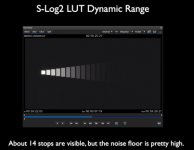
Look at Art's chart on FS700 S-Log. There is definitely 14 bars (even the very faint beginning of a 15th bar). Art says NOT all 14 are useable, but he does say in the article: "In LOG mode (referring to S-Log 2) we are cramming about 13 STOPS into it." So I am interpreting Art as saying 14 stops total, 13 useable.
http://www.dvinfo.net/article/acquisition/sonyxdcam/fs700-the-4k-story-from-my-perspective.html/4
Based on my own "Emperical" eyes as I've pixel peeped S-Log to death by now, I'm going to side with Art and Toby Loc and saying S-Log 2 is 13+ stops of Useable DR. I wouldn't discount what Art is saying because he's a pro DP who has probably done more camera tests than anyone on this forum (except maybe Barry Green). He knows what he is doing for sure as he has done a lot of these tests.
Probably Paul and Art are just going about it different and interpreting it differently. I guess you just have to read both articles and go out and shoot numerous side by sides (as I have done), and make your own conclusions.
cuervo
Veteran
you have a point Sergesmart....but, I don't have a Sony 4k recorder. And neither does anyone else around here. All I see with my 8-bit Slog2 capture is a ton of noise in the lows and mids....and that worries me. Half of my work comes from shooting and handing the footage off to another person to edit. I can, hardly, hand off this Slog2 in native format. It looks horrendous. So, AFAIK, Slog2 is a fancy "anomaly" for me to play with. When I get my Odyssey, maybe I can add some empirical evidence of my own. Until then, Slog 2 is hardly practical for me to use on half my work.
Your test images are ungraded - you'll realise the difference once you put them into resolve or something and grade the Slog to fit within a rec709 range (or after applying the LUT). A lot of that mid and shadow detail is both very noisy and heavily compressed in slog2. If you like the 'log look' sure, it's great - but if you want the more contrasty look of normal film and TV you'll see the problems. Of course it very much depends upon how much noise you can accept in your mids as to whether or not you call it 'useable'. I think cine gamma 4 deliberately crushes the shadow stops to hide some of the noise - and in doing so it loses some of the highlight headroom.
All of my comments relate to my experience of using Slog2 in the real world, not charts.
My test images are both ungraded and graded and labeled as such. My intention was to see if SLOG2 had more dynamic range than cinegamma4, not determine it's dynamic range as a number, I can only infer that. It has clearly, observably, more than both and everyone rates the others as around 11-12 stops so it seems impossible for something to have DR of 12+ to actually be <11. Whether SLOG2 has the right bit depth, look, compression etc for use in a shoot is a separate issue, is much more subjective and is something to be considered before each shoot. I personally don't see it as perfect or to be used in every situation, mostly because of the poor choice of bit depth.
SergeSmArt
Well-known member
For me it's also "not so practical" ..as most of the times clients want to have images to be "READY" ... no one want to deal with "FLAT" stuff and pay for professional grading of it...you have a point Sergesmart....but, I don't have a Sony 4k recorder. .... Until then, Slog 2 is hardly practical for me to use on half my work.
I'd like to compare RAW samples from my FS-700 with RAW files from Sony F55.. because Alister Chapman says "there so little difference between them" ... and I think this difference mostly about different SFA F55 ...
Probably in a week or two I will be able to compare them, :love4: ... as I've got an order for F55 with RAW recorder, Set of 6 Sony Cine Alta lenses, tripods, Sound set, Editing set.. etc... it will be HUGE testing of everything for about a month ..
I'm not really sure what the DR of the scene was, I think it really depends on the window size, the room size, colour of walls, how much light is reflected inside etc etc. Whatever it was it was way beyond the dynamic range of any of the cameras as most of them can't make out any detail in my face or my T-shirt, only slog2 could make out any detail in either. That's all I was trying to find out really, whether it was a DR improvement over Cine4 and I was surprised how much it was.
I too don't know why sony went with 8 bit! I can only think it was to protect the F5 but like with their raw recorder it's like 2 steps forward, 1 step back. just hoping the odyssey can turn it into the monster all rounder that I think it could be.
Cheers for the tests by the way Paul
I too don't know why sony went with 8 bit! I can only think it was to protect the F5 but like with their raw recorder it's like 2 steps forward, 1 step back.
just hoping the odyssey can turn it into the monster all rounder that I think it could be.Cheers for the tests by the way Paul
Slight correction, but I think RAW from the FS-700 will be more like that from the F5 than the F55? (I think that was Alisters original comparison, wasn't it?) I think it's quite likely the FS700 and F5 may share the same sensor, but the F55 is different - extra hardware to give the global shutter capability, and colorimetry more suited to cinema than TV, for starters.I'd like to compare RAW samples from my FS-700 with RAW files from Sony F55.. because Alister Chapman says "there so little difference between them" ... ..