Experiments in SLog

paulcurtis

Veteran
I did say i'd try to compare SLog and the other profiles which i've done. I've written it up in a blog post and i hope it's okay posting that here. We keep meaning to start a blog as i have a whole stack of things i keep notes on and a lot of them might prove useful for others. So we'll be building this up. (This is just as way of saying be gentle we've only just developed the site...!)

http://blog.inventome.com/Blog/2013/9/fs700slog8bit/Sony-FS700-Slog-in-8bit-comparison

For those not interested in reading it all my conclusion is that SLog is very useful, more than i originally though. I can't prove anything but it feels less 'log like' than it should do, which is great for shooting with, even in 8 bit. Also pay attention to the blacks and experiment with Black Gamma - which, unlike most settings, does alter the profile...

hope this is useful to someone

cheers
paul
 
Nice writeup Paul. Essentially, what you're saying is that there's really no increased dynamic range with Slog2. There's only an apparent range increase because the highlights carry more information.
 
Only 10 stops? I saw some posts about 14 stops on the FS700 with the Slog curve:) I always thought that you can't get that much out of the camera. DR is determined by the sensor and if the sensor stays the same you really can't get that much DR... can you?:)
 
Nice writeup Paul. Essentially, what you're saying is that there's really no increased dynamic range with Slog2. There's only an apparent range increase because the highlights carry more information.

Thank you. The sensor hasn't changed so the bottom to the top will be the same. But the compression of that (via curves) might make accessing the top and bottom difficult, so slog can add more detail, giving more 'useable' range. But the dynamic range of the sensor would be the same.

Really the lowest signal depends on how noisy you want. What may change is that a 4K RAW signal, denoised and scaled to 2K might offer better definition in the shadows compared to a 1080 out, so again you're squeezing more range out of the sensor by lowering the noise floor a bit but the sensor is the same

Only 10 stops? I saw some posts about 14 stops on the FS700 with the Slog curve:) I always thought that you can't get that much out of the camera. DR is determined by the sensor and if the sensor stays the same you really can't get that much DR... can you?:)

Well, i'm very conservative - 10 stops plus another 1, maybe 1.5 if you're careful about shadows.

I wouldn't go any further than 11.5 - perhaps RAW will be cleaner and you can see a bit further. But certainly not 14. That F5/F55 territory.

cheers
Paul
 
So I guess the F5 doesn't use the same sensor... Or do you think the signal processing could play such a huge part?
 
So I guess the F5 doesn't use the same sensor... Or do you think the signal processing could play such a huge part?

Consider that the native bit depth of the recorder/processor on the FS700 is 8-bit. This really puts a limit on the "resolving power" of the data stream. The nuances of high lights and shadows just aren't propagated by the 8-bit processor, rather they're truncated. So, it's pretty clear to me that signal processing is a huge part, as is the lens, sensor, and overall signal path. That would account for, at least, 1-1.5 stops in the shadows.
 
I don't know Paul... Not trying to be confrontational, but I think 10 stops is a bit low.

I don't think RAW has anything to with Dynamic Range. Check out TobyLoc's DR comparison between 5DIII RAW and FS700 S-Log 2. FS700 clearly has at the very, very least 1 + Stops over the 5DIII. There is so much more DR on the FS700

https://vimeo.com/69415608

Also, in Art Adams initial presentation on FS700 Cinegammas, he rated it 12 Usable stops.

http://provideocoalition.com/aadams/story/cameras_sony_fs700_dynamic_range_presentation/

Then on Art's follow up on S-Log and 4K on the FS700, he charts on S-Log 2 states: "About 14 stops are visible, but the noise floor is pretty high." Art also mentions that S-Log 2 on the FS700 is "very, very flat." So I would assume it's probably pretty similar to the F3 since he's DP'd with every camera ever made probably.

http://www.dvinfo.net/article/acquisition/sonyxdcam/fs700-the-4k-story-from-my-perspective.html

So if Art rates the old Cinegammas around 12 usable, then S-Log surely has to be a bit higher than 12. To my eye, the highlights on S-Log alone warrant at least 1+ stops. They are so much better than Cine 4 and the shadow detail seems closer to Cine 1.

My big issue with S-Log so far is the color Red. It comes out kind of orange no matter what I try. I probably won't use S-Log until a real job until the 7Q comes out with 10-Bit. But it's fun for camera tests for now.

What I really like about it besides the insane highlights are the skin tones. They look so good with S-Log. None of the yellow-ish highlight that sometimes plagued the Cinegammas.

Once again, please don't take offense as I know you worked hard on the article. Just offering a different perspective.
 
Last edited:
Abelcine posted some scope shots of S-log curves. The sensor probably can capture 14 stops, that is how they are getting the higher ISO's. But S-log emulates film negative by providing very linear extended data in the highlights at the expense of compressing the bottom 4 stops of DR into the 0-10 IRE range to fit within encoded video limits. You aren't going to recover any useful detail below 10 IRE.
 
Last edited:
Consider that the native bit depth of the recorder/processor on the FS700 is 8-bit. This really puts a limit on the "resolving power" of the data stream. The nuances of high lights and shadows just aren't propagated by the 8-bit processor, rather they're truncated. So, it's pretty clear to me that signal processing is a huge part, as is the lens, sensor, and overall signal path. That would account for, at least, 1-1.5 stops in the shadows.

Hm... The recording bit depth really shouldn't limit the DR. It limits what you can do with the footage in post. But you shouldn't loose 2 stops of details worth of light because of it. It's the A/D's bit depth that can limit DR (correct me if I'm wrong) if it's to low. I don't know, this is a bit to technical for me:)

Did Paul do something wrong with he's test? If not, then the camera has 10 stops, which doesn't sound like much for such a camera, I mean even the FS100 has 11.5 stops (although I can count only 10.5 from that video - not 11.5??). http://nofilmschool.com/2011/06/sony-fs100s-dynamic-range/
But the FS100 has bigger pixels, so could it actually have more DR?
 
Last edited:
You may be right, Sanjin. Referring to the tests that Abelcine performed, it's evident to me, that counting f-stops near the bottom of the curve, as it approaches pedestal IRE, becomes increasingly difficult because the slope of the curve is so close to the pedestal. Easy to miss an f-stop. In fact, the curve's slope is so close to flat that, in digital terms, the difference in a half or 1/3rd f-stop can easily be lost in 8-bit truncation.
 
Yeah it is:) It's hard to decide what qualifies as useful data... But yes, I guess you could count 11.5 stops from that chart.
 
I'm more than happy to be corrected, but if you look i show 10 stops of very usable range plus another 1, perhaps 1.5 in the noise. And depending on your situation this may or may not be usable. So i have always maintained now and in previous posts (if you search) around 11 to 11.5 stops of real range. If you look at the diagrams, the images and the curves then make up your own mind. I'm just very aware that in post those bottom end stops are sometimes near unusable.

I may rewrite the word '10 stops' because i think people aren't noticing that i'm not saying 10 stops overall, just where the 10 stops point ends up...

I'd also say that the sensor is not capable of 14 stops. If so, then why would sony be outputting 12 bit linear RAW (linear meaning that stops and bits are distributed equally). I'm sure if the sensor was really doing 14 bit then they'd be outputting 14 bit linear like the F5. (Don't forget that linear output doesn't have a curve, it is just pure linear output)

I tried to say in the text that deciding when you no longer see range is very difficult because it depends how sensitive to noise you are.

I'd say go ahead and try similar tests yourself and lets us see, it's not difficult or expensive to do it.

I'm sticking to the FS700 has 11 to 11.5 stops of range. It certainly doesn't have 14 stops. You know that 11 to 11.5 stops is actually pretty damn good though, more than enough for most people...

cheers
Paul
 
So I guess the F5 doesn't use the same sensor... Or do you think the signal processing could play such a huge part?

I doubt it, i would imagine the 700 was a forerunner of the sensor. Or perhaps they bin the sensors. The same would happen to F3/FS100.

And yes the signal processing probably does play a large part, i would imagine that is one of the greatest differences between the 700 and 5.

cheers
Paul
 
I don't know Paul... Not trying to be confrontational, but I think 10 stops is a bit low.

I don't think RAW has anything to with Dynamic Range. Check out TobyLoc's DR comparison between 5DIII RAW and FS700 S-Log 2. FS700 clearly has at the very, very least 1 + Stops over the 5DIII. There is so much more DR on the FS700

https://vimeo.com/69415608

Also, in Art Adams initial presentation on FS700 Cinegammas, he rated it 12 Usable stops.

http://provideocoalition.com/aadams/story/cameras_sony_fs700_dynamic_range_presentation/

Then on Art's follow up on S-Log and 4K on the FS700, he charts on S-Log 2 states: "About 14 stops are visible, but the noise floor is pretty high." Art also mentions that S-Log 2 on the FS700 is "very, very flat." So I would assume it's probably pretty similar to the F3 since he's DP'd with every camera ever made probably.

http://www.dvinfo.net/article/acquisition/sonyxdcam/fs700-the-4k-story-from-my-perspective.html

So if Art rates the old Cinegammas around 12 usable, then S-Log surely has to be a bit higher than 12. To my eye, the highlights on S-Log alone warrant at least 1+ stops. They are so much better than Cine 4 and the shadow detail seems closer to Cine 1.

My big issue with S-Log so far is the color Red. It comes out kind of orange no matter what I try. I probably won't use S-Log until a real job until the 7Q comes out with 10-Bit. But it's fun for camera tests for now.

What I really like about it besides the insane highlights are the skin tones. They look so good with S-Log. None of the yellow-ish highlight that sometimes plagued the Cinegammas.

Once again, please don't take offense as I know you worked hard on the article. Just offering a different perspective.

Oh no worries, Gene, i'm not taking anything personally :)

Linear RAW and bit depth do have a direct relationship, so the 12 bits of linear RAW are linked to range.

Personally on Art Adams presentation, looking at the wedges, i think 14 stops is a little over eager. 12 i think is possible in some situations. I don't find the Slog that flat personally either but that's personal opinion at the moment.

I think the eye is right, i think it *looks* greater, but empirically i don't think it is. But because of the distribution is gives the feeling of more range, which is great.

And the skin tones do look better, or rather the highlights on skin. I've not had such an issue with red as you but i do know that red is a colour that cmos sensors have huge issues with and a lot of fixing happens. So i guess that SLog and RAW is less 'fixed'. That was one of the nice things about CCD, the reds were perfect...

cheers
paul
 
Most of the time I find myself saying something like "8 bit is good enough" - but here it's the opposite. For "ready to view" video then "8 bit is good enough" is a true enough statement - once you start talking about S-log, and especially RAW, it's a different matter.

My own feeling is that you can only be fully sure of DR *of the sensor* by examining RAW tests, and even then it becomes a case of whether the limiting factor is the actual sensor itself or A-D convertor bit-depth. Once you start to process it to S-log or "ready to view" video, then it's much less easy to be sure. The process must inevitably be condensing the data down in range - but how? It COULD do it uniformly, keep the full DR - but at some point it would have to be adjusted to get an output image suitable for viewing, otherwise it would look very low in contrast. Uniform condensing of the DR would then mean the most useful part of the range being expanded a lot, and consequent increased risk of banding, even with 10 bit, let alone 8.

I'd expect it more likely to compress (or condense) the highlights and lowlights more than the mid ranges to try to lessen that problem. That's also going to give the designer a compromise to make. Do you still keep the full sensor DR, and risk more banding, noise etc problems with the expansion? Or sacrifice a little overall DR for lessening the expansion problems? Personally, I think I'd go for a little of the latter - especially if I knew it was to be recorded in an 8 bit system.....
 
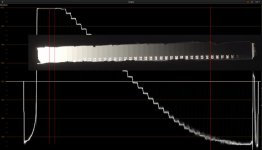
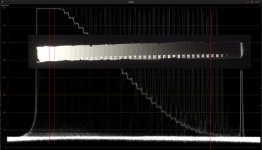
I'm including an image here which is the SLog waveform and step wedge combined. This is standard Slog, no tweaks. Some more experimentation needs to be done using black gamma and SLog because it does affect it (and it shouldn't really). One issue with SLog is that i've not been able to get true blacks, the blackest level seems around 16 (0-255) so no 'superblacks' are being output (superbrights are).

In the example below the file is from an external recorder in ProRes, in Resolve i bring down the highlights which are superbright within the 0-1023 scale, there is no clipping happening.

The waveform gets noisy in the shadows because SLog *is* very noisy down there as we know. I feel that it's a valid test with all that surrounding black.

I'm assuming my transmission wedge is accurate (i have no way to validate this) but they are supposed to be. I'm pretty sure the workflow is valid though.

I'm assuming the waveform is accurate, although i am targeting one of the channels, the one with the greatest range in (red) because the luma is slightly compressed due to a shift in white balance. I've sanity checked the results with actual eyedropper values though, i'm sure i'm not truncating or missing anything.

This first image is for the whole frame, the second image is from a crop with just the wedge (which cleans up the noise, something i just thought of doing - so it's a bit clearer)

wedges.jpg

wedges2.jpg


So if we think it should be greater range then what am i doing wrong?
 
If the FS700 RAW is 12bit then that means it's AD is 12 bit and that consequently means it's maximum theoretical DR is 12 stops.
Paul your tests are great, thx for the effort! In the still where you removed the noise it's clear that there is more latitude in there but is it usable is the question? Probably not. But what it will help with is with the "perceived dynamic range". Which is something nonetheless.
 
If the FS700 RAW is 12bit then that means it's AD is 12 bit and that consequently means it's maximum theoretical DR is 12 stops.
/QUOTE]

I don't think that's right stops are logarithmic and the AD convert will be a linear transform (as is the Raw I believe). The sensor's DR is simply the range between the brightest point it can resolve to the noise floor.
 
I'm not sure I'm techy enough for this conversation! I haven't heard of the raw linear bit rate to dynamic range connection before and it doesn't 'feel' right to me but I'm no expert. What I can say for sure though as I've tested it in real life as gene linked to - is that slog2 has much more useable dynamic range than cinegamma4 and a few places have rated that at 11.5 to 12 stops. In my test I held the highlights and can now see 1-2 more stops into the shadows with lower noise overall too when cinnegamma4 was black sludge, this is also compared with 5d3 raw which is rated at 11.6 stops. I think the conversation here is about useable stops but that will be a little subjective, if FS700 slog2 is really 10 or 11 stops then a canon raw still would be 8-9 stops which I don't think many would agree with.I don't really mind what the camera is rated at but its giving me about 2 more useable stops than canon raw which I find amazing, I would personally rate it at 13.5 stops based on the canon raw figure and how much more useful DR I see on top, but everyone has their own idea of noise floor and useable image! Hope this adds to the conversation, I'm excited about using the odyssey, 4k 10 bit prores should be magic with this image,will give an outstanding 1080p I think.
 
Here's a quote from Art Adam's presentation on the FS700 dynamic range "I count 14 stops from clip to the last visible step. Those last few stops are most likely not usable and shouldn't be counted on." (Emphasis mine).

To be honest, I'm not sure Paul is saying anything different, except that he's only counting the usable stops. So the camera has a maximum range of 14 stops, but those last 2 1/2 are so noisy they're not usable (because it is hard to differentiate true detail from noise).

Given that Art's presentation is pre-slog2 I'd be very surprised if slog did increase the DR of the camera, as that would mean it would be able to resolve more than 14 stops (which is a little pie in the sky for a 6k camera, don't you think.)

So, given that DR is the same, the difference between Slog2 and the previous cinegammas seems to be purely on how it records that range: shadow detail is pulled and highlight detail is less compressed. So it handles overexposure a lot better, at the cost of creating extremely noisy and compressed mids and shadow details.

Which probably explains why, in my experience, slog2 footage looks a lot better over exposed by 2 stops then pulled back, than it does exposed 'correctly', as those noisy mids are pushed back into the shadows where they belong.

Practically speaking, you seem to get better highlight handling, compared to the cinegammas, but at the expense of noisy mids and the need to apply a LUT.

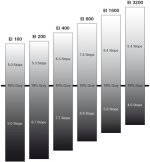
if you have a look at this image stolen from Arri it might make more sense what's happening:
image.jpg

The the slog gamma (ISO 2000) and Cinegamma 1 (ISO 500) record the same range, but the former is biased towards highlight derail and the latter is more balanced.

Colin Elves,
DP, London
www.colinelves.com
 
Back
Top