Don't you hate it when Photographers butt into a video discussion?

M. Gilden

Canon DSLR Moderator
You know what really irks me now that HDSLRs are so acceptable in the industry?

...Photographers.

Now, don't get me wrong, I've met and worked with some really amazing Photogs in my day, but in every crowd there is one elitist jerk who thinks they know DSLRs better than anyone. And now that these cameras have been on Hollywood sets, those guys suddenly think they are experts on video gear, too.

This morning, I got into a particularly annoying conversation with just such a $%#-head. Someone had asked for my advice in gear for his needs- a camera that offered shallow DOF with the ability to work like a camcorder (ie. no recording limits, audio monitoring, etc). I highly recommended the GH3, but this photographer friend of his started arguing about it.

He claimed he had never heard of the Panasonic GHs, they must not be any good ("oh, its a micro 4/3? With that kind of crop you might as well use a traditional camcorder!"), and kept saying he should just get a used 5Dm2 and a sharp prime. Because that's what people do.
This is barely a week after I explained to someone that no, I don't think the 7D is the best camera ever. "But it takes amazing photos AND videos!"
Yes, it takes great photos and workable video clips. I wouldn't go back to using it as a video camera in the year 2013 with so many better options available. But in both cases they insisted I didn't know what I was talking about.

I couldn't NOT make this meme picture after that.
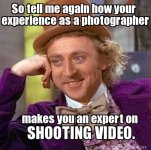
2015239.jpg
 
The meme is very funny, but that $%#-head would probably still be a $%#-head if he wasn't a photog
Many video people would still say Canon DSLRs are the best, simply because they were the best 3 years ago. I've had my share of arguments trying to convince video people that yes, my $400 second-hand NEX-5N takes better video than a 7D. And that includes people in these boards. In the end a deep breath and a visit to this is the right answer 90% of the time.

99% of the photogs I meet end up saying something like "I think my camera shoots video too, but I never tried to do so"
The fact that most of them have never been to a film set and my camera looks completely alien to them with all the accessories probably keeps them from thinking they are video experts

edit: also, there are
$%#-heads around, that's for sure, but you can also find photogs with great knowledge in things like composition and such; it's always nice to gave this kind of people around, to learn from
 
Last edited:
And what about those, who like me can make a good enough video with a DSLR, but can't make good enough photos? LOL
 
I would say photographers and videographers have a lot in common. Skills such as composition, framing, exposure and lighting are universal to both. I will admit that most photographers that I have worked with know little about the technology end of video. I just grin and nod my head when a video gear discussion comes up.
 
Last edited:
i kinda love it when someone asks about my C100, thinking it's a DSLR, and i have just a little bit of satisfaction in telling them it's a VIDEO camera, it doesn't do photos... (yea ok it does, but nobody's every going to call it a photo camera)
 
i kinda love it when someone asks about my C100, thinking it's a DSLR, and i have just a little bit of satisfaction in telling them it's a VIDEO camera, it doesn't do photos... (yea ok it does, but nobody's every going to call it a photo camera)

Had that exact situation the other day.
 
And what about those, who like me can make a good enough video with a DSLR, but can't make good enough photos? LOL

LOL- I've been asked to do photography as well, and I always tell clients that I technically *CAN*, but you're probably going to get better results from someone with more experience with photography. Yes, there is a lot of overlap, but not everything translates. I don't own any external flashes or fast autofocus lenses, for starters. Even if I did, what works in photography sometimes involved concepts that wouldn't have occurred to me because it wouldn't work in video. On the flip side I've seen photographers try to do "video" at a wedding, and take a clip in portrait orientation in 60i. Because they don't know better. :cheesy:

I occasionally do product photography on the side for a client who also uses me for video, and I did a bar mitzvah or two as a favor for friends I went to school with back in the day. Aside from that, I would never claim to be a pro photographer.

I actually ended the conversation mentioned in the OP by sarcastically admitting he must be right, his experience as a photog clearly makes him a more reputable source of video equipment information than those who, you know, actually make their living doing this. Then added I fully expect him to ask me for advice next time he needs to purchase a wireless bounce flash. :2vrolijk_08:

i kinda love it when someone asks about my C100, thinking it's a DSLR, and i have just a little bit of satisfaction in telling them it's a VIDEO camera, it doesn't do photos... (yea ok it does, but nobody's every going to call it a photo camera)

Ha- you know, there are photographers out there shooting with RED cameras. Weird choice, but I guess if it is what you happen to have around, it *could* do the job. I'm convinced that's why Canon DSLRs still find their way onto movie sets. I'm sure the set of the Avengers didn't have a GH2 lying around, but they probably had some photographers with a Canon 5D they could throw into an otter box for those first-person-perspective scenes.
 
It has since been pointed out that memes are supposed to be in all caps.

Oops. Turns out I don't care. :)
 
So I started photography professionally in 1994, and got serious about video five years ago.

There is so much cross over to learn.

I drink up info from video people - especially editors, directors, focus pullers, almost everyone but, least of all cam ops.

A lot of video people, however, do tend to look down on photographers and IMO do this at their peril.

We photographers are the people who have been dealing with narrow DOF and raw for decades and often are a technical step ahead of video people.

Also the industry norm in photos of 'shoot - post - deliver' (as opposed to 'shoot - deliver rushes') give us a step up over most ops on understanding the relationship between exposure choice, space in the grade and the like.

Anyone who does not have full respect for other professionals and their talent base will only be losing out.

S

Thank you.
 
I have a couple of specific 'photographer' points that videographers should listen learn from.. (mainly at a higher level)

1) The relationship between a raw file and the amount of lighting/post time

Raw you can light less, but will have a cost in post. Balancing set/post cost is a critical skill.

2) Focusing manually 4k

You cant do it. Even for a still. AF is the only way to keep it pin at 4k (shooting narrowish DOF)

Both hard learned lessons both with quite significant ramifications, especially the first. But also the second for those investing in cine zooms.

S
 
Last edited:
I have a couple of specific 'photographer' points that videographers should listen learn from.. (mainly at a higher level)

1) The relationship between a raw file and the amount of lighting/post time

Raw you can light less, but will have a cost in post. Balancing set/post cost is a critical skill.

2) Focusing manually 4k

You cant do it. Even for a still. AF is the only way to keep it pin at 4k (shooting narrowish DOF)

Both hard learned lessons both with quite significant ramifications, especially the first. But also the second for those investing in cine zooms.

S

Raw for me is not about being slack with exercising control over what goes in front of the camera. It is about having a much broader creative canvas to work with the image in post. Being able to control at a very fine level how color value and detail are mapped throughout the full DR of your final video "print".

This only works for you if you do take the time with the raw data before transcoding to video. Otherwise you may as well let the camera make the decisions and shoot video.
 
The meme is very funny, but that $%#-head would probably still be a $%#-head if he wasn't a photog
Many video people would still say Canon DSLRs are the best, simply because they were the best 3 years ago. I've had my share of arguments trying to convince video people that yes, my $400 second-hand NEX-5N takes better video than a 7D. [
/QUOTE]

Arguable. I still like the image from the 7D more than the 5n eventhough I constantly see you keep posting the same "nex-5n is better than the 7d"-nonsense all the time.

No wonder you guys have to convince people all the time...because your wrong.
 
It goes both ways, you know. Video people thinking they know EVERYTHING about photography... So funny...

I guess I shouldn't be surprised that it happens both ways- I just haven't seen it personally. I mean, when I was first working with video over 15 ago, I knew very little about SLR cameras. I knew the basics of framing, aperture and exposure, because it was important to understand, but my reference came from old film cameras. As things went digital, I respected that my photography friends had fancy expensive equipment I knew nothing about, and vice versa. It was a sort of mutual respect.

When folks started adopting DSLR bodies for video a few years back, that line blurred. But it would make sense that it blurred more from the direction of photographers- we started treading on their turf, and not vice versa. Why a video person would think they know more than a photographer about still photos is baffling to me. But hey, there are jerks everywhere. :)

maarek said:
The meme is very funny, but that $%#-head would probably still be a $%#-head if he wasn't a photog
Many video people would still say Canon DSLRs are the best, simply because they were the best 3 years ago. I've had my share of arguments trying to convince video people that yes, my $400 second-hand NEX-5N takes better video than a 7D. [
/QUOTE]

Arguable. I still like the image from the 7D more than the 5n eventhough I constantly see you keep posting the same "nex-5n is better than the 7d"-nonsense all the time.

No wonder you guys have to convince people all the time...because your wrong.

Somebody put on their cranky pants this morning!

You're welcome to your opinion, as is everyone else. But understand that Samuel's opinion is highly regarded around this forum- he's actually considered an excellent source of information and backs up his claims with tests and examples. I'm happy that you like your 7D, but many of us only used it because it was the lesser of all evils at the time.
When other, arguably better options came out, I still recommended Canon DSLRs because of the features Magic Lantern brought to the table- but not the 7D. Now, finally, the 7D is getting the Magic Lantern treatment, but honestly in the year 2013, I find very little reason to recommend it anymore. If you have one already, and are still using it to create great looking video, more power to you! There are still folks rocking a DVX100 as well, and I have nothing but respect for those people. But times have clearly changed and it is no longer the "no brainer" decision it once was.
 
slack with exercising control

Perfect blinkers - describing someone else's methodology as slack.

It is like saying that shooting at 1200 is "not right" - it wasn't when 1200 looked **** - but now digging iso and dr speeds up set time and therefore saves money.

It is not slack - it is sharp - or may not be - but when you dig your head in the sand and dont listen or engage only you lose.
 
Perfect blinkers - describing someone else's methodology as slack.

It is like saying that shooting at 1200 is "not right" - it wasn't when 1200 looked s*%t - but now digging iso and dr speeds up set time and therefore saves money.

It is not slack - it is sharp - or may not be - but when you dig your head in the sand and dont listen or engage only you lose.

I was referring to my own practice, not others. Agree completely. Knowing your camera's sensitivity and DR intimately gives one freedom to use it to full advantage.

I've done mixed still and motion work with both film and electronic media. The fundamentals of light and exposure don't change, but the practical capabilities of digital cameras both still and motion sure have in recent years.
 
Last edited:
Back
Top