C200: Does the C200 Produce a Sharp Image?

dharty

Active member
I am going to be buying either the C200 or the EVA 1. I am 90% decided on the C200 because of ergonomics, an EVF, better LCD screen (seems crazy Panasonic would saddled a great camera with a bad LCD screen), availability of in-camera RAW, and DPAF, but then I saw a test by Vistek comparing the C200, EVA 1, FS5, and Ursa Mini Pro. One image test was camera sharpness, and the C200 was clearly the least sharp. These two images are screen grabs from the vistek video.
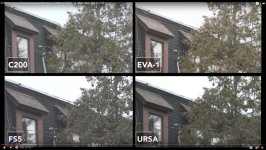

Vistek Screen Grab B.jpg

Vistek Screen Grab A.jpg

The differences in sharpness are more apparent in the video:

https://www.youtube.com/watch?v=QBnCXRgjCUs&t=136s

Aside from possible operator error or faulty auto focus in the test (they used four different 24-105 lens), has anyone found iimage sharpness to be a problem with the C200 4K, MP4 image? I have shot with the FS7 and C200 in different circumstances and saw some difference in sharpness but not to the extend the Vistek test seems to indicate.

Does an 8bit or 10 or 12 bit codec effect image sharpness, or does sharpness have more to do with the sensor the image is scaled from? In one side-by-side comparison I saw between a C200 RAW and MP4 image, the RAW image did look sharper.

I am concerned about sharpness because I produce programs for museums that are presented increasingly on large 4K screens.

Thanks,
Drew Harty
 
Last edited:
You shouldn't be too worried.
If you look closer at the commentary of the video, he says:
Hello Mo - I'm using all internal compressed codecs standard with each camera. I definitely did not shoot any raw. There simply was no time for that.

I can assure you that the softness is coming from the MP4 codec.
Shoot those same shots in RAW and you will see a world of difference.
 
While some of the softness indeed comes from compression (high frequencies = detail = lost during compression), the main reason the C200 (and C300 II, which I use) are both somewhat soft, is the sensors don't have enough resolution to fully capture 4K. More info here: http://www.dvxuser.com/V6/showthread.php?356356-Actual-Camera-Resolution-Before-Aliasing

To truly get 4K, we need 3840/.67 = ~5.7K which is then deBayered and downsampled (filtered) to 4K at high quality. Panasonic got it right with the EVA1: a 5.7K sensor for 4K! If the FS5/FS7 are sharper, it's due to better deBayering (Sony has much more processing power vs. Canon) and possibly a less aggressive optical low pass filter. While I'm not thrilled the C300 II (and C200) are both somewhat soft and still have aliasing issues (again, need ~5.7K sensor with matched OLPF and high quality downsampling), the DPAF and skin tone color quality still make the C300 II and C200 preferred capture devices over anything from Sony or Panasonic. Given Sony's superior sensor tech and embedded processing advantages, if they could match or exceed Canon skin tones (not easy!) and match or exceed DPAF quality AF, they'd have a huge market advantage. Downsampled ~5.7K to 4K will indeed look very sharp/detailed, because it is (not artificially over-sharpened), and if "too sharp" for the target application, the solution is simple: diffusion filters or Gaussian blur in post. It's not possible to go the other way in post (sharpening simply increases acutance/perceived detail, which can look digital and less organic/filmic).

While ARRI is still king for color / skin tones / actual DR / filmic-look, their hardware is kind of ancient and very power hungry (and big and heavy, even the Mini once kitted up for handheld). I think it's time Zeiss, Cooke, Leica etc. worked with ARRI to develop ultra-pro level AF. The advances made in AI face and object tracking are amazing (including the low cost/low-energy Movidius AI chip), and should have a place at the top of the camera food chain (which is currently completely lacking). Which makes the C200, C300 II, and C700 pretty unique in their combinations of features and quality, not available anywhere else for any price.
 
Last edited:
What also stood out for me is the skin-tone test, where the C200 and URSA Mini Pro have a similar magenta shift, where the FS5 looks a bit on the yellow side, and the EVA1 seems to have better looking color and contrast than the other three cameras. ( you can also see the woman's pores in the EVA1 footage, where this is blurred with the other cameras, so the EVA 5.7K image downscaled to 4K is producing a significantly sharper image )
 
Thank you, but P.S. that's not mine...just sharing. (Also noticed it was posted a few seconds before me too.)

Nevertheless, it's a good one for sure!
 
Construct 1_MVI_0066_0908.jpg

I think the C200 is sharp enough for a cinema camera. This is a screen shot from some footage I captured a few weeks ago, not a scientific test but I am pleased with the results. Using the internal MPEG codec, shot at UHD resolution, ISO400, 5600K WB, in-camera sharpness turned off (set to 0). Sigma 24-105 f/4 Art lens, on sticks with optical stabilization off. I don't think I want something that is overly sharp for cinema purposes. Right now I do mostly corporate work, interviews, conferences, etc. Seeing every pore or wrinkle on someone's face is undesirable. If I need more sharpness I can turn it up in camera or add it in post.

Note, I tried to post a higher resolution version but it appears to have been scaled down here. Does anyone know how I can post the full res version?
 
Question, when adjusting sharpness in camera, does it affect ALL modes? or can it be assigned differently for RAW and mp4?

No and no: Sharpness settings don't affect raw at all. In fact, only ISO, aperture, and shutter speed affect raw. That's not obvious from the camera. Color temp also affects raw but only in the sense that the color temp is included in the raw metadata; it can be changed in post.
 
emConstruct-1_MVI_0066_0908-T1.jpg

Just for fun I took the image posted earlier and gave it this treatment in post. It holds up very well even though it originates from a 4:2:0 8-bit MPEG codec. Additional info I forgot to mention earlier, camera was set to WideDR, 2-stops ND, 24 fps. I try to be thorough with shooting specifications in case anyone is interested.
 
I am going to be buying either the C200 or the EVA 1. I am 90% decided on the C200 because of ergonomics, an EVF, better LCD screen (seems crazy Panasonic would saddled a great camera with a bad LCD screen)... [/SIZE][/SIZE]

If a substandard LCD bothers you on a sub $10K camera... I have two P2 VariCams that were listing for $40K when I bought the first one in '11 and they have some of the worst on-board LCD screens I've ever seen, even for the time period. Sub $1K DLSR's had screens then that blew them out of the water. They're so low res that it's actually hard to read the menu items.
 
Thanks JSC for the informative description. It's good to hear you felt the C200's comparative lack of sharpness is acceptable given the camera's other obvious strengths. My primary use of MP4 will be for interviews where tack sharpness is not always an asset and good lighting can greatly increase the perceived sharpness of an image. I will likely use RAW for b-role footage where I can take advance of color grading and additional sharpness will be an advantage.

Thanks, Drew
 
If a substandard LCD bothers you on a sub $10K camera... I have two P2 VariCams that were listing for $40K when I bought the first one in '11 and they have some of the worst on-board LCD screens I've ever seen, even for the time period. Sub $1K DLSR's had screens then that blew them out of the water. They're so low res that it's actually hard to read the menu items.

Why do manufactures put low quality LCD screens on a camera? It's the most basic interface with a camera.
 
View attachment 128844

Just for fun I took the image posted earlier and gave it this treatment in post. It holds up very well even though it originates from a 4:2:0 8-bit MPEG codec. Additional info I forgot to mention earlier, camera was set to WideDR, 2-stops ND, 24 fps. I try to be thorough with shooting specifications in case anyone is interested.


Several videos I've seen comparing C200 video codecs to other cameras confirm what you have found: the C200 MP4 8 bit codec holds up pretty well--even if the images it produces are not as sharp as some other cameras.
 
[Does anyone know how I can post the full res version?

It's best to link to an image on another server. That way it still gets scaled down in size to fit within the thread here, but it can be opened in a separate tab and viewed at 100% in original quality.

I have my own server that I use, but you could use a service like Flickr or other image service. You'd want the direct link to the image file though. And don't check the box that asks if you want to retrieve the image and save locally.

If you don't link, but attach photos to a post, they get resized with pretty destructive settings (in terms of pixel level detail). But if you still feel that is your only option it might make sense to upload 1:1 pixel crops that are smaller than 1024x1024px. That might avoid the resize and we can still evaluate pixel level detail.
 
I actually commented on this video when I saw the sharpness comparison. The fact that they used MP4 instead of RAW wasn't immediately apparent, and I think people will just see the sharpness test and think this camera isn't as sharp as the others, which is not the case.

It's the second test I've seen recently where they shoot in the worst recording mode on the camera and proceed to zoom in 300% and try to push/pull it to hell in Resolve. The fact that the MP4 is as good as it is is a miracle, but RAW is noticeably better and IMO is the only standard this camera can be judged by.
 
Back
Top