Do you usually crank up the ISO?

JaredSMark

Active member
I'm having a bit of a difficult time getting a proper exposure without cranking up the ISO. I'm using the kit lens on a 60D with a shutter speed of 50 and an aperture of 3.5. I find that I've got to crank the ISO to 1600 to get it decent. 800 works but I have to move a lot closer to the softbox. I'm running an Arri 1k through a medium chimera. I was thinking that'd be enough, but apparently not.

At this rate, to shoot something at ISO100 and with a higher aperture, I'm probably going to need an Arri 12k light :tongue:
 
That's not really what I'm concerned about. I'm just baffled at how I've got to crank the ISO up to 800 or 1600 to get the proper exposure, and that's with putting the lights 2 feet away maximum.
 
Add more light. It's always better to have too much than too little. And don't be afraid to under expose a little. As long as you're not clipping the shadows you'll be fine. There's nothing wrong with shooting at 800ISO.

A softbox will reduce the light falling on any single point because it's diffusing it. It loses light going through the diffusion material itself (in this case the softbox) as well as the area, as it's illuminating a much large space than if it weren't being diffused.
 
Have you considered faster lenses?
That would certainly help. The Canon 50mm f/1.8 would be a nice addition. Plus, it only costs 100$. Not bad at all. I prefer my old Nikon (manual prime) so I can close the aperture just a bit, and get a nice bokeh instead of the plain circles bokeh.
Add more light. It's always better to have too much than too little. [..] There's nothing wrong with shooting at 800ISO.
I second that, but on the other hand, when you can't add lights, there's another workaround: NeatVideo!
Not the best and ideal solution, but worked well with a little tweak in post:
RAW footage:
MVI_6549 (0-00-23-20)_02.jpg

NeatVideo applied + Levels:
MVI_6549 (0-00-23-20)_01.jpg

Levels + Curves adjusted:
MVI_6549 (0-00-23-20).jpg

Can help a bit!
 
I agree with everyone suggesting a faster lens. It's hard to enjoy your camera when you are constantly fighting it. The kit lens is not bad for day exteriors but for anything else it is a headache. Cranking to 800 or 1600 ISO is not the end of the world in non-professional contexts but why do something you don't want to do? There are some super cheap lens options out there, especially when you consider their price in relation to the money you've already dropped on the camera body, tripod, batteries, memory cards etc etc. Not to mention the time you're going to sink into this.

I loved my 50mm 1.8 within 10 seconds of putting it on. But over time, I started to feel constricted by its focal length on the aps-c sensor. Everything was closeup, closeup, closeup. So I recently got the Sigma 30mm. Not that much more--$289 from BH Photo--but so much more space to get the shots I want. Kind of wish I'd gotten it from the start and saved the money I dropped on the 50mm, which I never even use anymore.
 
That would certainly help. The Canon 50mm f/1.8 would be a nice addition. Plus, it only costs 100$. Not bad at all. I prefer my old Nikon (manual prime) so I can close the aperture just a bit, and get a nice bokeh instead of the plain circles bokeh.

I second that, but on the other hand, when you can't add lights, there's another workaround: NeatVideo!
Not the best and ideal solution, but worked well with a little tweak in post:
RAW footage:
View attachment 68037

NeatVideo applied + Levels:
View attachment 68036

Levels + Curves adjusted:
View attachment 68035

Can help a bit!

How does NeatVideo compare to Magic Bullet denoiser?
 
Shoot at f/1.4 to f/2.0. Buy cheap lenses like the Helios on ebay but you really need to have faster lenses.
Use only ISO 100, 160, 310, 640, 1250.
Or buy a 5DMKIII and play with any ISO up to 3200 without worrying.
 
I actually had the 28mm 1.8 Prime by Canon for my 60D but that was a while back. I forget exactly how it performed since it's been a while, but I'm thinking it was probably better than the kit lens. I've never had the cash to buy a buttload of lenses and test them out, so do you think getting another 28mm 1.8 by Canon would be better than the cheap 50mm? I was planning on getting a prime anyway soon.

By the way, I understand that a faster lens will help with low light situations due to the aperture, but side by side with a slower lens, does the fast lens naturally perform better and have more light even at the same aperture and focal length? Maybe due to the build? Or is it just strictly aperture that's going to affect the amount of light?

I'd like to be able to shoot at a pretty small (high number) aperture, but I'm thinking that even with a faster lens, it won't help *that* much. That's why I'm thinking it's either add more lights, or crank the ISO. I think I remember encountering somewhat the same problem on my 28mm 1.8. Take in mind I'm shooting almost strictly indoors at night.
 
Adding more light should ALWAYS be the first option to go to when possible. From there, bump up the ISO till the noise starts becoming problematic. Then start going for either shutter speed or aperture depending on shooting subject.

The downside to using aperture to control your exposure is that you lose the ability to control how much depth of field you have. Being able to change ISO is such a powerful tool in modern filmmaking.

I don't know the exact shooting conditions you're under, but in my bedroom I can get decent exposure at 35mm f/4 ISO 800 using 4 100watt equivalent CFL bulbs in my ceiling fan. It's a stop underexposed, but there's no clipping, so it's not really an issue. Shooting at f/1.8 at 50mm, unless you're shooting in a really big room you're gonna be working with about a foot or less of focus.

In the end, if you can add more light, do it. With the indie scene exploding the last few years, the budget-minded filmmaker has never had more options for affordable lighting, from CFL, LED, or even the classic Tungsten. The only times you shouldn't add more light is when you can't add more light, or you already have too much light.
 
When you have a fast lens, let's say a 50mm F1.8 and you set it at f4, it will allow exactly the same light to reach the sensor as a 50mm f3.5 lens set at f4. So you really need to use that fast lens as wide as possible. The downside is that at its widest, you get shallow field of depth, so getting and keeping the subject in focus will be harder (when either the subject or the cameraman is moving back and forth slightly.) Hope this helps. All this can be learnt easily by experimenting with a fast lens in stills photography. Good luck!
 
Neat Video can bite you in the rear if you rely on it constantly. Plastic skin tones, posterization... and all that rendering.

Most faster-aperture lenses will perform better at, say, F4 or 5.6 than a kit lens of the same focal length - generally speaking, they're better lenses. Sure, there's plenty of cheap 50mm's out there... but when you get wider, fast lenses get pricier and tend to be aimed more toward pros, with better build quality and optical formulas... generally. And... most any 35mm lens will be at its best from around F4/5.6 to F11 or so, as far as sharpness, CA, etc. goes. Stop down to f16 or tighter and you often get bad diffraction issues. Generally speaking.

There's far more 2.8 primes available than 1.8 - but you're not talking a huge difference in light transmission.

That said, there are plenty of 2.8 primes from 20 - 28mm out there, particularly AI & AIS Nikkors. But relying on 1.8 - 2.8 for every shot? That's a nightmare. Get some lights... you can research cheap lights on this site and dig through about 10,000 posts on the subject.
 
Neat Video can bite you in the rear if you rely on it constantly. Plastic skin tones, posterization... and all that rendering.
[..]
There's far more 2.8 primes available than 1.8 - but you're not talking a huge difference in light transmission.
[..]
That said, there are plenty of 2.8 primes from 20 - 28mm out there, particularly AI & AIS Nikkors. But relying on 1.8 - 2.8 for every shot? That's a nightmare. Get some lights... you can research cheap lights on this site...

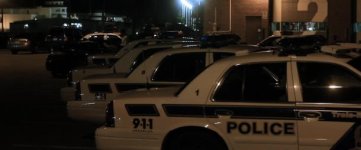
1) That's for sure. It's not an option, but a tool that can help. I, as I wasn't able to get some lights in the Police parking, was "forced" to use the available light with my 50mm f/1.8. Neat Video helped, but my shots aren't as good as if there were a couple K of lights setup'd that night.
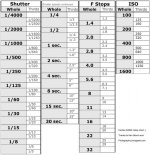
2) There's what, one third of a stop? :
F-Stops - Shutter - Iso.jpg
3) That's for sure. I would invest a couple bucks for Work lights (around 10$/set) and it would certainly help if properly handled on the set.
 
An aperture setting lets in the same amount of light no matter which lens you use. In other words, f5.6 (or any aperture setting) lets in the same amount of light on any lens. So if you bought an f1.8 lens, and stopped it down to, say, f8, it will let in the same amount as your kit lens set to f8.
Given the choice of either adding more lights or cranking up the ISO, adding lights is going to provide a better look, most likely. Cranking up the ISO adds noise. And plug-ins like Neat Video reduce noise but they take time to render and they reduce the resolution of your image.
Shooting with faster lenses at wider apertures would help. Every f-number doubles the amount of light that hits the sensor. So, f2 lens lets in 8 times as much light as f5.6.
 
It's easy to forget how much of a difference a fast lens makes compared to a slow kit lens. Let me tell you how much, when I first started out I had the 7D with the 18-55 also, I hated the camera! Yes to the point of hating it alltogether. I couldn't shoot a decent looking video without being under direct sunlight, ALL my shots were grainy as hell, my 7D wasn't too much different than my phone when it came to the results!

I then decided to try fast lenses as a last resort, so bought the cheapest one to experiment, the 50mm f/1.8. I put it on my 7D and god, it was transformed into a complete different camera to work with. All my shots are clean, sharp, cinematic and even colors were improved I have no idea how! When I was using the kit lens I was constantly at 3200/6400 ISO to get correct exposure (especially at the long end), and with the 1.8, my ISO is constantly around 160/320/640, yes it's that much!

I then bought the samyang cine prime set and love every moment I shoot with them. I only use the kit lens now as a wide angle @18mm and only under sunlight, it's the only cheap wide-angle lens so keep it.
 
I actually had the 28mm 1.8 Prime by Canon for my 60D but that was a while back. I forget exactly how it performed since it's been a while, but I'm thinking it was probably better than the kit lens. I've never had the cash to buy a buttload of lenses and test them out, so do you think getting another 28mm 1.8 by Canon would be better than the cheap 50mm? I was planning on getting a prime anyway soon.

Before I converted to m4/3 and was working with a 7D, T3i, and 60D, that EF 28mm f1.8 was my favorite prime lens for video. Also had the EF 24mm f2.8 and the old style EF 50mm f1.8. Each had it's place but the 28 was the most used lens for it's "normal" perspective. I'd get another one and get very familiar with it, it's a great working lens even in better light levels.

And keep the 50mm, even at night it's very good for "tight" compositions.

As far as "noise" goes, that may be best evaluated by testing for it in your final delivery format. Burn some of your typical night shots to DVD and watch them on TV. One of my common delivery formats is MP4 on thumb drives so I view typical stuff on my HDTV using a hardware media player connected to the TV with HDMI. Noise shows up worst on your monitor especially if you have even the least amount of oversharpening on your monitor controls (VERY COMMON!).

By the way, I understand that a faster lens will help with low light situations due to the aperture, but side by side with a slower lens, does the fast lens naturally perform better and have more light even at the same aperture and focal length? Maybe due to the build? Or is it just strictly aperture that's going to affect the amount of light?

No, although it may be a tad sharper/contrastier if the slower lens is a zoom. Aperture is what controls the amount of light passing through the lens.

I'd like to be able to shoot at a pretty small (high number) aperture, but I'm thinking that even with a faster lens, it won't help *that* much. That's why I'm thinking it's either add more lights, or crank the ISO. I think I remember encountering somewhat the same problem on my 28mm 1.8. Take in mind I'm shooting almost strictly indoors at night.

To shoot at a pretty small aperture indoors at night you need a LOT MORE light. The ability to "crank" the ISO is one of the reasons I shoot mainly with GH3's, better high ISO performance with 3200 quite good and 6400 usable (very little noise with proper exposure).

150 watt equivalent CFLs in 11" reflectors will give you a fair amount of light that looks about as broad and soft as some light boxes yet will allow you decent working distances.
 
By the way, I understand that a faster lens will help with low light situations due to the aperture, but side by side with a slower lens, does the fast lens naturally perform better and have more light even at the same aperture and focal length? Maybe due to the build? Or is it just strictly aperture that's going to affect the amount of light?

The full answer to this is a bit more technical than people have let on. Two lenses at the same f-stop have the same iris size allowing light in, but the lens surfaces (internal and external) may be stopping more light. Uncoated glass costs you 3% of the light per surface, so cheap lenses can easily lose a stop or more to internal reflections if they have many elements. Look at a 75-300mm $200 lens at 200mm f/5.6 and it will definitely be darker than a 200mm Canon prime $1000 lens at f/5.6. This is why movie cameras have always exposed using t-stops instead of just f-stops.

Usually, the faster lens will also give you better sharpness, fewer chromatic aberrations, and less edge falloff than the slower lens at the same aperture. Usually.
 
Back
Top