
Navigation
Install the app
How to install the app on iOS
Follow along with the video below to see how to install our site as a web app on your home screen.
Note: This feature may not be available in some browsers.
More options
You are using an out of date browser. It may not display this or other websites correctly.
You should upgrade or use an alternative browser.
You should upgrade or use an alternative browser.
Deep DOF lenses for canon SLR
- Thread starter Tetewsky
- Start date

A couple of things:
1) Any lens is going to stop down quite a bit, most likely to f22. Since aperture is what ultimately determines DOF, f22 is going to leave you with pretty deep focus.
2) At really wide angles, like 16mm, most things will stay in focus anyway, even at a wide aperture. The Tokina 11-16mm, zoomed out to 11mm and at f2.8, leaves most everything in focus.
Last edited:

markblasco
Well-known member
You won't be able to get everything in focus with low light, it's just not possible. During the day outdoors that won't be a problem with any lens, since the F-stop figures for lenses are the widest that they get, but all lenses can be stopped down to get more in focus. This reduces the amount of light they pickup, though, which means the more you want in focus, the more light you need.
You won't be able to get everything in focus with low light, it's just not possible.
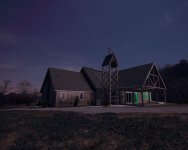
Just for reference, I took this back in November around the full moon. 11:45pm. Canon T2i, Tokina 11-16. It was an 8-second exposure at f2.8 and ISO 200.
Attachments
Last edited:
Just for reference, I took this back in November around the full moon. 11:45pm. Canon T2i, Tokina 11-16. It was an 8-second exposure at f2.8 and ISO 200.
Ok.... But you can't do 8 second exposures in video.
Ok.... But you can't do 8 second exposures in video.
Correct, but since aperture, not exposure time, determines DOF...

Jarrett P. Morgan
Well-known member
Does anyone know any wide angle lenses that are cheaper than $500 that i can get where everything will be in focus? What aperture should I get. I'd be shooting at night and day with it and during the night outdoors I'd have limited lighting.
The issue you are going to run into at night is that unless you get REALLY wide you will need to stop down and it can be hard to get the exposure right due to the lack of light.

Michael Carter
Veteran
Subject distance has a big effect as well. If you're reasonably far back, anything in the 20-28mm range should hold pretty deep focus at even F4. But this is really not a one size fits all situation - the OP saying "where everything is in focus" doesn't tell us much. You want it for exteriors, exteriors with landscapes, or small-room interiors? it's really the kind of question where the only sensible answer is "don't spend a lot of money until you've shot a lot more stuff and learned a lot more about optics, exposure, framing, etc". The Canon kit lens is really a decent lens for the $$ and gets as wide as can be until you get up over a grand, do some tests with that with the scenes you envision. Shoot stills at *whatever* shutter speed it takes, see what f-stop you need to get the footage you want and then figure out how much light/what ISO you need to make it happen.
Loren Simons
DVXuser Sponsor
Ok.... But you can't do 8 second exposures in video.
What he's trying to show you is that at f/2.8 (which is the lowest you'll be able to set your aperture on the 11-16) you get a wide range of the image in focus. If you look, a majority of the grass, all the way to the back of the house (maybe even the trees) are in focus. It must have been nearly pitch black to have an image exposed like that even with an 8" shutter.
Side note: Great photo
Thanks, Loren!
It was not as dark as you might think. That was one of the brightest moons I've seen, with an almost-perfectly-clear sky (thin, whispy clouds, seen in the background). I just wish I'd been able to black out the emergency exit sign in the chapel (that lovely green glow). Next time, perhaps.
One thing about the Tokina, it is not at its sharpest at f2.8, not by a long shot. But again, a lens that wide doesn't really do bokeh.
Last edited:
Snapper123
Well-known member
Half the scenes in The Wrestler were filmed with a Zeiss 12mm, in which Zeiss seems to specialize in creating wide angle lenses that have much less distortion and fish-eye looks than normal wide angles. It was also filmed on 16mm film, I'm guessing that it also caused that lens to be cropped down to 24mm or so, which is what it looked like to me most of the time; the same director used this to his advantage in Black Swan, using a cropped sensor for the subway scenes to have as little depth of field as he could, combined with crazy settings like 1600ISO and F8. There seemed to be very little depth of field in The Wrestler, it had a very documentary style about it, yet not once did it look out of place. When dealing with wide focus planes, I'd always important to make sure that there are just a few places that have a smidge of blur to them - especially with DSLR's, having too much in focus can be a major risk with moire and camcorder textures. That's one thing I love so much about the zoom feature in video mode, before you press record, you can pretty much zoom into any area you want and check what you want the objects to look like!
markblasco
Well-known member
Correct, but since aperture, not exposure time, determines DOF...
Yes, but 95% of most video's are not going to just be wide shots with things in the distance. The original poster framed their question in a way that led me to believe they don't really understand exactly how it all works, and in that situation I would rather err on the side of saying it can't be done, rather than saying it can be done and have that person upset later on when they find out all of the limitations.
Pietro Impagliazzo
Well-known member
Well it can be done... At ISO 204800.
I'm guessing it will be possible in less than 10 years for a clean image at that ISO and less than 5 years for a noisy but usable image at that ISO.
I'm guessing it will be possible in less than 10 years for a clean image at that ISO and less than 5 years for a noisy but usable image at that ISO.
Subject distance has a big effect as well. If you're reasonably far back, anything in the 20-28mm range should hold pretty deep focus at even F4. But this is really not a one size fits all situation - the OP saying "where everything is in focus" doesn't tell us much. You want it for exteriors, exteriors with landscapes, or small-room interiors? it's really the kind of question where the only sensible answer is "don't spend a lot of money until you've shot a lot more stuff and learned a lot more about optics, exposure, framing, etc". The Canon kit lens is really a decent lens for the $$ and gets as wide as can be until you get up over a grand, do some tests with that with the scenes you envision. Shoot stills at *whatever* shutter speed it takes, see what f-stop you need to get the footage you want and then figure out how much light/what ISO you need to make it happen.
I'd be doing tracking shots/stabilized shots outdoors, which is why I would like a deep DOF lens, so that they don't go out of focus. I think a wide angle for those shots outdoors would make the most sense, but I wouldn't want to much barrel distortion.
I'd be doing tracking shots/stabilized shots outdoors, which is why I would like a deep DOF lens, so that they don't go out of focus. I think a wide angle for those shots outdoors would make the most sense, but I wouldn't want to much barrel distortion.
You'll definitely want a wider lens for those shots. Especially because imperfect stabilizer movements (even tripod moves, for that matter) are magnified to unbearable amounts with long lenses. But again, uderstanding DOF...
Aperture ultimately defines DOF, and even a lens rated at f1.4 is going to be able to stop down which will increase DOF. Just remember that you need light in order to stop down and keep proper exposure, which isn't as much of an issue outside during the day as it is for interiors and night shots. However, wide-angle lenses just don't exhibit shallow DOF like longer lenses do. They physically cannot. So with a 20mm lens you'll be safe at a wider aperture. That's why I put up the example from the Tokina... to show that wide lenses, even at f2.8, don't really do shallow DOF. In other words, with a wide lens you are less constrained by your aperture setting. Doesn't mean that it doesn't matter, just that it's going to allow you some flexibility.
There are plenty of lenses under $500 that will work for you (like THIS ONE, for example).
one thing, and thank you to all the above posters.
I only have one lens which is the 50mm F1.4, and am I mistaken in it not being able to stop down? I know I bought a prime, and I thought they didn't change apertures, but to make sure I looked up how to stop aperture down, and you're just supposed to turn the wheel. I assume that I was right in that it doesn't.
I know I probably sound like I'm completely new, but I've never owned a good camera until a few months ago. My main focus beforehand was really primarily editing with the equipment I originally had.
Yes, you can stop it down. It doesn't have a manual aperture ring, but you can use the camera's controls to do that. Which Canon are you using, by the way? With most of the Canon DSLRs, the scroll wheel defaults to shutter speed, but if you hold down the aperture button (Av) while you scroll and it will affect the aperture. You do need to be in a manual shooting mode to do this.
A prime lens does not change focal lengths. That's what makes it a prime. Like any lens, it's aperture rating is for maximum aperture (widest open).
Also, you're really limited in what you can do with nothing more than a 50mm lens. You really need to diversify your glass collection. If you're going with all primes, you'll want something like: 24mm, 35mm, 50mm, 85mm. And if you need a super-wide, refer back to that Tokina.
Last edited: