D5200 Anyone got it ???

I got the Leica-r adapter but no camera yet... supposed to be here on Monday.

If the first round of tests go well I'll pick up a hyperdeck and do some tests recording to prores and uncompressed. After 4 years with the 5D I'm done with heavy compression and transcoding.

Is the 422 fed to the HDMI out before the picture profile is baked? Or is it just the REC709 crushing the blacks?
 
I got the Leica-r adapter but no camera yet... supposed to be here on Monday.

FYI, installing these adapters is not as simple as many would think, you can use the weekend to get that done.
The best instructions are in the Leitax page, links on the left of this: http://www.leitax.com/leica-lens-for-nikon-cameras.html
pointing to pages like this: http://www.leitax.com/conversion/leica/Summilux-50/index.html

Is the 422 fed to the HDMI out before the picture profile is baked? Or is it just the REC709 crushing the blacks?

HDMI out is after picture profile is baked, but even so picture profile is not as useful as I would have wanted, because it is applied over an already-mostly-destroyed image

AFAIK, the image processing in the D800 is as follows:
First, the sensor captures lots of info: 14-bit RAW with nearly 14 stops of DR.
Then, that CFA image is debayered. This throws away most of the information captured by the sensor. The result is an 8-bit image with baked-in WB and colors, and with reduced DR and a very specific light response function: the slope is really minimal in the deep shadows (only two or three brightness values for the last stop of light).
Then, the picture profile is applied. I can push up the shadows a lot, but given that this is done over an image which is already half-destroyed, there's only so much I can achieve. Hence the ugly posterized noise in the shadows with Flaat_12: I can get the detail to show up and be discernible, but there are only two or three brightness values for tha last stop of light (just that instead of being mapped to values 0-1-2, they may now be 0-8-16).
The result of that process is then either sent out through HDMI, or sent out to the internal encoder (which further destroys the image, applying 4:2:0 color subsampling and all the H.264 nastyness).

So, the best you can achieve is to record accurately the 8-bit image that comes out of the debayering process.
If you're recording internally, pushing up the shadows with a profile helps them survive the 420 H.264 encoding process (it will kill a 0-1-2 difference, but not a 0-8-16 difference). If the encoding process won't be so aggressive, all you achieve by pushing up the shadows strongly is to leave less room for midtone gradation.
If you don't push up the shadows with a profile and encode internally and then push them out in post, they look grey and mushy and ugly. This is much less of an issue if you're recording 422 externally.
Two or three values for a stop of light is not nearly enough, but it can be made useful with noise reduction: http://vimeo.com/39899742 (the Flaat_13 profile was way too aggressive, I dropped it with the beta-3 version, but it gives you an idea).
Summary: you'll have to test empirically to see how much of an advantage a profile can give you when recording externally with your new puppy.


edit:
wow, that was long and boring
sorry
compensating fun video here: http://vimeo.com/59387517
 
Last edited:
Samuel, thank you, great thoughts and appreciate your development...

I use lately neutral profile on all Nikons, with contrast to minimum and color somewhere in middle..

going to portrait or your 11 profile gives a bit more yellow, greenish cast, which I do not really like,
always struggle with too much yellow on Nikons, too bad D5200 do not have K balance, have to do tricks with it,
My footage from yesterday just got uploaded
http://www.youtube.com/watch?v=-7_Sagw6GBY&feature=youtu.be

some candle light at the end, iso I believe was 2000

I am impressed, never had a C300, thought of buying C100, now will have to think
smiley.gif


is D5200 not as good as D800e or D4 in a 2.7 mode? For sure, is it better for run and gun situations, you bet!
I'd say it missing some fine detail of GH2.
 
Last edited:
FYI, installing these adapters is not as simple as many would think, you can use the weekend to get that done.

Yeah done it before, all my Leicas have leitax EOS adapters. I just bought one for testing, if all goes well the rest of the EOS get swapped for Nikon.
 
Don't go too fast on getting a D5200! The d7100 might be announced next week according to nikonrumors.com. Who knows, it might even have higher bit rates and diffrent video codecs like the GH3! It will certainly be a higher priced cam with a few more bells and whistles than the d5200.
 
AFAIK, the image processing in the D800 is as follows:
First, the sensor captures lots of info: 14-bit RAW with nearly 14 stops of DR.
Then, that CFA image is debayered. This throws away most of the information captured by the sensor. The result is an 8-bit image with baked-in WB and colors, and with reduced DR and a very specific light response function: the slope is really minimal in the deep shadows (only two or three brightness values for the last stop of light).
Then, the picture profile is applied. I can push up the shadows a lot, but given that this is done over an image which is already half-destroyed, there's only so much I can achieve.
Sorry, but that theory doesn't match the D5100 histograms I see in After Effects. If the Picture Profile was remapping 8-bit RGB source data into a different 8-bit curve, we would see gaps and spikes in the histogram of the processed image. You can see this type of degradation happen when grading previously unprocessed images in 8-bit mode. What I see instead is that properly decoded JPEG and MOV images straight from the D5100 contain dense, fully populated histograms, regardless of what custom or built-in Picture Profile was used to produce them.

From an engineering perspective, it would be incompetent for Nikon to shortchange their cameras by converting the 14-bit RGBG sensor data into 8-bit debayered RGB data. With modern CPU's, there's no good reason to use anything less than 16-bit precision for internal image processing. I'd agree that the Picture Profile curve remapping is most likely done after the base profile's gamma and user adjustments are applied, but all of these calculations must be happening before the RGB data is converted into YUV data. It wouldn't be until the image was subsampled down to 4:2:0 color depth that there would be any reason to reduce the precision of its components below 16 bits.

The posterization that occurs in the shadows of H.264 encoding is an inevitable consequence of its 8-bit luma scaling. There are far too few steps in the dark end of the scale to adequately encode shadow details, regardless of which profile you choose. That is why 10-bit and higher encoders are necessary to preserve the darkest details.
 
I dropped by Best Buy today to play around with the D5200. I felt that the body was just too small for my hands. I currently have a D800 and love it but wanted to pickup maybe something in a DX mode which was smaller and without Moire in video which I can throw in the glove box in my car and use more frequently than the D800 as a result. I used to own a D90 which I loved the size but the video codec was aweful on that. I hope Nikon comes out with a slightly better body but this same sensor which doesn't have moire issues in video. Anyone else feel the same? The 5200 feels too much like a toy.
 
Don't go too fast on getting a D5200! The d7100 might be announced next week according to nikonrumors.com. Who knows, it might even have higher bit rates and diffrent video codecs like the GH3! It will certainly be a higher priced cam with a few more bells and whistles than the d5200.
Yeah but how much higher would it cost. 2-300 and I'd think about it but even then I couldn't really aford it at the moment
 
Sorry, no offence meant!

None taken! I just meant it feels hugely exaggerated :)

Sorry, but that theory doesn't match the D5100 histograms I see in After Effects. If the Picture Profile was remapping 8-bit RGB source data into a different 8-bit curve, we would see gaps and spikes in the histogram of the processed image. You can see this type of degradation happen when grading previously unprocessed images in 8-bit mode. What I see instead is that properly decoded JPEG and MOV images straight from the D5100 contain dense, fully populated histograms, regardless of what custom or built-in Picture Profile was used to produce them.

From an engineering perspective, it would be incompetent for Nikon to shortchange their cameras by converting the 14-bit RGBG sensor data into 8-bit debayered RGB data. With modern CPU's, there's no good reason to use anything less than 16-bit precision for internal image processing. I'd agree that the Picture Profile curve remapping is most likely done after the base profile's gamma and user adjustments are applied, but all of these calculations must be happening before the RGB data is converted into YUV data. It wouldn't be until the image was subsampled down to 4:2:0 color depth that there would be any reason to reduce the precision of its components below 16 bits.

The posterization that occurs in the shadows of H.264 encoding is an inevitable consequence of its 8-bit luma scaling. There are far too few steps in the dark end of the scale to adequately encode shadow details, regardless of which profile you choose. That is why 10-bit and higher encoders are necessary to preserve the darkest details.

Well, that theory I posted is the only thing that could explain what I'm seeing in the shadows when I push them up with an aggressive picture profile: heavily posterized noise.

So I'd say it's a mixture of the following:
* I haven't actually measured it, I may have exaggerated a bit, it may not be as bad as I said above (2 or 3 values for the last stop of light), but it's pretty bad indeed, maybe 5 or 6, nowhere near what you'd have a high-color-depth image to start with; just compare the still and the video at the end of this: http://vimeo.com/39899742
the still is a jpg shot with exactly the same settings and picture profile, and not processed any further; that's a huge difference, and the only way I can think of for this to happen is that the camera is cutting corners when debayering for video, by generating that low-color-depth image I talked about above
* you only see this with very aggressive profiles, such as the extinct Flaat_13, and, to a lesser extent, the very-much-still-alive Flaat_12; you may not notice this with regular profiles; among other things because...
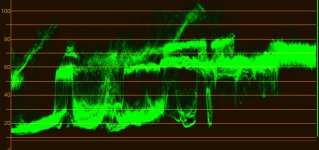
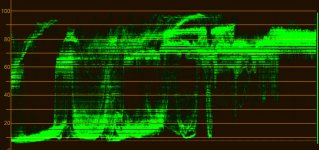
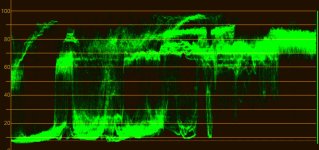
* I know exactly what you mean about the waveform/histogram gaps; but the H.264 compression is ran after this, and at low bitrate it will actually fill the gaps artificially (it involves an approximation that will make the waveform/histogram look more even - but the image will obviously not be any better)


edit:
this is not even a Nikon camera but it will work as an example...

original image:
wf1.jpg
strongly graded:
wf2.jpg
strongly graded and exported to H.264 32 Mbps, then brought back into the timeline:
wf3.jpg
 
Last edited:
Don't go too fast on getting a D5200! The d7100 might be announced next week according to nikonrumors.com. Who knows, it might even have higher bit rates and diffrent video codecs like the GH3! It will certainly be a higher priced cam with a few more bells and whistles than the d5200.

Or it might shoot soft as s*%te like the D4.

I just bought the D5200 for testing, if I lose $100 on it then so be it, it's a couple of cases of beer, my liver will thank me for it.

P.S. If the D7100 is essentially the same but in a larger heavier body with more stills features and identical video spec I'd rather have the smaller lighter body. The D5200 with a ninja or hyperdeck weighs slightly more than a 5D which is about the perfect weight for my rig.
 
Last edited:

The d5200 is looking pretty good to me. I was ready to buy it but nikonrumors.com says that the d7100 might be announced next week. Hoping for a choice of bit rates and codecs ala GH3! As well as aperture control on live view. Thanks for the test!

Or it might shoot soft as s*%te like the D4.

I just bought the D5200 for testing, if I lose $100 on it then so be it, it's a couple of cases of beer, my liver will thank me for it.

Yeah, we won't know until is out, but it seems that Nikon is raising the bar. Go Nikon, my favorite camera brand!
 
I just added a bit more to that post re the D7100. I doubt the video spec will be any different.

I have a radical idea for the D5200, I'd like to rehouse it in a custom body with a Sony E-mount and a speedbooster.
 
I just added a bit more to that post re the D7100. I doubt the video spec will be any different.

If the video specs of the d5200 and d7100 are the same I will get the d5200. I have the d5100 with a battery grip and size-wise I like it. I would be using the same battery grip for the d5200 if I end up getting it. I am just hoping that the d7100 has a more robust codec and manual aperture with live-view. Either way I am very excited about the new Nikons.
 
Back
Top