Hey Phil, thanks for your concern. He uses pwm with a frequency >30000hz, I almost certain that all commercial applications from Litegear etc. use a similar approach. Also litemats are on coroplast. So sure, you gotta be cautious to stay within the limits of your leds but I don't see how your points are a problem for homebuilt lights. The big vendors cook with exactly the same stuff.

Navigation
Install the app
How to install the app on iOS
Follow along with the video below to see how to install our site as a web app on your home screen.
Note: This feature may not be available in some browsers.
More options
You are using an out of date browser. It may not display this or other websites correctly.
You should upgrade or use an alternative browser.
You should upgrade or use an alternative browser.
Creating a community for DIY LED lighting stuff (DIY Quasars inside)
- Thread starter TimTom
- Start date

Jim Arthurs
Well-known member
The other major problem I notice here is that he's using pulse width modulating dimmers which risk causing flicker at any frame rate with rolling-shutter cameras (which is almost all modern cameras) and especially at high frame rates.
Not a problem with the high frequency dimmers, to demonstrate, I shot a test using those same Chinese 95 CRI LED strips that DIYPerks used... the first and probably only time I will shoot at 240fps with the GH5s...

http://files.datausa.com/imageshoppe/outgoing/LED_DIY/LED_PWM_dimming240fps.mp4
If anyone is curious, the full 16' string of LED's uses just above 3 amps at 12 volts at full brightness.
I did use a higher amperage dimmer than he used, here's the link... (very expensive, BTW...
)https://www.ebay.com/itm/12V-40V-10...e=STRK:MEBIDX:IT&_trksid=p2060353.m2749.l2649
It is possible to homebuild simple LED lights which don't have these problems and I have worked out an aliexpress shopping list to do it if anyone's interested.
Of course we're interested, please share! Everyone is always interested and respects expertise and experience. I'm sure as heck not trying to produce "production ready" lighting, just create some secondary use products for personal projects, as I'm sure most are here.
Regards,
Phil Rhodes
Well-known member
Not a problem with the high frequency dimmers, to demonstrate, I shot a test using those same Chinese 95 CRI LED strips that DIYPerks used... the first and probably only time I will shoot at 240fps with the GH5s...
The higher the frequency, sure, the more likely it will be to work most of the time. I worry that a specific camera-light combination could easily cause problems that are difficult to predict and impossible to solve. Much of the time, PWM flicker will look like a fairly minor, almost invisible problem. You need to be looking at it on a waveform monitor that operates at full frame rate, which most in-camera and in-monitor ones don't. It can suddenly become a not-so-minor problem which you only see in the edit and which has the client screaming because once seen it's hard to unsee.
One particular concern (not the only one) is that readout on rolling shutter cameras happens very, very quickly, more than fast enough to image 30KHz PWM cycles; nobody's ever going to make a PWM controller fast enough to overcome that.
There are lights out there (the Astera tube stuff, with advanced chases and colour effects) which use dithered PWM, which has pseudorandom patterns in it to avoid repetitive flicker. That's a reasonable engineering compromise on something which needs a lot of control over a lot of different light sources, but it just isn't necessary on general-purpose lighting.
Anyway, extreme caution advised. Commercial LED lighting options made for film and TV work are overwhelmingly not using PWM dimming for these exact reasons. The only exception I'm aware of is the Photon Beard Highlight which uses PWM in the very bottom of its dimming range, because it's intended for TV studios and it needs to be able to fade cleanly all the way down to black. Directly because of this, it's also more or less the only LED out there that actually can produce a smooth, clean fade to black...
They're also not using resistive current limiting, other than on things like the Litegear tape which is built essentially the same way anything else is. On the other hand, Litegear aren't sticking row after row of it onto things to create a high power light. Although some people actually do. It works, though it isn't particularly efficient, because it burns so much power into heat. Usually it's being done for convenience, rather than because people are desperate for a low energy light.
P

nyvz
Veteran
The higher the frequency, sure, the more likely it will be to work most of the time. I worry that a specific camera-light combination could easily cause problems that are difficult to predict and impossible to solve. Much of the time, PWM flicker will look like a fairly minor, almost invisible problem. You need to be looking at it on a waveform monitor that operates at full frame rate, which most in-camera and in-monitor ones don't. It can suddenly become a not-so-minor problem which you only see in the edit and which has the client screaming because once seen it's hard to unsee.
One particular concern (not the only one) is that readout on rolling shutter cameras happens very, very quickly, more than fast enough to image 30KHz PWM cycles; nobody's ever going to make a PWM controller fast enough to overcome that.
There are lights out there (the Astera tube stuff, with advanced chases and colour effects) which use dithered PWM, which has pseudorandom patterns in it to avoid repetitive flicker. That's a reasonable engineering compromise on something which needs a lot of control over a lot of different light sources, but it just isn't necessary on general-purpose lighting.
Anyway, extreme caution advised. Commercial LED lighting options made for film and TV work are overwhelmingly not using PWM dimming for these exact reasons. The only exception I'm aware of is the Photon Beard Highlight which uses PWM in the very bottom of its dimming range, because it's intended for TV studios and it needs to be able to fade cleanly all the way down to black. Directly because of this, it's also more or less the only LED out there that actually can produce a smooth, clean fade to black...
They're also not using resistive current limiting, other than on things like the Litegear tape which is built essentially the same way anything else is. On the other hand, Litegear aren't sticking row after row of it onto things to create a high power light. Although some people actually do. It works, though it isn't particularly efficient, because it burns so much power into heat. Usually it's being done for convenience, rather than because people are desperate for a low energy light.
P
Not sure I follow your point about readout speed. Who cares what the readout speed as long as the shutter speed is compatible? Are you saying you think a high readout speed will render some kind of artifact on its own on a flickering source regardless of shutter speed? I can't work out how that could possibly be an issue at normal shutter speeds.
I agree that 30khz might not be fast enough for the highest of high shutter speeds, but in those cases you'd likely need all the light you can get and bypass PWM dimming by running at full output anyway. Even skypanels use PWM and need to be run in highspeed mode to bypass PWM, don't they? I do know Digital sputniks use voltage dimming but they have said fairly complex software curves are required to compensate for color shifts that occur through that method... I know some others do the same thing but use PWM to get the lower output dimmed modes.
I've been using that 5x8A DMX LED Dimmer for a while, nearly every major manufacturer seems to have rebranded it in the past year (including Litegear). I believe it was originally made by Sunricher which is a Chinese company. Over a year ago when I found it it became very clear it was the only one of its kind in that it was affordable and had adjustable PWM up to 30khz. I put a couple of them in an studio install I did and was so happy with them I bought one and a 600W meanwell PSU to build my own light. I've been building some daisy chainable rollable modular RGBAW lights to hook up to it based on a 4'x2" form factor that could easily have a curved diffuser put on it to work as a "tube" (quasar rainbow-type) light. Getting a little fed up with soldering though so might just fall back on one big 600W RGBAW panel and maybe find a mounting system that accomodates not cutting strips at all. Problem is I seem to have shorted one of the channels, despite being fairly careful with my wiring and testing with my multimeter, I wonder if there is a way to recover it or if I'll have to buy another $80 controller. May have to just ditch the RGB functionality since the chance of me needing it in such a high powered light is somewhat lower...
Last edited:

Run&Gun
Veteran
I haven't read the entire thread, but these last few posts bring up something. How exactly do the Quasar X-fade tubes work? I have a lot of them and the color temp is adjusted with an on-board control, but you use off-board, off-the-shelf dimmers to dim them similar to how I would with tungsten. I use off-the-shelf Lutron LED Lamp dimmers(recommended by Quasar) available at any Lowe's or Home Depot. Now, I haven't shot any high speed footage, but we haven't experienced any flicker or color shift with them at 23.98, 1/48 shutter.
Phil Rhodes
Well-known member
Noah, if you have a rolling-shutter camera, if the light comes on or goes off during the readout period (which LEDs are more than fast enough to do) then you get a torn frame. If you make your PWM go very fast, you can even end up with stripes, or very very very fast, diagonal lines. I'm not aware of a PWM solution that attempts the sort of frame synchronisation that would be required to avoid that (in fact I'm only aware of one range of lights, the Outsight Creamsource, that offers shutter-awareness of any kind at all.)
More to the point, even at 30KHz, you only have 625 PWM cycles per 24p frame, and the inclusion or exclusion of one of them represents more than 1 least-significant bit of variation. I'm not saying it can't work. Usually it does work, sort of, especially if you don't look too closely. I'm saying it's a bad idea which can bite you unexpectedly and in ways that are hard to predict and basically impossible to mitigate. It's also completely unnecessary in a world where current regulating DC-DC converters are trivially inexpensive.
Run&Gun - I don't know specifically about Quasar tubes as they're rare and expensive in the UK, but various LED devices have been made which are aware of and work with conventional triac dimmers. It's a daft approach, from an engineering standpoint, since there are better ways to control LEDs which don't require a bulky triac dimmer assembly, but it avoids gaffers having to learn new things. The Visionsmith Relamp stuff works the same way. The technical challenge with doing this is that the device has to run its own internal electronics from the power that's coming in, which will have bits chopped out of it by the triac, and then they have to process that power for appropriate LED behaviour. For this reason they can have strange, twitchy behaviour at very low intensities, where there's barely enough power going in to run the electronics let alone the light. From what I've seen the Visionsmith stuff is very good but I haven't used it for real. Personally I'd rather use a current control (that is, a knob on the light, or a DMX/lumen radio/whatever interface) that's properly plumbed into the DC converter that's running the LEDs, which is cheaper, smaller, lighter, more reliable and has zero setup time.
More to the point, even at 30KHz, you only have 625 PWM cycles per 24p frame, and the inclusion or exclusion of one of them represents more than 1 least-significant bit of variation. I'm not saying it can't work. Usually it does work, sort of, especially if you don't look too closely. I'm saying it's a bad idea which can bite you unexpectedly and in ways that are hard to predict and basically impossible to mitigate. It's also completely unnecessary in a world where current regulating DC-DC converters are trivially inexpensive.
Run&Gun - I don't know specifically about Quasar tubes as they're rare and expensive in the UK, but various LED devices have been made which are aware of and work with conventional triac dimmers. It's a daft approach, from an engineering standpoint, since there are better ways to control LEDs which don't require a bulky triac dimmer assembly, but it avoids gaffers having to learn new things. The Visionsmith Relamp stuff works the same way. The technical challenge with doing this is that the device has to run its own internal electronics from the power that's coming in, which will have bits chopped out of it by the triac, and then they have to process that power for appropriate LED behaviour. For this reason they can have strange, twitchy behaviour at very low intensities, where there's barely enough power going in to run the electronics let alone the light. From what I've seen the Visionsmith stuff is very good but I haven't used it for real. Personally I'd rather use a current control (that is, a knob on the light, or a DMX/lumen radio/whatever interface) that's properly plumbed into the DC converter that's running the LEDs, which is cheaper, smaller, lighter, more reliable and has zero setup time.
Jim Arthurs
Well-known member
All these PVM concerns are a bit like giving a bunch of guys who want to deep fat fry Turkeys in the backyard the notes from a chef who is prepping a Quail for a five star restaurant. OF COURSE if you're renting or buying expensive lights for a high end or unique shoot you need to be spot on all these issues, but if you're just making some "fun" lighting for interviews and the what-not shot at normal shutter speeds, I WILL say there's no downside to the PWM dimmers when used on average video work under any conditions.
I'm having trouble understanding what these unexpected issues might actually be... I guess that's why they're unexpected. In any event, a more careful test...
http://files.datausa.com/imageshoppe/outgoing/LED_DIY/LED_STRIP_PWM_EXTREME_DIMMING.mp4
So, to summate what this test is showing... a 13KHZ (not even 30KHZ) dimmer, AT FULL DIM (5.5 stops under full brightness, BTW), running through shutter speeds from 1/60th down to 1/16,000 of a second. I'm using the aperture to keep the exposure at 50IRE as long as possible, then I have to let it trail off when I run out of stops. Why 50 IRE? So that the image doesn't clip and ruin any chance of detecting dimming. I then (right side of screen) normalize the levels to 100% so any pulsing or other effects will be exaggerated. As detailed or more than you can see on a scope while shooting. What I see is that you're fine until you hit 1/1000th of a second, then s*%t gets real and funky as the science project crashes and burns!
My takeaway (others may differ) is that this 3 dollar US dimmer is allowing you to shoot at 240fps AT FULL DIM without any image issues. Again, AT FULL DIM (and WHY would you full dim a light when shooting high speed???).. when the LEDs are at full brightness you simply can't hit a shutter speed fast enough with the average cinema camera to cause issues unless you're at NASA AMES doing Phantom photography at thousands of frames per second. And if you're doing that, you should stay away from the 3 dollar dimmer.
Regards,
Usually it does work, sort of, especially if you don't look too closely. I'm saying it's a bad idea which can bite you unexpectedly and in ways that are hard to predict and basically impossible to mitigate. It's also completely unnecessary in a world where current regulating DC-DC converters are trivially inexpensive.
I'm having trouble understanding what these unexpected issues might actually be... I guess that's why they're unexpected. In any event, a more careful test...
http://files.datausa.com/imageshoppe/outgoing/LED_DIY/LED_STRIP_PWM_EXTREME_DIMMING.mp4
So, to summate what this test is showing... a 13KHZ (not even 30KHZ) dimmer, AT FULL DIM (5.5 stops under full brightness, BTW), running through shutter speeds from 1/60th down to 1/16,000 of a second. I'm using the aperture to keep the exposure at 50IRE as long as possible, then I have to let it trail off when I run out of stops. Why 50 IRE? So that the image doesn't clip and ruin any chance of detecting dimming. I then (right side of screen) normalize the levels to 100% so any pulsing or other effects will be exaggerated. As detailed or more than you can see on a scope while shooting. What I see is that you're fine until you hit 1/1000th of a second, then s*%t gets real and funky as the science project crashes and burns!
My takeaway (others may differ) is that this 3 dollar US dimmer is allowing you to shoot at 240fps AT FULL DIM without any image issues. Again, AT FULL DIM (and WHY would you full dim a light when shooting high speed???).. when the LEDs are at full brightness you simply can't hit a shutter speed fast enough with the average cinema camera to cause issues unless you're at NASA AMES doing Phantom photography at thousands of frames per second. And if you're doing that, you should stay away from the 3 dollar dimmer.
Regards,
Phil Rhodes
Well-known member
Yes, sure, and I think that's fine, so long as it's understood by everyone.
One upside to all this is that it's pretty easy to get DC converters which will do it without flicker, so frankly there may not be much need to do it with PWM unless you're in a very specific situation anyway. This is something else I could write about, maybe.
One upside to all this is that it's pretty easy to get DC converters which will do it without flicker, so frankly there may not be much need to do it with PWM unless you're in a very specific situation anyway. This is something else I could write about, maybe.
nyvz
Veteran
Phil I think I understand what you're saying but unless I'm wrong you seem to be suggesting that at 1/48th of a second it seems like worst case scenario you'd get up to a 1/625 variation in exposure, is that right? And on a whip pan where a blur travels 625 pixels you might see a variation of a 1 pixel offset between one line and another if the readout occurs during one of the 625 on/off cycles at 30khz? Am I thinking about this the right way?
I'm having trouble imagining how it could manifest in a significant or even really observable artifact at all at such a high pwm frequency and low standard 1/48th sec shutter speed.
I'm having trouble imagining how it could manifest in a significant or even really observable artifact at all at such a high pwm frequency and low standard 1/48th sec shutter speed.
Phil Rhodes
Well-known member
Segmented motion blur is one way you can most easily see things like this, yes. As I say, at conventional shutter speeds and frame rates it's likely to be less visible. The maximum relative exposure variation due to flicker will depend on the PWM duty cycle (that is, "brightness") of the light and the stability of its timing relative to that of the camera. Getting into the details of exactly how a particular sensor reads out and how that might interact with a particular lighting strobe rate requires details about the camera we probably don't have, and also makes assumptions about the stability of the PWM timing that we don't know about.
So, as long as your light is at a reasonably high PWM duty cycles, with a reasonably large number of PWM cycles per frame, you have only reasonably slow-moving objects in shot, the sensor readout timing is reasonably friendly to your situation and the PWM timing is reasonably consistent, you shoot at reasonable frame rates with reasonable shutter speeds, you'll be usually, probably, generally, be reasonably OK, most of the time, with luck, probably. Probably. Mostly. For some value of "reasonable."
I'm never going to be comfortable recommending this as an approach when it relies on so many assumptions and there are such readily-accessible better ways to do it.
P
So, as long as your light is at a reasonably high PWM duty cycles, with a reasonably large number of PWM cycles per frame, you have only reasonably slow-moving objects in shot, the sensor readout timing is reasonably friendly to your situation and the PWM timing is reasonably consistent, you shoot at reasonable frame rates with reasonable shutter speeds, you'll be usually, probably, generally, be reasonably OK, most of the time, with luck, probably. Probably. Mostly. For some value of "reasonable."
I'm never going to be comfortable recommending this as an approach when it relies on so many assumptions and there are such readily-accessible better ways to do it.
P
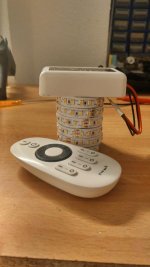
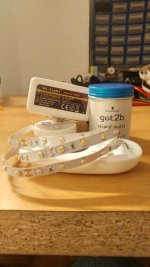
I might have solved an issue I ve had forever: practical light sources that are color tuneable, color accurate, dimmable and (nobody asked for that but whatever) wirelessly controllable. Yeah. Oh and cheap. And yes the controller is a consumer product but for whatever reason: it is flicker free. At least for 1/50s and 1/100s.
Attachments

KurtF
Well-known member
I might have solved an issue I ve had forever: practical light sources that are color tuneable, color accurate, dimmable and (nobody asked for that but whatever) wirelessly controllable. Yeah. Oh and cheap. And yes the controller is a consumer product but for whatever reason: it is flicker free. At least for 1/50s and 1/100s.
Details? What controller? What strip and Power Supply? Curious folksies want to know.
nyvz
Veteran
I might have solved an issue I ve had forever: practical light sources that are color tuneable, color accurate, dimmable and (nobody asked for that but whatever) wirelessly controllable. Yeah. Oh and cheap. And yes the controller is a consumer product but for whatever reason: it is flicker free. At least for 1/50s and 1/100s.
View attachment 133461
That low PWM frequency is very limiting. I've tested most of the cheapo wifi/bt/milight controllers and if you're lucky you'll get 500hz pwm which still isn't enough, most are lower. Very surprising no one has made a flicker free controller like that yet. There are lots of them but few publish pwn frequency and most have unacceptably low PWM. Just get one of those $2 10khz or 20khz motor speed controls, not wireless but pretty simple and works at far more shutter speeds. The reason low PWM lights are so bad is not so much that you have to shoot at 1/50th, though that's a deal breaker in some cameras that will always see flicker because of slightly varying actual shutters and limited shutter speed options, it's more that if you ever have to shoot with actual practicals or screens or anything else that forces you into a 1/60th or other particular shutter you'll be stuck with deciding which to let flicker...
I have made good use of the junky controllers that force you into 1/50th shutter but they aren't really general purpose due to that limitation.
Jim Arthurs
Well-known member
I agree with Noah 100%. Very good innovation on a problem, and your idea is sound, just move over to a higher frequency PWM controller from ebay (links in various posts above)... these consumer level dimmer devices will REALLY fall down in short order... for proof, just look at this Mi-light review video, around :59 seconds in...
https://www.youtube.com/watch?time_continue=3&v=mzbKiyyL2S0
Gads, that gives PWM a bad rep worthy of Phil's concerns...
https://www.youtube.com/watch?time_continue=3&v=mzbKiyyL2S0
Gads, that gives PWM a bad rep worthy of Phil's concerns...
Yes! I totally and wholeheartedly agree. But for my low budget sets where I control everything they work. I tested them to see their limitations. Nothing for a set where money counts. But great for my short films.
I actually have these 10K 10A dimmers coming in any day
The color tuning wheel on the milights is so very cool I hate turning two knobs to mix color and brightness. I wanf overall brightness and color that stays at the same level. I wish this system existed with 10khz...
I actually have these 10K 10A dimmers coming in any day
The color tuning wheel on the milights is so very cool I hate turning two knobs to mix color and brightness. I wanf overall brightness and color that stays at the same level. I wish this system existed with 10khz...
Phil Rhodes
Well-known member
I'm looking into it; it can probably be done for not much money, but I fear if we want full colour mixing and calibrated whites then the cost of parts and labour may make it not worthwhile.
Do we care much about being able to dim these things smoothly, on shot? Some of the off the shelf power converter boards aren't very stable and can flicker when changing brightness.
P
Do we care much about being able to dim these things smoothly, on shot? Some of the off the shelf power converter boards aren't very stable and can flicker when changing brightness.
P