Creating a community for DIY LED lighting stuff (DIY Quasars inside)

Btw, just came across what looks like an inexpensive DMX LED controller that has pretty good fast PWM speeds. Looks like most are 7.8KHz but they may make them in 11KHz and 15KHz (and 1KHz). For $13 I may give it a try. Problem is the high speed PWM ones are only 3CH for some reason... But they are 8Ax3CH so they might be a good match for my 600W 24V meanwell power supply. Or perhaps I just throw two together to get channels to spare and cover RGBAW plus an extra W channel.

https://www.aliexpress.com/item/1pc...-max-8A-3CH-decoder-DC5V-24V/32789188761.html
 
The PCA9635PW would be an ideal driver for this type of project. It offers a plethora of output channels and 8-bit 97KHz PWM for each. To my knowledge, there are currently no boards on the market which feature this driver, so it would be necessary to design your own. I may open source mine at some point.

It is important to bear in mind that PWM frequency only needs to be a consideration if you are not filtering the output. Many of the cheap controllers linked on previous pages effectively consist of a cheap microcontroller switching one or more transistors at a given frequency and delivering the result directly to the LEDs.

The vast majority of mid-range lights intended for use in front of a camera sensor will employ large filter capacitors on the primary side, filter capacitors in front of the constant current DC-DC switch-mode converter and filter capacitors and inductors across the output. Provided the manufacturer does not allow mains ripple to contaminate the output (see: Godox), the end result should be flicker-free at any shutter speed.
 
Last edited:
So it turns out glu lighting is the s*%t. I now have 800W of 5600K in form of something similar to a Litemat 4L. Wasnt cheap, mats where 400€ about with taxes, 40A PSU is 250€ and controller 150€. Need to get coroplast and heatsinks and a kinoflo mount. Even more spendy.

Thinking about buying more bicolor mats. But I wonder how to effectively control them. Any one found a bicolor controll solution that is flicker free?
 
Thinking about buying more bicolor mats. But I wonder how to effectively control them. Any one found a bicolor controll solution that is flicker free?

https://koraled.com/collections/controllers/products/koraled-solaris-ctrl-universal-led-controller

These have had a really tortured history as part of a RedUser groupbuy with a lot of missed ship dates/deadlines and online ordering is a huge crapshoot, but if you can actually get your hands on them the feedback was quite good. Hoping the company pulls through because their products look pretty solid, customer service is just a mess right now.
 
I own the solaris controller. It's a solid unit but really not a good value, just too expensive and the wifi and rf controllability has been a work in progress for 3 years.
 
I own the solaris controller. It's a solid unit but really not a good value, just too expensive and the wifi and rf controllability has been a work in progress for 3 years.

How does it work wired? I see them popping up for $100 from time to time on RU and have been curious. Worth it at that price if I don't plan to use wifi/RF?
 
If you don't want to go deeper into the topic it is alright. But keep in mind that a 10A high frequency own dimmer is like 2.5€ - so if you don't mind the lack of a color knob and are ok to dim each channel individually than thats a much better deal. But that's why I asking. I hope to find a cheaper solution.
 
If you don't want to go deeper into the topic it is alright. But keep in mind that a 10A high frequency own dimmer is like 2.5€ - so if you don't mind the lack of a color knob and are ok to dim each channel individually than thats a much better deal. But that's why I asking. I hope to find a cheaper solution.

Which 10A dimmer are you talking about? I have a bunch of ~100W 20khz ones that were about $2 which match up well with my tecled 100W strips but it'd be nice to have a backup controller or a cheap way to make a second one that's cheaper. Also can you share your info on the glu panels? I remember looking at them but there isn't much info online. Only see 24cmx48cm 200w bicolor panels on Alibaba etc. Did you order direct? Do they have a price list?
 
They do just shoot them a message for a price list. They are cheap af. Get a sample so they will give you less than MOQ.
 
Question re:the power supply in the very first post (DIY quasar vid) - any leads on the design for that dimmer switch? Been trying to figure out how to build a switch that can fade between 2 different outputs like that!
 
You will need to program a micro controller. But that goes beyond my knowledge. I had a friend do that for me.
 
Hey gang, thought maybe a fellow DIYer might have some input or insights into a project I'm working on.... I'm building some DIY LED tube lights right now. Using 12V led strips, wrapped around a cylinder (currently using some thin wooden dowels), inside a frosted acrylic tube, has some end caps, and a female plug at one end to accept power. The end that has the power input gets a bit warmer to the touch than I'd like - rest of the tube stays cool. This is only happening after like 30+ min of continuous full powered use, which I don't really anticipate happening in real world scenarios very often. I'm using 12v everything, so I don't think I'm pumping too much current into it, I'm guessing maybe it's sealed 'too well' and there's literally just no where for that heat to go? Keep in mind I'm not an electrician or engineer, simply a 35 year old man with a passion for DIY projects. Any info, insights, or suggestions are much appreciated :)
 
Hey gang, thought maybe a fellow DIYer might have some input or insights into a project I'm working on.... I'm building some DIY LED tube lights right now. Using 12V led strips, wrapped around a cylinder (currently using some thin wooden dowels), inside a frosted acrylic tube, has some end caps, and a female plug at one end to accept power. The end that has the power input gets a bit warmer to the touch than I'd like - rest of the tube stays cool. This is only happening after like 30+ min of continuous full powered use, which I don't really anticipate happening in real world scenarios very often. I'm using 12v everything, so I don't think I'm pumping too much current into it, I'm guessing maybe it's sealed 'too well' and there's literally just no where for that heat to go? Keep in mind I'm not an electrician or engineer, simply a 35 year old man with a passion for DIY projects. Any info, insights, or suggestions are much appreciated :)

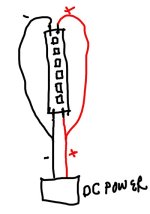
Sorry I didn't see this earlier... so the fix is simple if not intuitive... you need to connect with additional wires your + and - 12volt power wires to the other end of the LED strip as well as the end you're currently hooked to, so you're feeding power and grounding at BOTH ENDS of the LED strip at the same time. On even longer runs of LED strips (I'm assuming since it's in a tube it's fairly short) you may need to solder in the power and ground at the halfway point, or every meter or so depending on the LED load.

This should do it!

Regards,
 
is there any info on how much heat led strips can handle? Has anyone wired up 200 or 300 watts of strips on a single panel? how necessary is heat sink?
 
Thanks so much for the response, this is great info but I have follow up Qs! I'm using about a half-strip of LEDs, so 2.5M or ~8', which seems short enough to not need to solder anything at the midpoint. There's a power connection on one end of the tube, and nothing at the other currently, the LED strip is cut/ends inside the tube at the other end, but if I understand correctly I need to (somehow) connect power/ground at that other end of the tube as well? Any suggestions on doing that? Does it need an 'output' - even if I don't use it? Or would grounding it to something at that far end work? Thanks again for the input :)
 
The length is a factor (wire resistance) but also the number of LEDs/meter/yard is important.. the more LEDs, the more power needs to be distributed. I would suggest you run wires up along the strip and add power and ground to the other end.
Perhaps a very crappy drawing will help...

LED STRIP HOOKUP.jpg
 
Jim, I appreciate this a ton - don't poo poo your artistic ability btw, the drawing did exactly what it needed to. There isn't anything wrong with wiring the lights this way? I.E. I won't shock the **** out of myself or burn something up? A massive thanks again for helping me understand this better. - Adam
 
Back
Top