Creating a community for DIY LED lighting stuff (DIY Quasars inside)

Nope, no fire flame or damage, in fact it will reduce that potential outcome... all it will do from your point of observation is reduce the heat of the wires and those first few LED elements at the beginning of the strip, and also as a bonus, even out the brightness along the length of the strand.

But talk is cheap, here's a quick video demonstrating that crappy diagram...

http://files.datausa.com/imageshoppe/outgoing/LED_DIY/LED_STRIP_POWERING.mp4

One funny aside, that's the high CRI daylight strip we were discussing earlier in this thread. As I was waiting to allow time for heat to build up, my dog came into the room and laid on the strip, thinking it was a genuine patch of sunshine. So "dog approved light quality".

Hope this helps
 
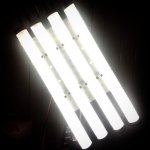
Not perfect but they are done - 4x 18" long 95+CRI daylight balanced LED tubes (in a pseudo kino-flo style arrangement here). I'm going to use these as-is and make some modifications in another batch (likely going to do some longer RGB capable ones). Tutorial video coming atcha soon too. 69794322_2484305615133185_2278825186725724160_o.jpg
 
Just finished my build / tutorial video (https://youtu.be/qnP8-wJVAlI) - a few notes: I wasn't able to get both the power input AND the dowel inside the end of the tube, hoping to remedy that in a future build; and finding a 'prettier' way to adhere the power adapter to the end would be good (standard industrial strength super glue didn't work well w/ repeated use). ANY input whatsoever is always appreciated. -Adam
 
Ok, I'll bite. I'm working on converting an Altman Micro Ellipse to a 50W COB LED. With their beam zoom from 25-50 degrees, focus, cookie/gobo holder, and frame shutters, they are a versatile light. I'm cutting off the back half, losing the yolk and ballast, and adding a 3D printed housing for a fan, heatsink, and COB. I have two of them. I thought it would be fun to play with and see what happens. I'm thinking the 3D plastic may not work with the heatsink. I'm waiting on the heatsink for my next step. I wouldn't advise anyone to do this. This is just for fun to see how it comes out.

https://www.altmanlighting.com/product/micro-ellipse-a/
 
Ok, I'll bite. I'm working on converting an Altman Micro Ellipse to a 50W COB LED. With their beam zoom from 25-50 degrees, focus, cookie/gobo holder, and frame shutters, they are a versatile light. I'm cutting off the back half, losing the yolk and ballast, and adding a 3D printed housing for a fan, heatsink, and COB. I have two of them. I thought it would be fun to play with and see what happens. I'm thinking the 3D plastic may not work with the heatsink. I'm waiting on the heatsink for my next step. I wouldn't advise anyone to do this. This is just for fun to see how it comes out.

https://www.altmanlighting.com/product/micro-ellipse-a/

That is very cool. Having that kind of control is pretty interesting. Being able to get hard light that controlled is nice. So often in digital, i have avoided hard light, but when it can be set just about ambient levels and carved out some shape, it can be amazing. Hope to see the result. Awesome that you have a handle on 3D printing!
 
I've not done 3D printing. I can make the 3D drawing and come up with the file for printing. The local library has a 3D printer. You give them the file and they will print it. That's one more thing I'll be learning about. This is going to go very slow, so don't expect to see any results soon.
 
I've not done 3D printing. I can make the 3D drawing and come up with the file for printing. The local library has a 3D printer. You give them the file and they will print it. That's one more thing I'll be learning about. This is going to go very slow, so don't expect to see any results soon.

Hi Paul, ironically the tipping point for my journey into 3D printing was this older thread from 2017, which you contributed to...

http://www.dvxuser.com/V6/showthrea...light-project&highlight=printed+light+housing

Every word is gold in post #10 and most still applies today. I now have three printers; two filament and one resin printer, and while I haven't actually printed a lamp housing, they are all working every week on various projects, I've probably put 40 or more rolls of filament through them by now. I have made some VERY useful things for myself, and in all honesty think these 3D printers are actually more reliable (and easy to repair with cheap components) than your average 2D Epson or HP office printer. The experience certainly wasn't a fad for me, but now a key component of both work and play. I will say that they are near pointless for folks who can't or won't CAD or 3D model out their own designs. There's only so many vases and dragon figures you can print off of Thingiverse before you go mad... :)

The Chinese clones are just as capable as the more expensive machines and your price of entry can be around $300 or less today (under $200 before the Pandemic). They still are more for mechanically minded folks, as you are, and I think you'd have a great deal of fun with one. I'm not sure how far you'll get with the public library access approach. I think you'll hit a frustration point pretty quickly with whatever particular limitations in skill or equipment they have, and how slowly you can iterate... I literally have boxes of "fails"!

I hope this helps,
 
Thanks for the notes Jim. Yes, that thread about the light enclosure got me looking at printers. I've looked at buying a 3D printer many times. Every time I look, I decide not to do it. Everything I read says "Run away, you'll have nothing but frustration". I also can't decide which one is right for me. No matter how much you read and how many videos you watch, until you get your hands on one, it's really hard to tell what its all about.

Another reason is that I have a 3 axis Bridgeport and that bugger is a pain in the butt. It works great, but I spent a good part of the day yesterday just trying to mill 6 holes in a plate. There's so much to the process of setting things up and going carefully to make sure you don't do something stupid. It just seems that 3D printing is more of the same. If I felt that it was about half as complicated and tedious as the mill, I might consider it.

I'm hoping the library experience will be encouraging and not discouraging. That's all part of why I expect this to go slowly.
 
Thanks for the notes Jim. Yes, that thread about the light enclosure got me looking at printers. I've looked at buying a 3D printer many times. Every time I look, I decide not to do it. Everything I read says "Run away, you'll have nothing but frustration". I also can't decide which one is right for me. No matter how much you read and how many videos you watch, until you get your hands on one, it's really hard to tell what its all about.

Another reason is that I have a 3 axis Bridgeport and that bugger is a pain in the butt. It works great, but I spent a good part of the day yesterday just trying to mill 6 holes in a plate. There's so much to the process of setting things up and going carefully to make sure you don't do something stupid. It just seems that 3D printing is more of the same. If I felt that it was about half as complicated and tedious as the mill, I might consider it.

I'm hoping the library experience will be encouraging and not discouraging. That's all part of why I expect this to go slowly.

I have a completely manual MicroMark mini-mill, and would LOVE to have your Bridgeport... and totally get the frustration. Before I knew what I was getting into, a good VFX friend of mine that does a lot of machining described it this way... "The good news is you can make what you want. The bad news it will take you five times as long as you think it will."

So you're more than half way there with your skills... understanding how to tram the 3D printer is dead simple compared to tramming a mill. Everything will make sense. And it's unlikely it will take a finger off like a mill will. Start with PLA and when you get good with that, you'll have to use PTEG filament to provide some heat resistance. Remember, itt's just a fancy glue gun under motion control using gcode. You can use it to make jigs for your machining, even, or any of a thousand things.

Get an Ender 3 Pro. Super simple to assemble, with a heated bed hot enough for even ABS. Good build volume. You'll love it, and eventually wonder how you got along without it.
 
I have a completely manual MicroMark mini-mill, and would LOVE to have your Bridgeport...

Ahh, nice. I do a lot of manual stuff with mine. It came from Sandia Labs, so they destroyed the Accurite controller in case it had any secrets on it. They left the motors, glass scales, and driver boards. I had to reverse engineer Accurite's pinout and add a controller that Mach3 talks to. It took a while.


And it's unlikely it will take a finger off like a mill will. ...

That's the thing. The Bridgeport has servo motors that are the size of a big car starter. I've watched it shear off a 1/2" end mill like it was wood when the program went wrong. The motors don't bog down. They just keep going. I'm always a bit apprehensive when the computer is running it.

If the library run goes well, it might motivate me to buy one. I'm sure, as you said, I'd be making lots of things if I had one.
 
I'm late to this chat, but is anyone having trouble with the LED strip lights getting very (very) hot when wound around a dowel like that and enclosed?

Haven't read the whole thread, apologies if this's been talked about.

P
 
I'm late to this chat, but is anyone having trouble with the LED strip lights getting very (very) hot when wound around a dowel like that and enclosed?

Haven't read the whole thread, apologies if this's been talked about.

P

Reference post #61 or earlier...
 
Reference post #61 or earlier...

Ah, yes, I thought that might be a bit of an issue.

Y'know, it really isn't complicated to do a slightly better job than this; at least some of the heat being generated in these designs is coming from the current-limiting resistors on the LED strip. It just needs to be a string of LEDs (or a bunch thereof) and a constant-current driver.

The issue is finding a way to build the emitter arrays. Most of the ways I can think of would involve soldering.

If that's not alarming to anyone I could maybe put something together about it?
 
Back
Top