Coronavirus Impact

Status
Not open for further replies.
Yeah that's explosive growth. Depressing to see my USA shoot to the top. (Though I bet China is still #1 in reality.)

Yes not good viewing. The Brits are really pushing this 40 x under reporting angle. The perspective of historical hindsight will no doubt throw more light on what happened. Little solace to the world currently though. Stay well all.

Chris Young.
 
I don't have evidence of internal CDC deliberations but I have evidence of mask effectiveness and usage in Asia.

An article from March 18 referencing CDC guidelines that sick people should wear masks so as not to spread the virus. (But if you're an asymptomatic carrier, you don't know you're sick!) https://www.healthline.com/health/cold-flu/mask

January 24 Shanghai mandates mask wearing in public places (article from Feb 8): http://www.xinhuanet.com/english/2020-02/08/c_138766346.htm

Feb 27 South Korea: "Health authorities are now advising everyone to wear masks in the presence of others and to change into a new mask every day." https://abcnews.go.com/Internationa...ace-masks-domestically-amid/story?id=69254114

Nobody thinks masks are 100% effective at preventing transmission. The main purpose is to block most of the droplets from a person's mouth when they are speaking. Even a bandana is better than nothing. N95 particle respirators are more effective at keeping the virus from entering the mask, which is why doctors are risking their jobs to publicly shame their hospitals for not providing them.

There's a mountain of evidence for the helpfulness of facial coverings and a reasonable motive for why the CDC wouldn't want the public to buy up the stock they need for healthcare providers.

At worst, they misled us. At best, they got the basics totally wrong.

How could anyone have gotten it right? The Chinese decided to keep the world in the dark. As far as mask usage in Asia, it's more of a fashion statement.
 
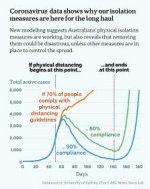
Not really relevant to many but it is interesting to see how Aussie has calculated how the lockdown compliance will affect the virus spread. 70% lockdown compliance and we have run away viral spread. 90% compliance brings us close to zero spread at 140 days in from lockdown. Interesting.

Chris Young

coronavirus-covid-modelling-isolation-chart-data-data.jpg
https://amp.abc.net.au/article/12114978
 
I could really expand on the stupidity of these cameras in my efforts to grab some CV17 shots.

I left the D600 on overnight and it did not have a flat battery, and is ready to fire in about .25 of a second.

The EX1 drains its batteries, so one has, to get it shooting..
-put the battery on
-boot the camera
It takes about 30s to get shooting.

Filming an passing ambulance 30s is.. for ever.
 
If you want to see what kind of games are being played with the disease modeling and the dishonesty of various claims with regard to how effective our social distancing measures are for the longer term and what the likely outcome will be, see here:

A call to honesty in pandemic modeling

Basically, the models that are currently being used show a benefit for short-term suppression of transmission of the virus through social distancing. HOWEVER, these are MISLEADING, since they just push the peak beyond the duration of the current model, lol!

And until an effective vaccine (or cure) is available, if you just push the peak until later in the year, it will be actually counterproductive, as the virus spreads more rapidly in colder weather!

Bottom line, as usual, credibility is at stake - to quote from the article:

"The public should not be misled by presenting false stories of hope to motivate behavior in the short-term. Public health depends on public trust. If we claim now that our models show that 2 months of mitigations will cut deaths by 90%, why will anyone believe us 2 months from now when the story has to change?"

Stay safe, and don't just rely on what someone says (including me!). Use masks, wash hands, don't assume something is safe regardless of what the supposed "authority" tells you.
 
Public health depends on public trust.
The record is dismal, things I remember being said over time:

- the virus does not spread from person to person
- it's under control
- it's a problem in China we are not going to have the same problem
- it's like the flu
- more people die of the flu
- we are totally prepared
- people who are warning about the dangers are just scaremongers
- it's not very contagious
- stopping people from certain regions from entering our borders is racist and does not help
- we should not test people who might have it, we only test if they come from infected countries or know someone who is infected
- go on with living, the risk is low - NYC new year parade, LA marathon, New Orleans Mardi grass, etc
- this is only dangerous for old people who are already sick
- asymptomatic people are not infectious
- don't wear a mask it does not help

Models based on the number of known cases are pretty much useless because they correlate strongly with the number of tests taken. Furthermore, there are regions in the country where there is a 5-8 days backlog in testing. Also, people who have no symptoms or very mild symptoms tend not to get tested.

By not doing serological random sampling we don't have a clue how many people are actually infected or have been infected in a given region.
And based on this clueless information we make charts with "predictions" that only tell us to "hide in our caves" like shaking bunnies for "some indeterminate time", because if we do that the nasty virus will magically go away after that "indeterminate time".
And the trend is even worse, more and more voices want even stricter lockdowns, isolation of people who have it, closing beaches and parks, not being able to go out at all except for getting food once a week, etc.

Yes, it is going to be a disaster, but I fear it will be a disaster one way or another, lockdown or not.

Will fear of death stop us from living?
 
Last edited:
[...]
Yes, it is going to be a disaster, but I fear it will be a disaster one way or another, lockdown or not.

Will fear of death stop us from living?

As the rest of Europe lives under lockdown, Sweden keeps calm and carries on

"Tegnell even questions whether stopping the progress of the virus is desirable. “We are just trying to slow it, because this disease will never go away. If you manage, like South Korea, to get rid of it, even they say that they count on it coming back. Stopping it might even be negative, because you would have a pent-up possible spread of the disease, and then once you open the gates, there is a possibility that there would be an even worse outcome.”

While Tegnell understands that he will be blamed if Sweden ends up in a similar situation to that of Italy, he refuses to be panicked. “I wouldn’t be too surprised if it ended up about the same way for all of us, irrespective of what we’re doing,” he says. “I’m not so sure that what we’re doing is affecting the spread very much. But we will see.”
"

The UK started with a similar approach, but Sweden is very different to the UK. You can fit its entire population in Greater London, an area 400x smaller.
 
Colder water is slower than warmer water for cleaning purposes. Unless you are trying to absorb a gas.

"You often hear that the water you wash with should be warm, but why? After all, even hot water does not kill bacteria or viruses until you get to a temperature that would scald the skin.

"Cold water will work, but you have to make sure you work really vigorously to get a lather and get everything soapy and bubbly," said chemist Bill Wuest, an associate professor at Emory University who studies disinfectants.

To do that, you might need to sing "Happy Birthday" three times instead of two.

"Warm water with soap gets a much better lather, more bubbles," Wuest said. "It's an indication that the soap is ... trying to encapsulate the dirt and the bacteria and the viruses in them."

https://www.cnn.com/2020/03/24/heal...sanitizer-coronavirus-wellness-scn/index.html
 
The key for Sweden will be whether their health service can handle the influx of Coronavirus patients. The entire reason for the existence of the "flatten the curve" approach is not that it's hoping to lessen the absolute number of victims, it's to distribute the same number of victims but in a longer time frame, that way instead of all of them bunching up at once and overwhelming health services, they trickle in and the services have the time to treat most of them. Now, if Sweden is confindent that they have the resources to service all patients even if they come in bunched up, then there is no reason to flatten the curve. The NHS has been underfunded for years, and has had to operate close to full capacity even during ordinary times, so they have no room to spare and no excess capacity - this is a recipe for disaster should any challenge present itself, because they'll immediately be overwhelmed - it's like the folks who live paycheck to paycheck, it's one big expense (say car repair) away from disaster. The tragedy of the NHS is that this was a well-known situation, so it's natural to anticipate "if we are operating close to our full capacity, what happens when disaster strikes and the demand skyrockets?" - this was entirely foreseeable; failure to address this was a political failure... but I'll stop here as I don't want to get into politics.

Be that as it may, if Sweden thinks they can handle the excess demand, then this strategy might be a winner for them - but if they are wrong, they'll end up like Italy. Since the number of victims is the same regardless of whether you flatten the curve or not, Sweden has elected NOT to flatten the curve, because the flattening the curve carries with it an extreme economic penalty as the world is finding out, and that penalty is not less money in your pocket, it's actually a penalty in health outcomes - there's a calculation that the 2008 Recession cost horrific 500,000 excess cancer deaths:

Financial crisis caused 500,000 extra cancer deaths, according to Lancet study

So you are paying a cost - a health cost - by depressing the economy. Sweden ran the numbers and calculated that the health costs of economic breakdown do not justify the approach of flattening the curve. Ultimately, the irony is that Sweden is a small country, and whatever they do with their economy depends very little on their own actions, if the world experiences an economic shock, it will spill over to little Sweden very quickly and there's nothing they can do about that.
 
The UK started with a similar approach, but Sweden is very different to the UK. You can fit its entire population in Greater London, an area 400x smaller.

The UK reversed course after realizing how many would die. I don't see why the relative population size of Sweden would change the relative death toll.
- unless you're saying they have a lot of social distance already? Probably not true of urban areas. Sweden has at least closed high school and higher education, banned gatherings of over 50 people, and limited the number of people in restaurants. In a year, we'll know if they should have done more or if we overreacted.

People who are arguing to reopen the economy now - we are buying ourselves valuable time by flattening the curve to:

- restock supplies and prep hospitals
- experiment with drug therapies
- boost our testing and contact tracing capacity

So even though an outbreak will begin after we end mitigation efforts, we will be better prepared to handle it and fewer patients will die.

One drug (hydroxychloroquine) has shown effectiveness in a small Chinese study, but only if it's taken in the early stages of disease. But right now due to capacity constraints, nobody goes to the hospital or gets a test unless they're already seriously ill!

Finally, South Korea never closed their economy because they had robust testing and contact tracing systems in place that allowed them to quarantine clusters of patients before they could infect others. If we get our outbreak under control, we can do what they are doing.
 
Last edited:
Also - who in this forum thinks your work would go back to normal without government restrictions? Are film productions and sports leagues going to risk death or permanent lung damage for their stars during an uncontrolled pandemic? No.
 
Status
Not open for further replies.
Back
Top