Coronavirus Impact

Status
Not open for further replies.
[...]
I'm just imagining as more masks become available suddenly the CDC will say, "Actually, turns out these masks do help prevent inhaling the virus as well. We just had previously wanted to prioritize them for those who are already sick."

You're catching on :)

Like I said, the trust is gone - they'll say anything to further whatever immediate goals they have, and not bat an eye when they contradict themselves later on. See my last few posts, including the modeling of disease in the "flattening curve" approach, and how that was taken down - with the conclusion that we can't rely on those who deliberately tell the public one thing only to then contradict themselves later. The whole mask thing is an ongoing scandal. Folks in Asia were buying masks like crazy as soon as the news from China trickled out - here's an article about Taiwan from February 10:

Taiwanese Scramble for Face Masks to Stop Deadly Virus From Nearby China
By Ralph Jennings
February 10, 2020 03:16 AM

So everyone out there already knew they needed masks specifically to protect themselves from this virus, as soon as the news came out of China, but our CDC knew nothing about putting on masks to protect from the virus? As the article clearly says, this was to protect against this virus - and jokers here want to claim that masks in Asia are just a fashion statement, lol. No, people were scrambling like crazy to buy and the government and industry unleashed all capacity to produce more - this is not a fashion outbreak, lol.

Look, you need to think for yourself. Don't take anyone's word for it, no matter the source (including me!). You are responsible for your own protection, because to the authorities you are just an individual and completely dispensable. Use your brain, and take all precautions. Don't listen to nonsense - a bandana is better than nothing, and an N95 mask is better than a bandana - those are just facts. Given that the folks on the front lines, the healthcare workers, doctors and so on - those are the folks who are taking the risk on behalf of ALL OF US - I therefore think it's only decent to leave the N95 masks for them, and limit ourselves to lesser grade masks - yes, they are inferior, but then again, you are not facing the same type of constant exposure and danger that a nurse or doctor does, so you can afford to sacrifice a little. But do it with your eyes open and fully informed - that's what bothers me about the authorities lying, their lack of trust in the public... why not just say "please leave the N95 masks for frontline personnel", do it openly and honestly, instead of lying.
 
At what point do we get back to normal in regards to supplies in the stores and everyday isn't like going to the grocery store after they've said that a cat 3 hurricane is coming
Nobody really knows, but since you and I know "hurricane mode" well, I'd guess (totally pulling out of my a$$, of course), 3 months for hurricane mode of TP, alcohol, etc.

And as my long post above points out, if a Walgreens gets 12-15 bottles of alcohol, the supply chain is broken somewhere...
 
Can someone explain why N95 masks are supposedly effective to prevent exhaling the virus, but not effective to prevent inhaling the virus? So these masks are designed to let virus in but not let it out?

I get any type of covering would reduce the distance of a sneeze or cough, but normal breathing, not so much. The way I'd imagine it, if it can prevent the virus from going out, it can prevent it from coming in. Someone want to clarify?

I'm just imagining as more masks become available suddenly the CDC will say, "Actually, turns out these masks do help prevent inhaling the virus as well. We just had previously wanted to prioritize them for those who are already sick."

Where did you read that? I thought that N95 masks DO prevent the virus from coming in because they seal and have very small pores.

I read that surgical masks do not because they allow air in at the sides. But they can block most of the droplets and aerosols from escaping during exhalation.
 
You're catching on :)

But do it with your eyes open and fully informed - that's what bothers me about the authorities lying, their lack of trust in the public... why not just say "please leave the N95 masks for frontline personnel", do it openly and honestly, instead of lying.

I'm not happy about being lied to, but I can sort of understand it. People were stealing masks from hospitals even though they were told they didn't work. I don't think the value of self-sacrifice for the community is as strong in the US as in some countries.

Look at the toilet paper situation...
 
Nobody really knows, but since you and I know "hurricane mode" well, I'd guess (totally pulling out of my a$$, of course), 3 months for hurricane mode of TP, alcohol, etc.

And as my long post above points out, if a Walgreens gets 12-15 bottles of alcohol, the supply chain is broken somewhere...

Maybe not broken in the traditional sense that we'd think(facility shut down, diminished capacity, etc.), just vastly, hugely overwhelmed. From what I read a few weeks ago, a lot(most? all?) of the manufacturers run at full capacity all the time and the "supply chain" (manufacturing, warehousing, transportation, store stock) is set-up and optimized to work with what they've determined to be normal consumption to maximize profit and limit excess product just sitting, so there is no room for "error" and once it's disturbed or disrupted it's very hard to correct.

Just using the alcohol, for example, a typical Walgreens or CVS may only sell 15 or 20 bottles in a typical week, because I'm guessing most people don't use huge quantities of it normally. I think I have a half(maybe 3/4) full bottle under my sink and that bottle is several years old, so on average, I'm buying a bottle every, maybe, three to five years.
 
That's exactly right. The supply chain system went to a 'just in time' method decades ago. Instead of everyone having stock in warehouses (which is taxed), most operations are now optimized to manufacture and deliver just in time with a minimum of warehousing extra stock. So any change can't easily be compensated for, especially if manufacturing lines are optimized for a given rate of production. There may not be any excess capacity to produce more.

https://en.wikipedia.org/wiki/Just-in-time_manufacturing
 
Last edited:
I believe your wrong, are you in a bubble ?

The Tokyo Olympics are cancelled until 2021 !

Grand Prix F1 canned, Australian AFL Football & Rugby canned, clubs going broke !!
 
Where did you read that? I thought that N95 masks DO prevent the virus from coming in because they seal and have very small pores.

I read that surgical masks do not because they allow air in at the sides. But they can block most of the droplets and aerosols from escaping during exhalation.
That's correct, N95 masks prevent viruses from being inhaled. Surgical masks protect patients from exhaling doctors infecting them.
 
That's exactly right. The supply chain system went to a 'just in time' method decades ago. Instead of everyone having stock in warehouses (which is taxed), most operations are now optimized to manufacture and deliver just in time with a minimum of warehousing extra stock. So any change can't easily be compensated for, especially if manufacturing lines are optimized for a given rate of production. There may not be any excess capacity to produce more.

Which begs the question, do "we" change and go back, at least to some degree, of having "excess" stock for situations like this? Especially goods and supplies that have long shelf lives. Let's say the chain is set-up for 7 days, meaning that whatever is manufactured today is completely through the chain and sold and into the hands of the consumer in no more than 7 days. I'd guess that if there was 4 weeks worth of buffer product, for a lot of items, then we probably wouldn't have a lot of the shortages and unavailability that we're experiencing now.

I'm sure there are lots of people that would argue NO to changing the "just in time" supply chain method, that this is an extraordinary event, which of course it is, but that its still no reason to change the current way of operating and sacrificing on the bottom line "just in case" it happens again. Unfortunately, and as much as I want to be wrong, I don't think this will be the last time that something like this happens in a lot of our lifetimes. They may not be yearly occurrences, but I think they're going to become more frequent than every 100 years.
 
  • Like
Reactions: HKB
Which begs the question, do "we" change and go back, at least to some degree, of having "excess" stock for situations like this? Especially goods and supplies that have long shelf lives. Let's say the chain is set-up for 7 days, meaning that whatever is manufactured today is completely through the chain and sold and into the hands of the consumer in no more than 7 days. I'd guess that if there was 4 weeks worth of buffer product, for a lot of items, then we probably wouldn't have a lot of the shortages and unavailability that we're experiencing now.

I'm sure there are lots of people that would argue NO to changing the "just in time" supply chain method, that this is an extraordinary event, which of course it is, but that its still no reason to change the current way of operating and sacrificing on the bottom line "just in case" it happens again. Unfortunately, and as much as I want to be wrong, I don't think this will be the last time that something like this happens in a lot of our lifetimes. They may not be yearly occurrences, but I think they're going to become more frequent than every 100 years.

I think we just need a larger stockpile (and perhaps manufacturing capacity) for basic infectious disease healthcare supplies. I don't see why people can't continue "just in time" for most everything else...
 
  • Like
Reactions: HKB
I sense that you're joking. But the Chinese wear visors like this - apparently nobody's worried about the droplets coming up from beneath because they generally float to the ground.

https://pbs.twimg.com/media/EUpJTy2UwAIfjSF?format=jpg&name=large
I don't think that's nearly as good of eye protection as swimming googles. Maybe if all you do is stand still then you wouldn't need to worry about gravity ground bound germs, but a gust of wind, air-conditioning, or simply walking about (or say descending on stairs) could push the air upwards into your eyes with that visor.

3M sells sealed goggles which look better cosmetically than swimming goggles. The advantage of swimming goggles is that many people already own them.

Ah, so you were serious. Yeah I also would have thought that an updraft would defeat the visor but someone was trying to convince me otherwise... my wife has a prenatal visit next week and I'm advising her to wear gloves, her woodshop safety goggles, and a N100 mask (N95 would be fine too, but I bought a N100 in February and haven't opened it yet). I'm planning on using a scarf or something in public until surgical masks are available. I haven't considered my eyewear. Hitherto, I've just been wearing gloves to the grocery store, but obviously I could do more.
 
Which begs the question, do "we" change and go back, at least to some degree, of having "excess" stock for situations like this? Especially goods and supplies that have long shelf lives. Let's say the chain is set-up for 7 days, meaning that whatever is manufactured today is completely through the chain and sold and into the hands of the consumer in no more than 7 days. I'd guess that if there was 4 weeks worth of buffer product, for a lot of items, then we probably wouldn't have a lot of the shortages and unavailability that we're experiencing now.

I'm sure there are lots of people that would argue NO to changing the "just in time" supply chain method, that this is an extraordinary event, which of course it is, but that its still no reason to change the current way of operating and sacrificing on the bottom line "just in case" it happens again. Unfortunately, and as much as I want to be wrong, I don't think this will be the last time that something like this happens in a lot of our lifetimes. They may not be yearly occurrences, but I think they're going to become more frequent than every 100 years.

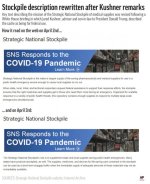
JIT is pretty well embedded. Motivations are efficiency of operation and profitability. It won't change unless those two motivators justify it or the law intercedes. No one is going to change for once-a-century (or less) events. The national stockpile concept is more appropriate.
 
Here's one of many logistical issues you'd never think about. From Freightwaves - "... The problem is the airfreight capacity needed to relieve the current backlogs is scarce as passenger flights, which account for more than half of total airfreight capacity via lower deck belly space, have largely been grounded."
 
Here's one of many logistical issues you'd never think about. From Freightwaves - "... The problem is the airfreight capacity needed to relieve the current backlogs is scarce as passenger flights, which account for more than half of total airfreight capacity via lower deck belly space, have largely been grounded."

I really think the only way to avoid this predicament is to have a massive testing, contact tracing and quarantine program ready to go, like South Korea did.

Apparently, Asian countries were better prepared for covid because they faced SARS not too long ago.
 
  • Like
Reactions: HKB
Status
Not open for further replies.
Back
Top