Chinese Ball + LED ?

yoclay

Veteran
So I am looking for a way to add some rim light to a couple walking in the street during the day. The light needs to give them a feeling of being in late winter light. The scene is being shot with a stead. We can't install lights on the street. My idea is to use a boom like sound engineers use. To get it above and slightly behind them with some spill both behind and on one side of their faces. The light needs to be light enough for someone to walk with the couple (as if he was a sound guy).
My solution is to try and use a chinese ball which is light in weight and can be rotated up and down on the boom creating a feeling of incident sunlight occasionally hitting them - as if they were walking on a bridge with trestles that occasionally blocked or let the light through, or as if the sun was poking through the trees.
The problem is that I need to find a way to use LED's and it has to be powered off of batteries. No generators or AC current. I currently do this with LED panels and V-Mounts, but I have not seen a Chinese ball solution.
Your suggestions?
 
We have done this using a China ball with a large CFL inside, mounted to a long collapsible boom, and powered by a battery fed inverter.
 
If it's full-on daytime, you'll need a lot of power.

The Alzo bulb/ballast is one of the best china ball daylight solutions out there. Not sure how much time you'd get from a battery/inverter setup. But it's about $140 and useful for all kinds of stuff.
 
Unless you were shooting this at dusk where the ambient levels have dropped significantly, you'd have a hard time getting enough exposure out of a china ball to play as a convincing sun source (and even then, the lack of sun anyone else in the frame and lowered overall contrast would be something of a giveaway). Also, sunlight is a hard source and a china ball is soft. You would be better off with a hard light source such as a fresnel. As far as the effect simulating light coming through a trestle or trees, that's a pretty specific effect that is more akin to the source being wiped on and off than faded in and out. It would be more effective to have a grip walk alongside the light source and walk a solid into the path of the light and out the other side (repeat as needed) to achieve that look.

In general, the more backlit the source is relative to the actors, the more realistic it will play. As it comes around the side of the face it will have more of a tendency to look unconvincing as a sun source.
 
I too find the idea of daylight and battery powered lighting at odds. Daylight is also difficult to plan effect lighting. An overcast day or a sunny day - hugely different looks, and to get shadows from the sun is easy, to get them 'in spite of' the sun, very tricky indeed.
 
Ok so a member at another forum you all know and love suggested using 10m of LED ribbon lighting in a china ball at the end of the boom. Powered by a DTAP to an Anton Bauer. Apparently this was exactly how they lit the characters in movement in many of the scenes in American Hustle. The strip lighting is a cool white which is used for architectural and industrial applications with 1020 led's per 5m. The strip is dimmable and can also be made to change color (Tungsten to daylight as well) depending upon the control units you put on it. Lite Gear sells this strip for video/film production purchases, but charges 2-3 times more for it than from other manufactures (about $1K). You can pick it up for about $300 currently on the market, but without any control units.

By the way, a 5m strip puts out 12000 lumens. That's the equivalent of several litepanels.

I think this is a very interesting solution and might just provide a nice rim/side kick even in general day light.
My goal was alway to have this as an occasional wipe, not as a constant source, though I do agree the source may need to be harder.


Screen shot 2014-01-04 at 10.53.37 PM.jpg
 
Last edited:
I thought about suggesting Literibbon as I own quite a bit of it and use it regularly. However, every time I mention it on messages boards, it tends to invite indignant responses due to the pricing so I generally don't bother any more.
 
You could always power a 400w joker inside of a 20" lantern with battery belts. You'll have to swap them out quite often, but it'd give you the punch and softness you're looking for.
 
I thought about suggesting Literibbon as I own quite a bit of it and use it regularly. However, every time I mention it on messages boards, it tends to invite indignant responses due to the pricing so I generally don't bother any more.

Keep fighting the good fight Charles! Eventually the internet will understand 'cost' and 'value' are different measures.
 
I have to wonder how much of an effect any instrument that can be placed in a china ball and run off of batteries could possibly have in daylight. 6k PARs are generally the smallest lights I see used for daytime exteriors. I think you'll be much better off with some bead board.
 
I have to wonder how much of an effect any instrument that can be placed in a china ball and run off of batteries could possibly have in daylight. 6k PARs are generally the smallest lights I see used for daytime exteriors. I think you'll be much better off with some bead board.

It all depends on proximity. A china ball at 12000 lumens 3 feet from a moving subject could be as powerful as a par 25 feet away. Remember that's the point of the boom pole. Also could be easier for continued/varied panning on the subject over a long walking shot. You would need several pars installed at strategic locations to accomplish the same thing.

Of course a lot depends too on how wide the frame is when speaking about rim/edge lighting. There is always a trade off. My ideal would be to have pars poking through various architectural and natural obstructions, but that is not going to be possible on this gig. Live sound, no AC power source, not enough personnel and a limited budget.
 
Last edited:
12000 lumens inside a china ball. Assuming the china ball is made up of diffusion material that has a 1 stop loss, then the resultant lumens my be somewhere in the vicinity of 6000 lumens that are radiated out in all directions.
My question is, why does the light need to go spilled behind the stage/subject area as that hemispherical 'waste' is 50% of the total radiated light. ?
So now, according to my calculations, only 3000 lumens are 'effectively' used from an initial start of 12,000. Assuming also that the leds are 100 lumens/watt efficient, the power needed from the source, most likely battery, is 100 watts draw. That is a huge price to pay for the paltry 3000 lumen output at the effective end of the sphere. That sphere may have to be mighty close to the subject to have the effect desired.
Am I missing something ?
 
It all depends on proximity. A china ball at 12000 lumens 3 feet from a moving subject could be as powerful as a par 25 feet away. Remember that's the point of the boom pole. Also could be easier for continued/varied panning on the subject over a long walking shot. You would need several pars installed at strategic locations to accomplish the same thing.

Of course a lot depends too on how wide the frame is when speaking about rim/edge lighting. There is always a trade off. My ideal would be to have pars poking through various architectural and natural obstructions, but that is not going to be possible on this gig. Live sound, no AC power source, not enough personnel and a limited budget.

I still think you'll be better off with bead board. No electricity required and even at a great distance away it will provide a huge amount of light in the area that it's focused on. Have the grips hollywood it or put it on a wheeled stand to follow your subject if necessary. But I really cannot think of a single instrument that will work with a china ball that will provide enough light to make a difference in full daylight, even at 3 feet away.
 
I still think you'll be better off with bead board. No electricity required and even at a great distance away it will provide a huge amount of light in the area that it's focused on. Have the grips hollywood it or put it on a wheeled stand to follow your subject if necessary. But I really cannot think of a single instrument that will work with a china ball that will provide enough light to make a difference in full daylight, even at 3 feet away.

No, I don't think that's going to work in this shooting circumstance. Will never be able to position it properly in relation to the sun while moving with a walking couple over a long stead shot. There isn't even the space to back up in certain circumstances without being in the shot (on a bridge or in the middle of traffic). Thank you though for the suggestion.
 
So mate, what is your thought in terms of where you see the sun's actual position when you shoot this? Or does it vary throughout the shot, i.e. you turn corners.
 
A couple of portable 2K battery powered with a narrowish beam at a distance may be the only option here, especially when we're talking about the sun in daylight. A china ball in daylight is just like a decoration.
 
So mate, what is your thought in terms of where you see the sun's actual position when you shoot this? Or does it vary throughout the shot, i.e. you turn corners.​

Generally speaking it is behind them on the trajectories that I have chosen. The problem is that we get a lot of grey days in Paris during the winter. It often needs a helping hand. Basically, trying to give it a bit of romantic edge, nostalgic glow to what would often be very flat conditions. It is not intended to be a key light, just a rim. Mostly behind them with a touch of spill on their cheeks.

12000 lumens inside a china ball. Assuming the china ball is made up of diffusion material that has a 1 stop loss, then the resultant lumens my be somewhere in the vicinity of 6000 lumens that are radiated out in all directions.
My question is, why does the light need to go spilled behind the stage/subject area as that hemispherical 'waste' is 50% of the total radiated light. ?
So now, according to my calculations, only 3000 lumens are 'effectively' used from an initial start of 12,000. Assuming also that the leds are 100 lumens/watt efficient, the power needed from the source, most likely battery, is 100 watts draw. That is a huge price to pay for the paltry 3000 lumen output at the effective end of the sphere. That sphere may have to be mighty close to the subject to have the effect desired.
Am I missing something ?

If the ball is light enough and placed off center, just turning the boom on its axis while they are walking should create some changing light conditions. The advantage is that a sphere will create roll-off, whereas a flat light source will often be too abrupt. Also it was recommended to me to put 10 meters in the ball, so that is actually 24000 lumens. If the light is warmed slightly it should also create more contrast with the grey day blueness which is life here for months on end.

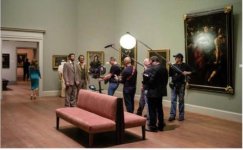
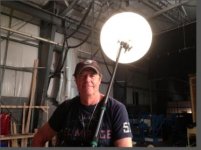
Screen shot 2014-01-06 at 3.24.50 AM.jpg
(not me)
 
Last edited:
If you are going with Literibbon there would be no need to pan the ball on and off, you can regulate the intensity with a dimmer. Also keep in mind that the ribbon comes in two densities, so you can double the output simply by choosing the tigher spacing.

An overcast day has a color temperature significantly cooler than 5600K, so any daylight output will appear warmer than the surroundings by default.

Using a china ball will result in light pushing out in all directions as noted above, so depending on the width of your shot, you may see its effect on the ground, on buildings, poles or other people that they pass along the way etc. Picture a person passing them on the same side as the ball, or a mailbox etc. They will travel through the light gag, becoming toplight and then frontlit as they recede into the background, in both instances hotter than the main subjects are backlit. If you were to use the Literibbon, it would make sense to mount it in such a way so that it is all facing one direction and black out the bottom of the ball (via duvetyne skirt or even black spray paint). You'd still see broad projection towards the actors but it would diminish or eliminate the light from going the "wrong" way and giving away the source.

Overall, this setup will produce quite a stylized effect and I think it would well be worth shooting a test before committing to the concept, especially if it involves purchasing 10m of Literibbon! A CFL daylight bulb in a china ball at dusk would provide enough illumination to recreate the relative values.

I actually had already planned on a black side, or at least piling the ribbon up more on one side than the other. However, beyond that I was curious what would happen if I created a silver butterfly for the back to reflect a slightly harder edge into the scene from the sides of the ball. Just using a dimmer is probably not what I am after though because I want to see the light moving on them a little as well. Yes, it is very stylized and requires play before D-Day but intuitively I think it could work. After that the choreography of stead, sound boom, and light boom with the actors in movement is where the time consuming aspect comes in.
 
Back
Top