Charles Papert and the XL1 Seinfeld commercial.

MDKfilms

Well-known member
So I was tooling around some old websites that I use to go to but alas a lot of them are now defunct. But there is one about the XL1 still out there and I found this photo. I guess I forgot that Mr Papert was an early pioneer in the digital forum. Hope this brings back fond memories Charles. Cheers.

Here is a link to more old photos.

http://www.dvinfo.net/canon/images/images20.php
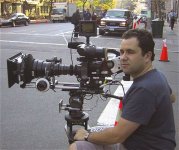
IMG_2474.JPG
 
Ha, thanks. Haven't watched those in a while. It looks like the link to the article I wrote about the shoot is still intact. That was a pretty crazy experience, using DV cameras on a project that big. The notion of a long form commercial/short film was a brand new one at that point. The pieces actually aired on network TV, much to our surprise...that was back when network engineers adhered to pretty strict standards and I was a little surprised the footage passed muster!
 
I was just reading the specs (the camera is "up" on Amazon, listed as discontinued). Canon claims that XL1's pixel shifting technology makes its 270K sensor perform on the level of a 410K sensor. I wonder why the same technology isn't used more widely besides the stills (Olympus EM-5/EM1 series, Pentax K1).
 
Canon claims that XL1's pixel shifting technology makes its 270K sensor perform on the level of a 410K sensor.
Canon's pixel shifting technology is actually Panasonic technology, as the XL1 used Panasonic's sensor from the original 3CCD DV camera, the AG-EZ1. That's the same technology employed by the HVX200 to make its 960x540 CCDs deliver HD images.

It works, and it allows bigger pixels that can gather more light, but it requires three chips. It's not actually "shifting" any pixels; the tech is that the three chips are intentionally offset by 1/2 pixel in both the horizontal and vertical directions. It leads to higher luminance resolution (a theoretical increase of up to 1.4x, but probably a more practical increase of about 25%) but it cannot increase color resolution.

Pixel shift is, in some ways, a 3-chip version of the Bayer/demosaic approach that a single-chip camera uses. The two techniques are quite related.

In later years Panasonic discouraged the use of the term "pixel shift" as it incorrectly implies that the sensors are actually somehow shifting. Panasonic's preferred term became "spatial offset."

I wonder why the same technology isn't used more widely besides the stills (Olympus EM-5/EM1 series, Pentax K1)
Well, because that's an entirely different ball of wax! :)

In the stills camera, as I understand the Pentax system, they're actually taking four separate images and are actually shifting the sensor in different directions, then merging/combining those results into one still photo (probably using a similar demosaic technique as a Bayer pattern or as the spatial offset system used).

To implement that in a video camera would be... well, it'd be a technological challenge. You'd have to have a micro-repositionable sensor, and you'd have to be shifting the living hell out of it at a minimum of, what, 240 times per second, and then you'd have the potential motion artifacts that would come from the time difference between photo #1 and photo #4 of each final frame... and you'd have the inherent problem that each exposure could be for no more than 25% of the exposure time of today's frame-by-frame exposures, so you'd probably have an increased noise issue that would have to be dealt with... I'm sure they'll do it some day, but I don't know if they can effectively implement something like that today.
 
Last edited:
Thanks Barry for that explanation. Fun occasionally to look back...as someone who used both those cameras (but certainly never with a rig that looked like Charles!)
 
The XL1 (and later XL1s) was one of my favorite cameras I've ever owned. It really was the first affordable video camera that felt cinematic, because it delivered something other than 60i, plus that softer skin-tone oriented Canon look. I shot a lot of shorts on it. Later I switched to a DVX100 and boy is this the worst place to ever say this but...I never liked the look as much as the XL1. Everything became a moving target after that; I didn't love the XLH1, and the HVX200 was to me a DVX with more resolution..and then we got into the DSLR stuff and I didn't think about 1/3" chips after that.

The Seinfeld/AMEX jobs were a bit of an anomaly. That was when DV became flavor of the month and the original idea for these was to shoot down and dirty with a small crew (something I subsequently did with Jerry when shooting promos for his "Bee Movie" five or so years later on HVX200's). On this one, Barry Levinson was hired to direct and gradually it became a full-fledged shoot and the budget balloooned--yet somehow the camera behind the big lens package remained DV!
 
... In the stills camera, as I understand the Pentax system, they're actually taking four separate images and are actually shifting the sensor in different directions, then merging/combining those results into one still photo (probably using a similar demosaic technique as a Bayer pattern or as the spatial offset system used).

To implement that in a video camera would be... well, it'd be a technological challenge. You'd have to have a micro-repositionable sensor, and you'd have to be shifting the living hell out of it at a minimum of, what, 240 times per second, and then you'd have the potential motion artifacts that would come from the time difference between photo #1 and photo #4 of each final frame... and you'd have the inherent problem that each exposure could be for no more than 25% of the exposure time of today's frame-by-frame exposures, so you'd probably have an increased noise issue that would have to be dealt with... I'm sure they'll do it some day, but I don't know if they can effectively implement something like that today.

Olympus EM1 takes eights shots, Pentax K1 four. Pentax uses the motion correction technology to smooth out the motion related artifacts. Olympus just tells you not to use it on anything but some landscaping and interiors. The Camera Store guys took a few samples of a heat escape valve and the vapors - which kept going up, up and up - got horribly fuzzy.

On the other hand, Olympus almost quadruples its resolution in Raw and two and a halves it in JPEG while Pentax resorts to it in order to increase the dynamic range (I guess, kind of/sort of Red cameras get those three extra stops of DR). A video camera might be able to do a combination of both but would obviously need a lot more processing power for a "live" shoot. On the other hand, K1 has 36 million pixels and Olympus has 16 or 20, while a video camera might only have to do an HD-to-2.5K/4K type of improvement.

The demosaic process is something I thought about in conjunction with the various upscaling plug-ins. Most of them don't really do much but there's a surely an incredibly expensive pro package that requires a big time workstation and a ton of time to essentially double-triple-quadruple the available data in order to up the resolution if not the DR. The consumer TV's try to do it in real time and generally fail as well.
 
Last edited:
I'm glad this thread has produced some interest. Ya know Charles I went and saw the other segment shot in Manhattan, on Youtube, and I noticed that in the comments section no one was commenting on what it was shot on! After the first 30 seconds I forget about the tech and love the story. Seinfeld and Warburton help. Both clips look so good! If I didn't know otherwise I would say they looked like any other commercial shot on 35mm. What have we learned Dorothy? I think the capture medium is only as good as the talent behind it! And a great lighting package:)

Cheers.
 
When did the switch from the 16mm/35mm film to fully digital take place in TV/advertising?

ARRI D20 came out in 2005. Panavision Genesis in 2006. Dalsa Origin came out around 2007.

As I am looking at the "Gilmore Girls" DVD data, it looks like it was in 16:9 in seasons 5-7 and in 4:3 prior to that.
 
Aspect ratio and digital acquisition were changes independent from each other. We started "protecting" for 16:9 as far back as 2000 or so, if memory serves. The first show I can remember working on that actually started airing in 16:9 was ER, somewhere around 2005. The last season of ER in 2009 they made the switch from 35mm to RED. To help confuse things further, various blu-rays and streaming remasters have emerged in 16:9 of shows that never aired that way during their initial run. It has been amusing to note the sudden appearance of apple boxes and light stands on the edges of frames here and there, as the framing protection wasn't taken very seriously for a few years. We used to joke that a good job for the future would be doing digital cleanup on all of that junk when the 16:9 versions were being mastered...I shouldn't be all that surprised that there seems to have been little of that done. It is interesting to see shots that I remember specifically trying to cram three or four people across into a tight 4:3 composition now emerge in a widescreen version with all that extra room on the sides!

I think as far as the transition from 35mm to digital in TV episodic, that is a little hard to pin down but I would put it around 2013, give or take.
 
I got an "HD Ready" TV in the fall of 2002 but didn't purchase an HD tuner for it until the Superbowl'04. That was in HD but very little else was. Most scripted shows rolled over for 2005-06 season, IIRC. In fact, I got a 27" "improved SD/480p" set in 2006 since most shows were still in 4:3. The World Cup that year was in HD on ABC OTA but only in SD on Univision and ESPN.

Of course, in 2006, a 37" flat panel no-brand 720p TV was ~ $1,500 too.
 
Aspect ratio and digital acquisition were changes independent from each other. We started "protecting" for 16:9 as far back as 2000 or so, if memory serves. The first show I can remember working on that actually started airing in 16:9 was ER, somewhere around 2005. The last season of ER in 2009 they made the switch from 35mm to RED. To help confuse things further, various blu-rays and streaming remasters have emerged in 16:9 of shows that never aired that way during their initial run. It has been amusing to note the sudden appearance of apple boxes and light stands on the edges of frames here and there, as the framing protection wasn't taken very seriously for a few years. We used to joke that a good job for the future would be doing digital cleanup on all of that junk when the 16:9 versions were being mastered...I shouldn't be all that surprised that there seems to have been little of that done. It is interesting to see shots that I remember specifically trying to cram three or four people across into a tight 4:3 composition now emerge in a widescreen version with all that extra room on the sides!

I think as far as the transition from 35mm to digital in TV episodic, that is a little hard to pin down but I would put it around 2013, give or take.

I remember in ~2003 we had begun shooting Sports Century in HD. Even if you had been shooting on the original SD show, you had to be "vetted" to shoot on the HD shows. This was more or less a "crown jewel" series for ESPN at the time and they put a lot into it. They rented F900's and HD support gear packages and flew them all over the country for us. There was a strict list of specs we were to adhere to when shooting, including one I hated: "shoot 4:3, protect 16:9". But what was even worse than that, the shows that they spent LOTS of money on to shoot and master in HD(remember, HD was still a big deal back then), ONLY AIRED IN 16:9 HD ONCE. Every subsequent airing of each individual episode, after its premier, was in SD 4:3. To this day, I don't think I've ever seen any of the interviews I shot(I've seen some come out of the vault because of historical content with subjects that have passed-away) in 16:9 and HD, except for the premiers.
 
Last edited:
Back
Top