
Navigation
Install the app
How to install the app on iOS
Follow along with the video below to see how to install our site as a web app on your home screen.
Note: This feature may not be available in some browsers.
More options
You are using an out of date browser. It may not display this or other websites correctly.
You should upgrade or use an alternative browser.
You should upgrade or use an alternative browser.
C200: CFast compatability - Cards that support VPG-130
- Thread starter Fahnon
- Start date

puredrifting
Major Contributor
Got my FreeTail 256GB CFast. I let the C200 record it to full a few times and it works as you'd expect. Same with the ProGrades.
Is the Freetail brittle plastic junky feeling or robust Nylon reinforced plastic that feels like it will last a long time and stand up to abuse? We'd all love to save money but if the plastic feel is crappy, I'd rather pay for the ProGrades. Will you go deep into the Freetails and buy more or more ProGrades? I've been using the Egodisks hard for a year now and they still look and feel new, none of the paint or graphics have chipped or worn off.

brettsherman
Well-known member
My FreeTail is metal top and bottom with plastic sides, just like all my other Compact Flash and CFast. At least I believe so. I’ll look when I get home.
Seems pretty solid to me. However, I'm having one issue with my 512gb FreeTail. Most times on a single power-up, the C200 does not read the card. It requires a second power on/off cycle to finally be able to record to the card. Annoying to say the least. And it definitely freaks you out when your camera says it can't read or write to the card. I'll upgrade my C200 firmware first to see if that resolves it. Then I'll contact Freetail and see about getting a replacement.
Also, here's a pic of the FreeTail and ProGrade cards. Interestingly, the "branding" label is on the back/bottom of the FreeTail (and the front is blank). Similar to the Transcend CFX600s I used with my C300 Mark II. So, the empty side is "up" in the card reader. Not a big deal.
Construction on the two is the same... I imagine it's similar to the EgoDisk.
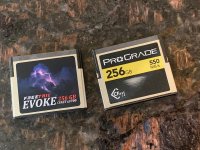
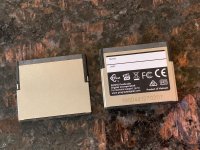
Construction on the two is the same... I imagine it's similar to the EgoDisk.
puredrifting
Major Contributor
Also, here's a pic of the FreeTail and ProGrade cards. Interestingly, the "branding" label is on the back/bottom of the FreeTail (and the front is blank). Similar to the Transcend CFX600s I used with my C300 Mark II. So, the empty side is "up" in the card reader. Not a big deal.
Construction on the two is the same... I imagine it's similar to the EgoDisk.
View attachment 133081
View attachment 133082
Thanks for the report. If the Freetail works just as well as the ProGrade and EgoDisk, once you have some hours on them, I can't see a reason to not buy them. It's about time we didn't have to pay a fortune for media for the C200!
puredrifting
Major Contributor
Yeah. I’m shooting a passion project in the next few weeks that I could always reshoot if necessary... so I’ll give them a workout and report back. If all goes well, I’ll likely snag at least one more FreeTail. $175 is a steal.
Definitely. I will buy half a dozen of them if they are reliable.

Pascal Parvex
Well-known member
You guys really risk your data for a few bucks saved?
You guys really risk your data for a few bucks saved?
First off, when you’re talking enough card to store a solid day or two of shooting, it’s not a “few bucks.” It’s literally THOUSANDS of bucks.
Second, it’s a calculated risk. All card brands fail. In order to make buying a lower priced card not worth it, you’d have to present evidence that they fail at a higher rate than SanDisk (or I guess Sony?). I’ve seen no evidence that that’s the case. In fact, in my own anecdotal situation, I’ve only lost one card in the past several years... a SanDisk Extreme Pro SDXC card. Over all the time I’ve been using memory cards of various types (first digital camera was a Canon EOS Digital Rebel... the original one) I’ve had fewer than 10 card failures... and nearly all of those were early in the history. Before this Extreme Pro died, I can’t remember a failed card.
There’s a lot of evidence that EgoDisk cards work just dandy... and ProGrade are quality cards from most of the team that used to make Lexar cards before Micron halted production. FreeTail the jury’s still out on in my mind, but I’ll give it a workout with stuff I can afford to lose (or drop back to MP4) before I endorse them.
To tell you the truth, I worry far more about the storage systems down the chain on the editing systems than I do cards. They’re far more likely to fail and they take a lot more work with them when they do.
puredrifting
Major Contributor
You guys really risk your data for a few bucks saved?
I did it on my documentary because I didn't have a choice. I bought an Ego disk card and ran dozens of tests, shooting short clips, long clips, filling up the cards, downloading them, erasing them. When I felt the one I had had been reliable for at least ten hours of shooting tests, I used it on some paying gigs and continued to work great. I then bought five more of them and ran tests on each. Flawless. Ended up shooting 60TB of CRL so far on the half dozen over the span of a year. To buy these same cards as the Sandisks that are "approved" (that really doesn't mean what you think it does, I've worked closely with the Canon engineers in Burbank) would have cost me the same cost as the camera, $7,500.00, I bought by half dozen Egodisks for $,1800.00. I see no improvement in the end result or reliability in using the approved cards so waste thousands of dollars for a perceived peace of mind that in reality doesn't exist?
You fly, using approved cards is the same as the TSA here in the States, it's "Security Theater". It makes people feel better, safer, like the Government is protecting them when in reality, the TSA is an agency filled with minimum wage incompetent boobs and terrorists use alternative means to smuggle weapons onto planes. Has the existence of the TSA or any of the overseas agencies that do the same prevented every instance of air-based terrorism over the past two decades? Not even close. IMHO, certified CFast cards are the same issue, all certified means is that the manufacturer did methodical testing and deemed a card "certified". Doesn't mean it cannot fail. We take a risk using any card shooting 4K or greater resolution in any camera. Memory becomes corrupted and goes bad. I had an "approved" Sandisk Extreme 256GB card go bad in my C200 last week. Canon certified that card, it's worked fine for a year and all of a sudden, it gave me a repeated "SD card error". I tried reformatting it in other devices, then again in the C200 and it gave me the same error. So I trashed it and ordered another. CFast is no different.
If the Freetail cards provide a track record of reliability over long use over a population of even a few dozen C200 shooters, I have no problem using them. It's all about "prove it to me through use" and it's really a matter of trust. Not saying Sandisk isn't good but are they ten times more reliable than the these cheap cards because they cost almost ten times as much? I seriously doubt it. It's all about calculated risk. I always shoot proxy so in the event of a card failure, I would have a low data rate 2K proxy. Wouldn't be ideal but for 90% of our clients, they would never know the difference as most of them don't care or even actively request that we don't shoot 4K or RAW. I mostly shoot RAW for our own internal projects and it's a risk I have taken and been successful with.
Last edited:
Pascal Parvex
Well-known member
Thanks for the feedback. As far as I know, cheap cards use second choice memory. But it seems this is not always true. ProGrade look very fine to me.
puredrifting
Major Contributor
Thanks for the feedback. As far as I know, cheap cards use second choice memory. But it seems this is not always true. ProGrade look very fine to me.
I can only tell you that a computer engineer who shall remain unnamed once told me that all of the non-Sandisk cards probably buy rejected 512GB memory from whomever Sandisk buys the chips from. Theese inexpensive cards possibly use these second rate 512GB chips and map out the faulty sectors which is how we end up with low cost 256GB cards. Makes sense to me. Why else would Sandisk charge and get $1,000.00 for the same card that everyone is selling for $179.00 to $300.00? There is no free ride and from what I am told, like most things in electronics, the raw components all come from just a few manufacturers. A company like Egodisk or Prograde buys the memory chips and they supply/make their own enclosure and RAID controller. If these are like P2 cards, they have two to four memory chips that are hardware raided together inside the enclosure. As we have all been saying, it's all about risk assesment and redundancy is ALWAYS a good idea. Even shooting 2k proxy is a safety measure for me. Not as good as RAW obviously but good enough for a lot things.
I can only tell you that a computer engineer who shall remain unnamed once told me that all of the non-Sandisk cards probably buy rejected 512GB memory from whomever Sandisk buys the chips from. Theese inexpensive cards possibly use these second rate 512GB chips and map out the faulty sectors which is how we end up with low cost 256GB cards. Makes sense to me. Why else would Sandisk charge and get $1,000.00 for the same card that everyone is selling for $179.00 to $300.00? There is no free ride and from what I am told, like most things in electronics, the raw components all come from just a few manufacturers. A company like Egodisk or Prograde buys the memory chips and they supply/make their own enclosure and RAID controller. If these are like P2 cards, they have two to four memory chips that are hardware raided together inside the enclosure. As we have all been saying, it's all about risk assesment and redundancy is ALWAYS a good idea. Even shooting 2k proxy is a safety measure for me. Not as good as RAW obviously but good enough for a lot things.
They may not even be buying rejected 512GB chips... they may just be happy with a much lower markup than SanDisk is.
SanDisk is a luxury brand... like Apple. They charge $1000 for a 512GB CFast largely because they can... just like Apple charges a hefty premium for the collection of chips and components that go into a MacBook Pro vs. buying those same parts in a no-name brand computer.
Stills2HDConvert
Well-known member
They may not even be buying rejected 512GB chips... they may just be happy with a much lower markup than SanDisk is.
SanDisk is a luxury brand... like Apple. They charge $1000 for a 512GB CFast largely because they can... just like Apple charges a hefty premium for the collection of chips and components that go into a MacBook Pro vs. buying those same parts in a no-name brand computer.
True.
We don't really have any proof they're buying rejected Sandisk chips.
That's pure speculation.
Crimson engine says that some are made in Vietnam and some are made in China.
"Made" probably means assembled. And from parts from where?
We don't know if the chips are actually fabbed in China or Vietnam or not.
I have a good bit of experience with Sandisk SSDs and we don't buy them anymore.
We've had so many fail.
The technology is nearly identical to cFAST.
Both SATA.
Different voltage.
To those who're using Sandisk CFast cards, I'd say, good luck.
puredrifting
Major Contributor
It is definitely conjecture but the engineer who told me this would probably be in a position and organization where he would have some insider information about this. That's the only reason I mentioned it, but yes, don't know if it's true. I'm just happy that we have choices finally for CFast cards and $179.00 for 256GB is mighty tempting, just going to wait a few months and see what the brave people find out.
puredrifting
Major Contributor
I’ve done two shoots on mine now... one to full, the other it was the second card so it only got about 3/4 full. Both shoots made it back to the computer with no drama.
Thanks! Good to know.

QuickHitRecord
Veteran
I'm reviving an old thread, in case any new C200 owners like me might find it useful. I have been looking for reliable 512GB cards to record CRL. Canon's official list is outdated and doesn't include any 512GB cards. I reached out to their Cinema division to address rumors that the C200 does not support any CFast cards larger than 256GB. Here is what Canon had to say:
Then I reached out to the three "premium" card manufacturers, and here's what I heard back:
SanDisk 512GB Extreme PRO CFast 2.0 Memory Card - $600 on B&H
Angelbird 512GB AV Pro CF CFast 2.0 Memory Card - $530 on B&H
ProGrade Digital 512GB CFast 2.0 Memory Card - $700 on B&H (or $1200 for two)
I also contacted the company behind the most inexpensive 512GB CFast card that I could find in July 2019:
Silicon Power 512GB CFast 2.0 CinemaPro CFX310 Memory Card - $300 on Amazon
I am not aware of any specific limitations when using cards in the vicinity of 512 GB. I believe the reason you probably don't see them on the list is because, like you mentioned, it was released in a time before cards that size were industry standard.
Then I reached out to the three "premium" card manufacturers, and here's what I heard back:
SanDisk 512GB Extreme PRO CFast 2.0 Memory Card - $600 on B&H
Please allow me to inform you that your CFast card is supported by your camera [the C200]... This card will work fine with your camera.
Angelbird 512GB AV Pro CF CFast 2.0 Memory Card - $530 on B&H
While technically our AV PRO CF 512GB cards are compatible with the Canon C200 we did see some strange issues, yes. From time to time the C200 won't detect cards that are already formatted, requiring the user to insert the card multiple times for the camera to successfully establish a link to the card. This will NOT happen if the cards are 'empty' although.
ProGrade Digital 512GB CFast 2.0 Memory Card - $700 on B&H (or $1200 for two)
Our engineering lab confirms ProGrade Digital CFast 512GB memory cards perform flawlessly across all benchmark testing on the Canon EOS C200 Cinema Camera.
I also contacted the company behind the most inexpensive 512GB CFast card that I could find in July 2019:
Silicon Power 512GB CFast 2.0 CinemaPro CFX310 Memory Card - $300 on Amazon
Regarding your question, actually, we don’t really test it on Canon C200. However, the performance of our CFX310 512GB is R: up to 529 MB/s, W: up to 198 MB/s (based on card reader), also you could refer to the detailed specification of our CFX310 512GB as below to make sure if it meets your request. https://www.silicon-power.com/web/product-CFX310
Last edited: