Canon R5 Announced with 8k

Oh no. Imagine the disappointment felt by all the people who bought thin tape and rice kernels for this. Now they have no use for thin tape and rice kernels. They’re going to need our help, to reach deep, pull 6k out of our pockets.

What overheats faster - R5 or a 5-minute rice?
 
Undone tweets: "To those asking: No, I don't have any thoughts on the R5's new firmware--I don't have the camera anymore. In fact, Canon stopped replying to my emails after my review came out."
 
Supposedly the ambient temperature sensor on the R5 is near the ports on the left side of the camera. And apparently by pointing a fan at this side of the camera, you can now record 4K HQ or 8K up to 90 minutes (and perhaps indefinitely) at least indoors. Recovery times also improve even with brief fan cooling between recordings. This approach doesn't seem to help as much in hotter outdoor environments:
https://www.jodumedia.com/blog/eos-r5-with-firmware-11-is-now-a-video-beast
 
What this suggests to me that, while the temperature sensors were always there, they were simply disabled by the original firmware or, at least, disabled on the very low temp range. That's why a freezer trick was useless. A simple correction puts them in play ... subject to further revisions and modifications.
 
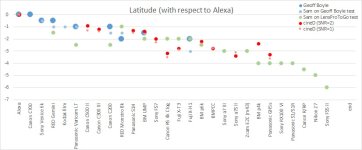
OK, so, since several people pointed out the merits of an objective and numeric measure of DR... Here's my summary chart, now with the cined results added.

Sin título.jpg

In many cases they are completely in line, in others there are strong deviations, and I'm not sure I prefer the objective measure in those cases. A clear example is the comparison of the p4k and the p6k: I see a huge difference in the lensprotogo video, but cined only finds a difference of 0.2 stops. But on that same article they post images of a -5.0 stops image from each camera pushed up, and the difference is striking. Their numbers only look at signal and noise, and *for me* the underexposed p4k image is useless not because of noise, but because of color; which you're unlikely to notice on a monochrome chart.

BTW, somebody asked about the alexa numbers from cined: I found them in the post that summarizes the methodology, here.
 
OK, so, since several people pointed out the merits of an objective and numeric measure of DR... Here's my summary chart, now with the cined results added.

View attachment 140294

In many cases they are completely in line, in others there are strong deviations, and I'm not sure I prefer the objective measure in those cases. A clear example is the comparison of the p4k and the p6k: I see a huge difference in the lensprotogo video, but cined only finds a difference of 0.2 stops. But on that same article they post images of a -5.0 stops image from each camera pushed up, and the difference is striking. Their numbers only look at signal and noise, and *for me* the underexposed p4k image is useless not because of noise, but because of color; which you're unlikely to notice on a monochrome chart.

BTW, somebody asked about the alexa numbers from cined: I found them in the post that summarizes the methodology, here.

Good intentions, bad science. The Alexa needs to be retested under the current test configuration, using the new Xyla backlit transmissive chart. It's an apples to oranges comparison, and so is lenspro2go versus CineD. I do appreciate having the data points, but just as you don't always "prefer" the objective measurement because it's not revealing of the certain differences that you saw, in the larger view it represents the folly of trying to use one single metric to pick winners and losers, and it forces you into doing the exact same thing as Gunther; putting your own "spin" on the numbers.
 
BTW, somebody asked about the alexa numbers from cined: I found them in the post that summarizes the methodology, here.

Samuel, what happens when consistent methodology can't be applied? The answer is you get inconsistent results. How many times have you heard someone say that ABC's NLE renders a darker image than XYZ's? And so you get to this line from the article you linked:

Our (CineD) Workflow using IMATEST:

Using the FFMPEG library we extract the highest quality I-frames directly from the video file, using this command (thereby avoiding any influence of an editing system):

ffmpeg -i videofile.mov -vf „select=eq(pict_type\,I)“ -vsync vfr framegrab%04d.tiff

When we are being told that even small differences like downscaling and compression are having a measurable effect on the DR number, what do you do when FFMPEG can't process a CRL or BRAW or rd3 file? The answer is you go to the ABC or XYZ nle's above. I have been using utilities like ffmpeg, AVISynth, mkvmerge, x264, x265 for years. It is a never ending job to find, link, compile file format libraries from multiple authors, most untested, unproven. Version builds and binaries are updated multiple times daily from multiple authors. It's a wonderful collaboration of authors when it works. But the bottom line as a methodology for pulling i-frames from a video clip is a moving target of new file formats. So yes, if file format is recognizable inside an mov container, ffmpeg is a great tool for extracting a high quality tiff image to be used by imatest for DR testing. But if it's unsupported in ffmpeg, you have to use somebody's NLE to extract a frame, somebody's whose image may be processed uniquely different than another's, and small differences we have seen appear in the generated DR number, again, illustrating the folly of trying to understand everything from one thing.
 
I'd love to have all the cameras at hand and be able to test and see how they perform. I've done it before, but always with the cheap ones I get to use. In this case, I'm just trying to get as much info as I can, from different sources. My favorite test is the kind that lensprotogo runs, but there's always the possibility that they botched a test with a specific camera (Varicam LT I'm looking at you), and it's a subjective test of "what's good enough" where conclusions will change depending on the person and even the time (I've rewatched the videos and tweaked the numbers more than once). The cineD test has the positive that it's a machine giving us the number, though it's true that there are manual steps in the way and it's not clear those are not introducing differences. When results from all sources are similar, I just take them (the UMP has around half a stop better DR than the p6k). When they are not, well, it's not that easy, I have to choose which ones to believe and why (I think the p4k has at least one stop less DR than the p6k: no matter what imatest says, those p4k shadows are not usable).

Sometimes results are different and still make sense: going back to the main topic of this thread, the R5 seems to have as much DR as the UMP but with a noisier floor. If you don't like that noise, then it's not useful DR and it falls behind. Compared with previous Canon cameras at this price or lower, it's a big improvement.
 
Last edited:
Maybe, maybe not. Which is which? :cheesy:

What're you gonna do, upscale the image and tell the client you shot it in 4K? What if you have to deliver the raw footage?

If you are doing all your own editing or you don't have clients who demand 4K delivery, then have at it. But for many people, it's not an option
 
What're you gonna do, upscale the image and tell the client you shot it in 4K? What if you have to deliver the raw footage?

If you are doing all your own editing or you don't have clients who demand 4K delivery, then have at it. But for many people, it's not an option

Why is everyone so unwilling to engage? Just watch and tell me which is which.
 
Although it's good the test is in 4K, it's actually not the best comparison/evaluation if it's a competition (guessing game).

Only because it's a close-up. One of the first things you learn when you're coming up and shooting is you salve IQ on lower-resolution cameras by shooting close-ups.

Show us wides side-by-side and I think everyone will see the difference immediately.
 
Blowing the Lid Off Camera Resolution Myths

Blowing the Lid Off Camera Resolution Myths

http://yedlin.net/ResDemo/index.html

Steve Yedlin to No Film School said:
ARTICLE COMMENT – DP Steve Yedlin Blows the Lid Off Camera Resolution Myths
Hi. Steve Yedlin here. This article is mostly great, but I wrote to the editors asking them to correct a few misleading details in it. But they've neither responded nor updated the article, so I'm posting here the notes I sent them:
-6 cameras were used but your article only lists 5. You seem to have combined AlexaXT and Alexa 65 into one. The Alexa65 is not 3k as the article says, but 6k. It's the AlexaXT that's 3k
-The article has positioned the phrase "Anything beyond UltraHD offers no benefit at all" within the page the same way it has positioned a quote of mine. Even though the article doesn't use quotation marks, the positioning and typesetting of the sentence and its association with my demo could imply that it's a quote from me or that it represents content of the demo, which it doesn't. Nothing in the demo makes that assertion or anything similarly superlative or hyperbolically categorical. To the contrary: there's a whole section in the demo special circumstances under which increased spatial resolution could be beneficial. The whole demo is very rigorous in its use of carefully measured language not to make overreaching statements such as this one.
-I don't contend, as the article says I do, that we've reached "peak" resolution. That implies it's the max possible. I never claim in the demo that more resolution isn't possible -- only that it's not especially applicable to a cinema audience's experience and that it can't usefully be quantified with k-counting. A better word might be "saturation" -- we've reached saturation of resolution for most practical applications for cinema viewing.
-Why does your link to Part 1 say "production" and link to Part 2 say "post production"? Those words don't correctly differentiate the two parts from one another in subject matter. Both parts are about acquisition AND pipeline for high resolution exhibition. Part 1 is more of a flyover for general concepts and Part 2 is more technically detailed, but they're both about both acquisition and pipeline, not just one or the other.

http://yedlin.net/ResDemo/index.html
 
Although it's good the test is in 4K, it's actually not the best comparison/evaluation if it's a competition (guessing game).

Only because it's a close-up. One of the first things you learn when you're coming up and shooting is you salve IQ on lower-resolution cameras by shooting close-ups.

Show us wides side-by-side and I think everyone will see the difference immediately.

Either way, I'm happy if people are jumping on board the anti-high res bandwagon. First by forsaking the 4KHQ of the R5 for binned 4K, and now apparently ditching 4K altogether
 
Back
Top