Canon R5 Announced with 8k

Correct, NorBro - the Tamron 28-200mm f/2.8-5.6 FE. It's a flawed lens, but I like its rendering. It actually acquits itself quite well at 28mm. Aside from some field curvature, there is little to complain about at that focal length. Here's a shot at 28mm: https://www.flickr.com/photos/inhousephoto/50241507991/in/pool-14683242@N25/

The first lens was the Samyang 45mm f/1.8 FE - spot-on guesswork again, thanks to context. It's not as sharp in the edges as in the center, doesn't have a great max magnification figure, and only opens to f/1.8, but I find that I prefer the look to the Sigma 50 Art. The Samyang has a bit of the swirly bokeh going on:

33-Deformation-3.jpg

The Sigma is a bit clinical. It could be good for my needs. But it's not my preference. then there's also the matter of veiling and flare resistance, where the sigma 50 and 24-70 bot have a weakness, which would be a big problem for me in many situations.

Anyway, my point was that the gestalt of your imager effect may matter more than its mtf chart or aberration corrections. What you like and dislike is a personal matter. This shot at 200mm has a bit of busy-ness in the bokeh but I like the feeling here: https://www.flickr.com/photos/nguyenkhanhvukhoa/50118114296/in/pool-14683242@N25/
 
Flickr Sony 135mm G Master @ f/1.8...if I were buying an a7SIII, I'd be filling up the piggy bank for that one.

I've been a bit crazy about bokeh the last few years.
 
I recognise the Samyang AF 45mm F1.8 FE and tamron 28-200mm F2.8-5.6 RXD anywhere.

Lol im guessing you used google lens or remembered what I said about considering those lenses.

I actually soured on those lenses soon after I said that and decided I wanted sharper lenses. I settled on the sigma 50 and 24-70. But the 24-70 has poor performance at close-focus. So, I considered the tamron 28-75. But I wanted 24 and it's not the sharpest lens either. So I considered the sony 24-105, which has the benefit of OSS. But its bokeh and rendering are just not that pretty, and its edges not that sharp. Back to the sigma 24-70. But it has poor flare resistance which is important to me.

The 28-200 acquits itself well at close focus and in terms of flare, although it doesn't go to 24mm. And being able to snap from 200mm to 28mm is hugely useful to me in certain situations. It's back in the running.

Looking at samples from the sigma 50 and the samyang 45, I searched my soul and preferred the samyang. Having better flare resistance doesn't hurt its case.

At any rate, I still have all my EF lenses at my disposal, albeit without AF on the A7SIII.
 
Flickr Sony 135mm G Master @ f/1.8...if I were buying an a7SIII, I'd be filling up the piggy jar for that one.

I'll take a peek but it's not a lens type I am currently in the market for.

That being said, I am also trying to game out what a larger arsenal of lenses would look like...as in, do I want to end up with a sigma 24, 50, 100...or samyang 45, 75...or sigma 24-70 and 70-200...etc

Which is another nice thing about the 28-200 - it doesn't help build a matching set but it can live in its own separate world. And it will probably always be the best performer in its category.
 
FWIW, lenses like that also limit your resolution. [This is just another note going back to that other conversation...if you're using better glass (like you said you wanted sharper lenses), you'll see more of that resolution your camera may have.]

I stopped buying super zooms a while ago because they just destroyed my IQ. Might as well use a fixed-lens 1" sensor camcorder.

Although I bought the 24-105mm for the R5 (4-7.1), it was strictly to use for testing because I knew in my heart I shouldn't invest in an expensive RF lens as badly as I wanted to (and this particular time it proved to be the right decision).
 
Flickr Sony 135mm G Master @ f/1.8...if I were buying an a7SIII, I'd be filling up the piggy bank for that one.

I've been a bit crazy about bokeh the last few years.

It looks beautiful but I'm not sure it owns the Sigma 135 in IQ. I'd have to investigate the specifics of how each performs.

A 135 is usually only useful for me as a CU interview angle. Or maybe getting b-roll of small objects.

A telephoto zoom is 10x more useful to me for its flexibility, plus anything over 100mm is usually shallow enough for me at f/2.8 or even f/4. I would probably stop down a 135mm f/1.8 for an interview. And a lot of telephoto zooms perform well optically.

The exception is if you're shooting a wide shot at 135mm. Then f/1.8 can rock for selective focus with a full-figure subject.

If I had that lens in my bag, I would use it then. But I probably wouldn't need it often enough to merit buying it. We'll see. I have the Rokinon cine-ds 135mm f/2 EF, after all, but I bought a whole set of cine-ds for the same price as the GM 135
 
Adding to my previous post...and that's why a lot of people in the past would not see a difference with their brand new 4K cameras and mediocre glass.

"I don't see a difference! 4K is overrated!"

It's because your glass isn't resolving the potential! (Provided they are properly watching.)
 
FWIW, lenses like that also limit your resolution. [This is just another note going back to that other conversation...if you're using better glass (like you said you wanted sharper lenses), you'll see more of that resolution your camera may have.]

I stopped buying super zooms a while ago because they just destroyed my IQ. Might as well use a fixed-lens 1" sensor camcorder.

Although I bought the 24-105mm for the R5 (4-7.1), it was strictly to use for testing because I knew in my heart I shouldn't invest in an expensive RF lens as badly as I wanted to (and this particular time it proved to be the right decision).

The thing is - if you need to snap from 200mm to 28mm, a superzoom is the best lens for that situation. And I only need to resolve 8MP. And I'm not a sharpness fanatic.

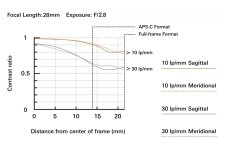
Also check out the MTF chart - at 28mm it is a bit soft in the edges, but look how well the sagittal and meridional resolution align:
21-a071_mtf-chart_28mm_en.jpg

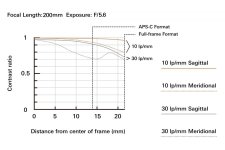
At 200mm it's a bit rougher, but overall sharper as expected from a telephoto:
21-a071_mtf-chart_200mm_en.jpg

I compared its charts to the other zooms I was considering. The sony 24-105 is garbage. The tamron 28-75 was on par with the superzoom. The sigma outperformed the superzoom by a good margin, but that will be useless if it comes up against the heavily backlit situations I anticipate. If I ever buy the GM 24-70 (which I did not research), my 28-200 would still find use.

Most importantly, I like the gestalt of the 28-200. I like the sigma better, but between the flare and the close-focus issues, I felt more excited by the superzoom
 
That's a nice range. (PS I wish someone made a 35-70mm f/2.)

That's the thing about the 28-200 - it's only a 7x zoom range unlike the 10x that canon and sony offer. And tamron has the most superzoom experience by many designs

The truth is - if I had each of the lenses I've researched in my bag, I would find different times to use them all. I'm trying to game out what I would use most based on design and quality. Bare minimum I want a fast, normal prime + a standard zoom + a telephoto zoom, or maybe just a superzoom for starters
 
I wonder if your lens research would be different if the camera had a S35 4K crop. Did you ever use it in 24p on the S1?
 
The MTF charts published by the manufacturers are theoretical computations. The difference between them and the real-world measurements is not always the same: it will be small on a standard prime, bigger on a wide-angle prime, even bigger on a zoom, and huge on a superzoom.

Not saying superzooms are awful, if it's the tool that meets your needs then go for it. But make sure you test it yourself (and test the copy that you'll keep: there's a lot of copy-to-copy variation here too).
 
Tony Northrup ran a semi-scientific experiment among his followers recently to try to determine whether people could tell the difference between 8K, 4K, or HD footage from the R5. Would be nice if the experiment were a bit more rigorous, but still found it interesting:
https://www.youtube.com/watch?v=Z-jdpFqA044&t=589

If you don't want to watch the video, here's a brief summary of the results:

  • Without the benefit of a side-by-side video for comparison, people have trouble differentiating between content shot at different resolutions.
  • In side-by-side comparisons, however, some portion of the viewers do notice a difference, although many still don't. But the percentages vary considerably depending on the nature of the content and type of playback screen.
  • People were more likely to notice a difference when watching content with a lot of fine details (furry dog) than with human faces.
  • People watching on higher resolution desktop screens were more likely to notice a difference than people watching on phones or tablets.
  • The biggest differences were observed when cropping into the frame, then a majority of people could tell the difference between higher resolution (4K or 8K) source footage if watching on a larger screen.
  • No one could tell the difference between the pixel binned (regular) 4K and the oversampled 4K HQ footage from the R5.

In the end, it mostly makes me wish that there were more experiments of this sort involving viewer perception. A lot of improvements in video capture technology seem to be driven by specs and marketing, rather than focusing on how people typically view and experience content.
 
I am not surprised by this. It has been my suspicion that people see a difference because they already know which is which.

That was my personal experience. I got the camera on July 29 and brought it to an assignment the next day. Yes, very bold, I know. I had not much time for studies of the manual. I thought it was HQ and me and my colleague we both found the footage very sharp and crisp. It turned out it was standard 4K25 and 4K50.
 
The MTF charts published by the manufacturers are theoretical computations. The difference between them and the real-world measurements is not always the same: it will be small on a standard prime, bigger on a wide-angle prime, even bigger on a zoom, and huge on a superzoom.

Not saying superzooms are awful, if it's the tool that meets your needs then go for it. But make sure you test it yourself (and test the copy that you'll keep: there's a lot of copy-to-copy variation here too).

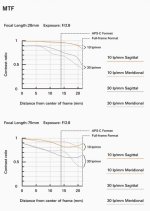
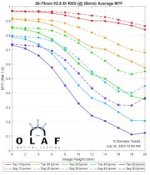
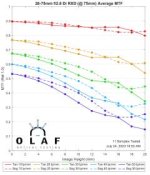
This is true, but the behavior described by the theoretical MTF chart (ie center vs corner sharpness, meridional vs sagittal resolution) seems to align with the measured performance, even if the lens is overall softer in reality. Here's the tamron 28-75 tested by cicala vs manufacturer chart (he hasn't done the 28-200):

MTF.jpg
28-75mm-f2.8-Di-RXD-@-28mm_MTF_Average.jpg
28-75mm-f2.8-Di-RXD-@-75mm_MTF_Average.jpg
 
That was my personal experience. I got the camera on July 29 and brought it to an assignment the next day. Yes, very bold, I know. I had not much time for studies of the manual. I thought it was HQ and me and me colleague we both found the footage very sharp and crisp. It turned out it was standard 4K25 and 4K50.

Yes, however in watching Tony's video, 23% of the people watching side by side on 8k displays were able to spot the difference. So you also have to consider the human eyesight, which to see the difference between 8k and 4k on the same size monitor, you have to be 3 ft closer to the screen. It follows that the audience samples who were able to spot the difference were also either looking at the screen from much closer or were viewing on much larger screens.
 
Tony Northrup ran a semi-scientific experiment among his followers recently to try to determine whether people could tell the difference between 8K, 4K, or HD footage from the R5. Would be nice if the experiment were a bit more rigorous, but still found it interesting:
https://www.youtube.com/watch?v=Z-jdpFqA044&t=589

If you don't want to watch the video, here's a brief summary of the results:

  • Without the benefit of a side-by-side video for comparison, people have trouble differentiating between content shot at different resolutions.
  • In side-by-side comparisons, however, some portion of the viewers do notice a difference, although many still don't. But the percentages vary considerably depending on the nature of the content and type of playback screen.
  • People were more likely to notice a difference when watching content with a lot of fine details (furry dog) than with human faces.
  • People watching on higher resolution desktop screens were more likely to notice a difference than people watching on phones or tablets.
  • The biggest differences were observed when cropping into the frame, then a majority of people could tell the difference between higher resolution (4K or 8K) source footage if watching on a larger screen.
  • No one could tell the difference between the pixel binned (regular) 4K and the oversampled 4K HQ footage from the R5.

In the end, it mostly makes me wish that there were more experiments of this sort involving viewer perception. A lot of improvements in video capture technology seem to be driven by specs and marketing, rather than focusing on how people typically view and experience content.

I did this test when I first got my R5 last month. If you look hard you can tell the difference in a side by side - the HQ is sharper/more detailed than the regular 4K. Whether that is a good thing is a moot point though, you don't always want more detail.

Certainly, the regular 4K looks great and most importantly the colour matches perfectly with more grown-up Canon cameras. I've used my R5 successfully as a B-Cam to my C500MKII several times in the last few weeks, on Tuesday I'll be using it as my A camera on a shiny new aircraft carrier and I'm confident it won't let me down.
 
Back
Top