Canon R5 Announced with 8k

Both models are crippled in a way that doesn't overlap their features. A7SIII could have had the A7III 24 MPX sensors for better stills and R5 could have had binned/cropped 6K to avoid the thermal problems. But somehow their relative advantages and disadvantages fit each other like a glove. I wonder why.

PS. R5's thermal shutdowns are timed for the indoor temp (23C/75F). Take it outside into the summer sun and humidity and you might end up with ... a complete uncertainty. Caveat emptor. You may have just bought yourself a $4,000 brick.

As a few documentarians found with the 1DC.
 
What makes them a horrible still camera for you? Just curious as I have been using them since the first generation r series as I was already in the sony platform with the fs700 for video and was trying to keep everything the same as they were often my b cameras. I'm currently debating on switching brands between all the cameras coming out as I do like the RF mount and the lens designs (plus the komodo is RF if I go that route). That said I have found the A7R series tethered into capture one has done wonders on set for me. I know you mention feel in the hand, and I've been using a battery grip to help with that with the A7R but that's not something I notice often as I am on the tripod 80-90% of the time.

Also don't bring up sony menus because you would be right and it will make my head hurt. THey aren't bad once you learn and customize them I feel like but the fact each generation has a new menu makes it a pain when working with several on set haha.

The bad ergonomics and physical design. The Sony's are essentially little rectangles that aren't much bigger than some old point 'n shoots. Which is fine for some. But they don't feel like they were ever designed to be held in the hand and used continuously, whereas most Canon's feel like they were(Personally I think the R5 could actually be a smidge bigger, just looking at images). Much in the same way of why, strictly speaking on an operator/shooting level, I vastly prefer shooting with(actual operation of) a true ENG camera and lens over any "cine" camera I've used to date. Honestly, there's no reason for the Sony A7's to be as small as they are, except as an academic/show-off exercise. It's kind of like the period we went through of the super tiny cell phones. Manufacturers were just kind of showing off, but forgetting that actual humans still needed to interact with them. Then they swung the other way with phones so big you can't operate them with one hand. And now we have HUGE phone screens, but they are so thin that it's the worst of both worlds. And I'm not a big guy or have huge hands, either. I just think that for optimal comfort and operation by actual people, things need to be of a certain size and design. Ergonomics are vastly underrated today. I'd like to see a Sony A7 in Morgans hand. It would probably look like a box or Tic-Tac's. Lol

Anyway... My .02, your mileage may vary, blah, blah, blah, etc.
 
I agree with you. I barely ever shoot barehanded though. 98% of the time I'm on a tripod, a gimbal or a shoulder mount. So then I just need to worry about the fiddly little buttons, argh

But the sigma fp - talk about an exercise in overkill
 
The bad ergonomics and physical design. The Sony's are essentially little rectangles that aren't much bigger than some old point 'n shoots. Which is fine for some. But they don't feel like they were ever designed to be held in the hand and used continuously, whereas most Canon's feel like they were(Personally I think the R5 could actually be a smidge bigger, just looking at images). Much in the same way of why, strictly speaking on an operator/shooting level, I vastly prefer shooting with(actual operation of) a true ENG camera and lens over any "cine" camera I've used to date. Honestly, there's no reason for the Sony A7's to be as small as they are, except as an academic/show-off exercise. It's kind of like the period we went through of the super tiny cell phones. Manufacturers were just kind of showing off, but forgetting that actual humans still needed to interact with them. Then they swung the other way with phones so big you can't operate them with one hand. And now we have HUGE phone screens, but they are so thin that it's the worst of both worlds. And I'm not a big guy or have huge hands, either. I just think that for optimal comfort and operation by actual people, things need to be of a certain size and design. Ergonomics are vastly underrated today. I'd like to see a Sony A7 in Morgans hand. It would probably look like a box or Tic-Tac's. Lol

Anyway... My .02, your mileage may vary, blah, blah, blah, etc.

Hey thanks for responding, yeah I would agree that the sony ins't perfect and for that fact any mirrorless I have tried feels slightly to small. Like some minor adjustments to the grip side I think would be a big improvement without adding much more mass to these cameras. And don't get me started on phones haha, i'd much rather have a thicker phone that could have a good length battery than something that burns out half way through the day of heavy use.

I recently picked up a black magic 4k pocket camera and have shot 2 projects on it, one with an anamorphic adapter setup, and one just base bones. I'm now selling the camera because its a pain to work with even if it does produce a nice image. If you aren't using c fast you are probably using ssd which I have had issues with external recording, then there is the whole battery solution. You either are constantly changing batteries or rigging it up, thus defeating the purpose of a small camera imo. The touch screen menus are nice I will give them that, just stinks that the v mount blocks that said screen haha.

With that all said this is the canon R5 thread so I will say I am still interested in the rf platform for architecture photography work because of that ef to rf adapter with drop in polarize. Will make life easier with tilt shift lenses if I go that route but we will see.
 
The R5 looks amazing. For those complaining about the micro HDMI, yes it’s a terrible connection, but this camera will excel with fewer things attached to it. No separate monitor, no cage, shoe mount for one accessory like a wireless rx and that’s it.

If you require on set monitoring, more sound options, need more real estate for accessories or multiple people have to be able to work from it, you’re better off using a dedicated video camera.

As a personal projects camera I don’t think I could ask for anything more.

For professional use the R5 should be used to fill gaps and do what larger cameras can’t (or in a better way).

Things like small gimbal, motion control, handheld all day (literally), small footprint, sometimes a cam, sometimes b cam.

The smaller and larger cams should work together to cover all bases rather than be built (ridiculous frankenrig cages) and stripped (heavy video cam on small gimbal) to act like each other.

Just my 2 cents, YMMV blah blah etc
 
"And then we told them it would shoot 8K RAW"

I'm surprised no one has done the laughing guy video with the R5 and overheating...

"And then in February, we told them it would shoot 8K RAW without overheating..."

[Insert laugh at 27 seconds.]

 
50102290166_e70d24d129_b.jpg

 
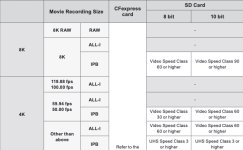
Came across this graphic on the Canon site. Their cameras are notorious for distributing resolutions/codecs on two separate card formats (if available).

This chart - if I'm reading it correctly - seems pretty straightforward.

As expected, 8K RAW and ALL-I on CFexpress, but surprisingly 4K/120p/60p ALL-I look to be as well.

Some SDXC cards would be able to handle the 235 MB/s for 4K/120p although not with a lot of headroom.

And it's cool they allowed 8K IPB on SDXC.

R5 Cards.jpg
 
Looking through the Full Specifications for R5 and R6...

R5 mentions overheating. R6 does not. Maybe R6 will not overheat at all, as some have suggested
 
Really shouldn't, 4K/60p IPB is weak.

28 MB/s max in that camera for normal video.

vs.

325 MB/s max in the R5.
 
Right but it's partly about scanning in addition to writing. The R6 sensor has fewer photosites which helps a lot. (But I suppose in theory that with different circuits it could generate just as much heat)
 
Only their engineers really know what's going on in there.

The Sony a6400 samples the 4K from its 6K sensor (full pixel readout) and holds up pretty well.

Its predecessor (a6300) did the same thing, but couldn't make it past 30 minutes before shutting down in most conditions. They either changed/improved something, or let it be for the next generation 3 years later when people wanted more or wouldn't buy.
 
Well, computer chips are trending towards higher power efficiency right? Ergo less heat? But more efficient chips are more expensive than their less efficient peers in a given generation? And...I have no idea what I'm talking about
 
Who knows. 8 years ago, some people never experienced overheating while shooting 4K on their 1DC (but some did).

I'm one who wishes they made the R5 a little bigger, but I know most would prefer a camera like this smaller/lighter.
 
Saw this just now...seems real based on also checking the person's social media.

One interesting comment is that supposedly the pre-production model he used had IS disabled in 8K RAW.

The Sigma fp disables IS in RAW too. Wonder what the final product will or will not have.

https://www.youtube.com/watch?v=ArNEnvCfJkM
 
Who knows. 8 years ago, some people never experienced overheating while shooting 4K on their 1DC (but some did).

I'm one who wishes they made the R5 a little bigger, but I know most would prefer a camera like this smaller/lighter.

Agreed. Making something big enough to actually not need add-ons can end up being the smallest option.
 
Back
Top