Canon R5 Announced with 8k

Right, but how difficult is it for a manufacturer to re-route the hdmi internally? Not even change the internal boards or anything, just run a cable internally to re-patch the hdmi to a better place? And then they could charge us a grand or two extra.


They keep doing undeniably amazing things, like here’s 8K raw at 60fps!!! But then that damned HDMI is always there. Seriously idiot savant behavior. Like they can play piano masterfully, but forget to tie their shoes or wipe their face.

COMPLETELY off-topic, but reminds me of a story my cousins dad told us YEARS ago, when Coke machines that accepted dollar bills just started to become a thing. I believe he was a test driver for an auto manufacturer and they were somewhere testing some car. Anyway, he walks inside and one of the engineers is standing at the Coke machine putting a dollar bill in, trying to get a drink, with no luck. So after watching him stick another dollar bill in without getting a drink, again, he said to him, "Odie, you dumb bastard. What are you doing?" It wasn't a Coke machine that accepted dollar bills. This engineer was folding dollar bills up and sticking them in the coin slot.
 
COMPLETELY off-topic, but reminds me of a story my cousins dad told us YEARS ago, when Coke machines that accepted dollar bills just started to become a thing. I believe he was a test driver for an auto manufacturer and they were somewhere testing some car. Anyway, he walks inside and one of the engineers is standing at the Coke machine putting a dollar bill in, trying to get a drink, with no luck. So after watching him stick another dollar bill in without getting a drink, again, he said to him, "Odie, you dumb bastard. What are you doing?" It wasn't a Coke machine that accepted dollar bills. This engineer was folding dollar bills up and sticking them in the coin slot.

Bahahaha! Amazing!

I swear, that is Canikony.
 
Last edited:
The basic form of a modern photo camera was created in the 1930's (in Germany). The first eye-level camera was introduced in 1948 (in Italy). The form survived to this day in the DSLR's and the mirrorless. It is what it is, despite the Polaroids and the Instamatics.

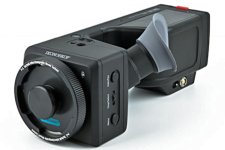
Film/video cameras, on the other hand, have mutated greatly over the years - from the early Bolex to Bell&Howell to Mitchell, from large/static to handheld. And then there were huge early digital cameras like Dalsa and Sony. And then it all began to shrink drastically until it became a rectangular pancake known as a smartphone.

Maybe, at some point, a shape of a video camera will settle down to a particular form but, as of now, all manufacturers make their own stew. Sony ain't Canon and Canon ain't Panasonic and Panasonic ain't ARRI and ARRI ain't RED.
 
For me it does more than that.

Yup.

I've found that different camera related forums are a bit predisposed towards certain cameras and manufacturers. This isn't the premier BMD or Pocket forum, so I don't feel I need to go into detail about that camera here.

Suffice it to say that anyone starting out now and who is even remotely thinking about going RED, should definitely spend a solid year of shooting with a P6K. Especially now that BMD has lowered the price to $1995 (insane value). Barring some of the practical things that James and I both touched on, there is nothing about its image, recording format or media to complain about. Sure, batteries are small... but then again, they're small and cheap. I can have 3-4 LPE6N in my pockets almost without realising it. I don't want to defend that battery as a 'good choice', but it's not the end of the world either when you look at it in context.
 
I am always surprised when people complain about 30 minute recording limits, but their batteries don't last much longer than that anyhow.
 
I am always surprised when people complain about 30 minute recording limits, but their batteries don't last much longer than that anyhow.

True story. And media can be an issue too, depending of format.

But in their defence, I wonder if it's often in situation where the camera might even have wall power, and codec is some heavily compressed long GOP.
 
I am always surprised when people complain about 30 minute recording limits, but their batteries don't last much longer than that anyhow.

30 minutes recording limit is a deal breaker, and some cameras have a lower limit than that if shooting 4K or higher frame rates. My GH5 and GH5s wedding combo swapped among 7 batteries. I replaced the GH5 with the P6K around my neck and a V-Lock battery on my belt. At my last wedding I switched on the P6K before the pre-nups and didn't turn it off again until the midnight sendoff.
 
I have done plenty of 30+ min takes.

For the most part, there are millions of ideas that can be shot with a 29min clip limit. (Someone will likely say: remember film?)

Again, i think there are certain types of pros and hobbyists that may only need 35min clips, but still reason enough.

The main issue is that the 30min clip length is a fake restriction. Because companies have to add it, it is more annoying than if it were just the basic limidations of the medium.
 
Yeah, as much as we all love Arri, the shows shot on Helium have looked fantastic.

Everyone I've shot films for has been quite happy with the results straight out of the camera.

Also, the show “Young Pope” or something, they use the dual exposure mode to hold window detail. I feel that is genius way to utilize that feature. It isn’t going to have the possibility of motion artifcats the same way, yet it is precisely one of the type of situations extended dynamic range is something you’d wish you had. Shot by Luca Bigazzi and his crew.

Yeah, that HDRx mode can capture a huge dynamic range. I haven't had a need for it yet, but I suppose I ought to try it out just to work with it while we're locked down.
 
Different people have different needs. I don't want something with the shape of the ikonoskop (too big, and not the right shape for a gimbal) and would have no problems with a 5-minute recording limit. The shape of the R5 is actually perfect *for me*. But I completely understand other people want different things, we're way past "good enough" and now choosing the right tool for *your* job is more important than what's best for a wide set of possible situations (unless being faced by very different circumstances is exactly what your job looks like).
 
Different people have different needs. I don't want something with the shape of the ikonoskop (too big, and not the right shape for a gimbal) and would have no problems with a 5-minute recording limit. The shape of the R5 is actually perfect *for me*. But I completely understand other people want different things, we're way past "good enough" and now choosing the right tool for *your* job is more important than what's best for a wide set of possible situations (unless being faced by very different circumstances is exactly what your job looks like).

The mirrorless form factor for shooting video is generally awful. But I give Canon points for implementing the built in ND filter for the adaptor if you want to shoot EF lenses. That's pretty cool.
For myself, implementing a mirrorless camera as an A camera, the main limitations are:

1. Should have redundant recording of at least some kind
2. Should have internal variable ND
3. Should have either built in mini XLR like the BMDs or facility for a GOOD external XLR box with phantom ala GH5.
4. Pro I/O. This means a mini SDI for video, a metal headphone jack with a dedicated volume up or down rocker or button
5. Real TC implementation via mini SDI I/O
6. Better quality audio circuitry/mic pre-amps, at least as good as C300 MKII, FS7 MKII, FX-9, etc. Not great but at least usable.
Neither our 80D or our X-T3 internal audio is as good even as our old C100. Having XLR in is only the first step. If the internal audio
is garbage, then what's the point?

Image quality is already there. Lenses are there. AF is getting really good on DSLRs/Mirrorless. Color, DR, latitude, codecs are all perfectly acceptable for pro work. Of course, we'd like ProRes RAW, BM RAW,
CRL or even Prores like the BMD Pockets but just H.265, workable but a PITA for many of us who have to transcribe it or send a long note with the media to a producer or their editor that this is H.265 and must be treated as such.

I could live with the awful ergonomics if the mirrorless cameras had all of these. Just as the R5 is proving, the manufacturers are 100% capable of offering these features, none of these require invention or innovation, the manufacturers just don't want to do it
because they think people will stop buying C300 MKIIIs and FX-9s. Maybe they're right, would you buy a C300 MKIII for $11k if the R5 or R5 MKII had all of these features at say $6,500.00? I'm not sure if I would still spend the extra for the digital cinema camera
if the R5 or R5 MKII had all of this goodness.

Before the C100 MKI and C300, our A camera for a few months was the GH4. I hated every minute of it, had all of the toys and accessories to make it function as a real video camera. Shot a film with it that was on PBS.
Shot a promo package for ME TV, some corporate pieces for Dell Computers. None of that footage is on any of our reels even though it was well lit, carefully shot, hated the colors, skin tones, FPN, etc. But things have progressed quite a bit past the GH4 with the latest mirrorless.
I would never go back to an A mirrorless unless it had these pro level features. But that's just me and my use case. Everyone's needs are different, of course.
 
Last edited:
The mirrorless form factor for shooting video is generally awful. But I give Canon points for implementing the built in ND filter for the adaptor if you want to shoot EF lenses. That's pretty cool.
For myself, implementing a mirrorless camera as an A camera, the main limitations are:

1. Should have redundant recording of at least some kind
2. Should have internal variable ND
3. Should have either built in mini XLR like the BMDs or facility for a GOOD external XLR box with phantom ala GH5.
4. Pro I/O. This means a mini SDI for video, a metal headphone jack with a dedicated volume up or down rocker or button
5. Real TC implementation via mini SDI I/O
6. Better quality audio circuitry/mic pre-amps, at least as good as C300 MKII, FS7 MKII, FX-9, etc. Not great but at least usable.
Neither our 80D or our X-T3 internal audio is as good even as our old C100. Having XLR in is only the first step. If the internal audio
is garbage, then what's the point?

Image quality is already there. Lenses are there. AF is getting really good on DSLRs/Mirrorless. Color, DR, latitude, codecs are all perfectly acceptable for pro work. Of course, we'd like ProRes RAW, BM RAW,
CRL or even Prores like the BMD Pockets but just H.265, workable but a PITA for many of us who have to transcribe it or send a long note with the media to a producer or their editor that this is H.265 and must be treated as such.

I could live with the awful ergonomics if the mirrorless cameras had all of these. Just as the R5 is proving, the manufacturers are 100% capable of offering these features, none of these require invention or innovation, the manufacturers just don't want to do it
because they think people will stop buying C300 MKIIIs and FX-9s. Maybe they're right, would you buy a C300 MKIII for $11k if the R5 or R5 MKII had all of these features at say $6,500.00? I'm not sure if I would still spend the extra for the digital cinema camera
if the R5 or R5 MKII had all of this goodness.

Before the C100 MKI and C300, our A camera for a few months was the GH4. I hated every minute of it, had all of the toys and accessories to make it function as a real video camera. Shot a film with it that was on PBS.
Shot a promo package for ME TV, some corporate pieces for Dell Computers. None of that footage is on any of our reels even though it was well lit, carefully shot, hated the colors, skin tones, FPN, etc. But things have progressed quite a bit past the GH4 with the latest mirrorless.
I would never go back to an A mirrorless unless it had these pro level features. But that's just me and my use case. Everyone's needs are different, of course.

All of that is completely coherent. Well ordered in terms of priorities and makes perfect sense.
The biggest issue for me with most DSLR/mirrorless is rolling shutter. Number 1 give away, and for me it just says cheap.
After that comes dynamic range (in the highlights especially) and color depth.

Just took another look at BMC pocket cams. Like the mini ATEM pro for a multicam feature.
I keep SO wanting to like BM cams...but the image even in raw from their pocket 4k...looks like crap.
It feels soft, poor highlight retention and most of all it just always feels like black and white that has been colorized. So strange.
The pocket 6k just dropped in price and it looks better in terms of sharpness and color, but frankly given that I am looking at braw from Blackmagic promos, it's still mehhh.

It almost feel like it's the old difference between medium format and 35mm cameras from the analog photo days.
Images from these boxy mid-range video cameras just feel more solid. Not sure why.

The exception for me would be the X-T3 and hopefully this new R5. We will see.
But one thing is for sure M43 mirrorless doesn't cut it.

Gotta say the C300 III with dual gain architecture, looks damn good by comparison to everything.
Apparently it has about 1.3 stops less than an Alexa or a Venice (according to Imatests from Cinema5D), but frankly the texture of the image feels strong and similar.
I think it could be an excellent B cam to those others. I think it's going to do better than the full frame C500 II.

I like the overall texture and look/feel on the X-T3 and I am sure the R5 will look great. Rolling shutter, that was my main thing when I tried the EOS R, it
was terrible, like my EOS 5D MKII terrible. The rolling shutter on the Fuji? I rarely notice it, which means the scan rate must be pretty high.

The C300 MKIII seems like a hit it out of the park winner to me. I like the C500 MKII from what I've seen (Canon still hasn't coughed up a review copy for me)
and the C300 MKIII looks basically like a S35 version. In normal, pre-pandemic times, the C300 MKIII would be a huge runaway hit. In post Pandemic times, it's
really difficult to say what's going to happen. I don't see a stampede of buyers buying much of anything this year, it's been a terrible financial blow so far for most
of us and we are nowhere near out of the woods yet. I don't envy Canon or Sony with the FX-9, 2020 has definitely been the worst time in modern history to
release a new professional digital cinema camera, although Sony undoubtedly got some good sales in since last November/December.

The C300 III has dual gain, the C500II, though it is full frame 6k does not. For me the dual gain is more important than the added resolution. I think it's really going to have a great and solid image. The images I have seen so far are excellent. My biggest issue with previous iterations was DR and highlight retention. Combine that now with dual pixel AF, quality codecs for a variety of situations, excellent color for skintones and a very reasonable price...just YES. First Canon camera I would consider buying in years.
 
The mirrorless form factor for shooting video is generally awful.

I think there are 3 modes which the form factor is not awful. #1 is on a gimbal. mirrorless form factor beats everything else on a gimbal because it is a shallow body and you need a motor behind the camera (even if slightly lower it still gets in the way). #2 is eye jammed on the viewfinder. The closer the weight to your head the less your arms have to carry. With a longer body, you're always fighting the leveraged weight. This is why SLR's were god awful, because you didn't have a viewfinder or had to use a loupe which increased the leveraged weight. #3 On a tripod or monopod. Tripod works for everything unless it's overly tall (1DX III I'm looking at you). And for a monopod the reduced weight makes it more stable than a super-beefy camera. I know you're not a fan of the monopod. And I'm not either except for 2 circumstances. Roundtable discussion where you can't last the duration handheld, so you can move the monopod around smoothly while getting usable footage and gently set it down when you get to the right angle. And Rally-March-Rally scenarios where you can't take a tripod with you.

I'm very interested in the R5. I don't care about Full-frame and as you know I like the XT-3. But Fuji should have fixed the crop factor and limited data rate in 4K 60P with XT-4. So if Canon delivers on that...
 
Last edited:
The X-T4 has limited and manageable 4K/60p data rates...100/200/400mbps.

If you're shooting 24p @ 400mbps then the 60p should be ~2.5x more around 1000mbps if it were an apple-to-apple evaluation (or an automatic calculation where data rates are defined by the codecs (like ProRes in Blackmagics) and not limited by hardware.
 
I think there are 3 modes which the form factor is not awful. #1 is on a gimbal. mirrorless form factor beats everything else on a gimbal because it is a shallow body and you need a motor behind the camera (even if slightly lower it still gets in the way). #2 is eye jammed on the viewfinder. The closer the weight to your head the less your arms have to carry. With a longer body, you're always fighting the leveraged weight. This is why SLR's were god awful, because you didn't have a viewfinder or had to use a loupe which increased the leveraged weight. #3 On a tripod or monopod. Tripod works for everything unless it's overly tall (1DX III I'm looking at you). And for a monopod the reduced weight makes it more stable than a super-beefy camera. I know you're not a fan of the monopod. And I'm not either except for 2 circumstances. Roundtable discussion where you can't last the duration handheld, so you can move the monopod around smoothly while getting usable footage and gently set it down when you get to the right angle. And Rally-March-Rally scenarios where you can't take a tripod with you.

I'm very interested in the R5. I don't care about Full-frame and as you know I like the XT-3. But Fuji should have fixed the crop factor and limited data rate in 4K 60P with XT-4. So if Canon delivers on that...

This. I honestly like the shape of my hybrid cameras, it just fits the way *I* shoot, which right now means >75% on gimbal plus 15% on sticks, just <10% on shoulder. And of course I'd like to get internal ND filters, but most of the other complaints fall in the "I want to plug things to the camera" category, and well, I don't want to plug things to my camera.
And total weight of the package is very important for me: a bigger body requiring a bigger gimbal quickly results in "I can't carry any lights with me" and that's not good.
I completely understand that other people shoot in different ways and have different needs and different tastes, but I'm guessing many people actually like the DSLR shape, as they're still making lots and lots of these.

Also, still is a lot bigger than video, even today. About 16% among pros renting at lensrentaks, if you look for the number that makes the overall be the weighted average of the other two over here:
https://www.lensrentals.com/blog/2020/04/how-covid-19-is-affecting-the-photo-video-industry/
 
Last edited:
This. I honestly like the shape of my hybrid cameras, it just fits the way *I* shoot, which right now means >75% on gimbal plus 15% on sticks, just <10% on shoulder. And of course I'd like to get internal ND filters, but most of the other complaints fall in the "I want to plug things to the camera" category, and well, I don't want to plug things to my camera.
And total weight of the package is very important for me: a bigger body requiring a bigger gimbal quickly results in "I can't carry any lights with me" and that's not good.
I completely understand that other people shoot in different ways and have different needs and different tastes, but I'm guessing many people actually like the DSLR shape, as they're still making lots and lots of these.

Sums it up well for me. ^^

It's not just about ergonomics either. I have an F55 after all, full compliment of PL cinema glass, matte box, shoulder kit and handle bar. For TedX it's perfect. It's just not appropriate for everything. Weddings for example. You want to document the event, not bring attention to yourself. The priest doesn't want that in his church. And more than having a particular form factor, I don't think the F55 even is a form factor. A shoulder mount broadcast camera has a definite form factor, and it's definitely not the appropriate one for weddings. The video hybrids on the other hand very much do fit with the customary role of photographers. If you went from table to table shooting with an F55, these are not actors and the response you would get would not be universally positive and does not fit the mood of the occasion. People associate big cameras with big video, little cameras with little video. If they think they are going to end up on Frontline they will be uncomfortable. But when you use a hybrid, you need only say something like, "Would you like to congratulate the bride and groom?" This will bring about smiles and well wishes and raised glasses and laughter befitting the occasion.
 
Back
Top