Canon goes 8K60p and "20+ stops DR" in 4K by NAB

how much less dynamic range would you guesstimate that the c300mk2 has versus the amira?
I suppose the same answer as above. I haven't done tests. If anything I'd guess they may have similar dynamic range, but Arri has rolloffs that make all the footage look better, even footage that isn't clipped.

Like, if you're shooting a six stop scene then all else being equal the difference between a 12 stop and a 14 stop camera would make no difference and the image would be exactly the same. Now, if one of those cameras had a better look to the image when transition from the darker parts to the brighter parts, then it would have the better image.

I'm just theorizing. I think it's generally better to go off of what you see than what tests say.
 
...why would they sell the c300s and c500s for less than the c300 iii and c500 ii?

By the time C300s and C500s ship, their predecessors will be 1 1/2 and 2 years old. So, it's a good bet.

PS. Canon should also upgrade their AF lens lineup to somewhere near the FE C 16-35mm T3.1 G level.
 
I don't know if there's truth in those claims, but I think that theoretical dynamic range is easy to measure by the ratio of the energy of the full photosite well to its minimum signal discernible above the noise floor. Something like that. Maybe someone nerdier than me can chime in with the exact formula.


Here's something I've posted before:

There is actually hard math for dynamic range and it's really easy to calculate - it's simply the ratio between the clipping point of the sensor and the average noise of the sensor.

The math is simply the 20log10 (voltage ratio) of the Full Well Capacity in electrons (clipping point) divided by the root mean square Read Noise in electrons (average noise).

So the math formula is just 20log(FWC/RN). That's very simple, relatively speaking.

However, there are two problems with this approach.


-----


One is that while the clipping point of the sensor is really easy to figure out, the average noise is absolutely not, at least while measured externally. Imatest's page on dynamic range has a ton of information (that I have not seen elsewhere) that explains the challenges in actually measuring DR: https://www.imatest.com/solutions/dynamic-range/

One huge takeaway is that even the tiny amounts of internal flare from lens optics absolutely affects dynamic range. That means that the dynamic range of a sensor, when paired with a lens, has an absolute limit (unless lens coatings get dramatically better) regardless of what the dynamic range of the sensor is actually capable of.

Imatest says on that page that they have never seen anything better than about 16.5 stops of DR, even though there are sensors out there with a specified 20-25 stops worth of range. Simply adding a lens completely negates that higher dynamic range.

They also say specifically that dynamic range is improved by noise reduction. So, because of that, they recommend only using raw data that is stripped of any noise reduction and minimally demosaiced.

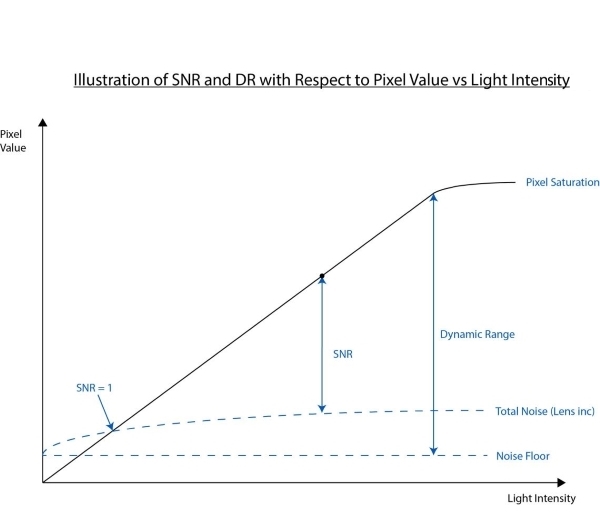
They say specifically that "Noise reduction can have a profound effect on DR measurements. In particular, SNR = 1, which is a criterion for the DR limit in some standards, may never be reached."

That means that noise reduction can prevent seeing where the noise floor is reached (SNR = 1 is where the signal and the noise floor is equal.) If you can't see the bottom limit, you have no way of actually measuring the average noise of the sensor.

So, that means that you cannot directly compare the output of a sensor that is highly processed, with noise reduction, to something that is only processed as minimally as possible.

On top of that, Imatest actually has their own dynamic range chart because of challenges in using the other industry standard chart (the DSC Labs Xyla.) On the Xyla, the much brighter initial steps were leaking into the rest of the image due to lens flare, causing an inaccurate reading (an increase in Dynamic Range.)


-----


The second problem with calculating Dynamic Range is that measured dynamic range is actually considered something completely different.

Measured dynamic range is not Dynamic Range at all - it is a similar, but separate concept known as the Signal to Noise Ratio, and it is that SNR number that we actually want to know, not the true Dynamic Range.

The discrepancy has come about from how a sensor engineer would define what Dynamic Range means versus what we would consider dynamic range.

To a sensor engineer, Dynamic Range, in sensor-land, is only a mathematical ratio between Full Well Capacity and Read Noise. It is not theoretical, it is hard math. You have two numbers and you look at the ratio between them and that ratio can only be one thing.

However, that hard number Dynamic Range does not include the impact that simply putting a lens in front of the sensor causes. It also does not include any other type of noise at all, just Read Noise. When there is lots of light available, the main type of noise limiting the amount of Signal to Noise Ratio is something called Shot Noise.


-----


Shot Noise is an inherent characteristic for photons to follow a certain pattern, known as the Poisson distribution. This distribution means that less light levels equals a noisier image, regardless of anything else.

Basically, photons do not come all at once, hitting the sensor evenly, but come in a staggered way that creates noise.

The only solution to the inherent noise of light (you can't currently escape it) is to increase the full well capacity. If you are able to capture more photons, it spreads out that distribution and lowers the effect of that noise.

If you look at the chart below, you'll see that SNR, which includes Shot Noise and ALL other total noise, has a smaller range than the Dynamic Range of just the sensor (which again only includes Read Noise - the noise floor of the sensor, not the noise floor of everything):


DR-SNL-Blog-Graph-1.jpg


This comes from this website (which has a good breakdown of all of this): https://www.lumenera.com/blog/under...-signal-to-noise-ratio-when-comparing-cameras .


-----


This quote (from the above website) sums it all up: "The result is that a larger dynamic range is always preferable because it allows for a higher signal-to- noise ratio, but it is not guaranteed. SNR will always be less than the dynamic range because it is limited by the noise in the image and is not always maximized due to challenging lighting conditions, exposure time limitations, and the choice of optics."
 
TL;DR - Dynamic Range just refers to the sensor, all by itself. What we actually care about (what we actually see in the recorded image) is the total Signal to Noise Ratio, which is ALWAYS going to be less than the Dynamic Range of the sensor. SNR is drastically impacted by ALL current lenses, and even the physics of photons.

At a certain point, higher sensor Dynamic Range is pointless if overall image SNR was not taken into consideration - you'll never see the higher DR numbers, since the physics of light and optics just chop a whole bunch of DR off the top. Even if Canon hits 20 true stops of sensor Dynamic Range, that does not equal 20 stops of SNR.
 
I wonder if the cost of R&D (or really just Development, as Mitch Gross tells us, and no research for research's sake) for producing a new camera has gotten so low that there's no downside from Canon/Sony releasing a new model. It would have to be cheap for them to retool the manufacturing assembly lines as well.

But what if they can just reuse most of the design, tweak a few features, and update the CPU and maybe the sensor and then release a new model?

It could be like cars or computers and you end up with the 2021 C300 followed by the 2022 C300. Maybe it won't go that far... But they seem to be rapidly abandoning previous models and I had thought that the pace of releases would have slowed down already.
 
If Blackmagic can do it with cameras that sell for a few grand, surely Canon can for $10K+ cameras.

We've also seen the recycled bodies from RED, Z CAM, Sigma, Kinefinity, and Panasonic and Sony (not quite but very close with the GH5/S and a6300s/a6500s).
 
Well,the counterpoint is that more expensive cameras would have longer lifecycles and should be better long-term investments
 
These will look very over priced if BlackMagic put the sensor from the 12K in the Pocket 6K Pro body and limit it to 8K say for a $1000 more. So $3500. 8K up to 120fps ? BRAW

I am really hoping they do.
 
The only thing is - you can sell a new computer every year (or 3x a year) because the basic components are getting faster all the time, and the user benefits from the extra speed.

You can sell a new car every year because the design/fashion is gradually evolving and people are interested in making a fashion statement and looking current even if the function is largely the same as the older models.

But cameras are not as much of a fashion statement for us. (Maybe for hobbyists they are. And maybe some clients care about the brand, but possibly less about the model.)

And a lot of the extra speed specs are overkill. You don't benefit from infinite framerates or resolution or bitrates. So, it's not clear to me that such a frequent-release schedule won't be self-defeating.
 
They are all no different than cameras because there will always be people who simply like using different cameras.

And YouTube's overall promotion of electronics is massive and critical.

Japan & company should wire Google lots of money.
 
One could take a Sony sensor and place it inside a Nikon camera on a lark ... oh, wait .... Nikon already did this as a part of their global manufacturing strategy. In other words, cameras are as modular as computers because that's what cameras are - computers with sensors attached. That's why Red can make a living just off trade-ins. Obsolescence may not be obsolete but various components can last generations, especially if they belonged to the higher end models, now traveling on a donward budget path.
 
Plus, if anything, computers are the machines that people usually don't upgrade until every 3-4 years.

I'm sure some buy/build a new computer every year because they really love computers, but buying a new camera every year seems more realistic for someone going out into the world and using it in various ways. Sometimes your styles or work life changes and you may require AF or IBIS or RAW or more resolution, or just want something newer in a different model.

Computers mostly only provide you more power and speed - which is great - but only really that exciting for true computer geeks/gamers.
 
Plus, if anything, computers are the machines that people usually don't upgrade until every 3-4 years...
The funny thing is that that's how I began my post before deleting that part. In the 1990's, this was rather common, even for generic home use. That's when the home PC's ran on average $1,500 and decent ones into $2,000's. Now, an average price in constant dollars is ~ $630 and that's with the currently dominating Wintel system in place. When ARM based CPU's become serious competitors in laptops/portables and then PC's, the prices are likely to crash even further.

And video cameras have already reached the end, aka the human eye, on resolution and the dynamic range. Which is what the Japanese cartel has been afraid of for a long time. Stills might some ways to go due to the post facto zooming on 8K screens but even there, it's long road of diminishing returns.
 
The thing about computers is that at some point many become pretty comfortable with what they have because it's really enough for what they do.

I preordered a M1 MBA last year and it would have been my first computer since 2015, but I canceled for various reasons. (Still will get the next generation though.)

But I've been pretty good with a MBP for all kinds of 4K and software.

It was really the HEVC and 6K/8K...that's when I knew I needed to upgrade. And more complicated motion graphics.

Also, for people who use a lot of different software, it would actually be a major hassle to upgrade every year. At least IMO...because some of our systems get more cluttered and complex with each passing month.
 
Seems to me the the more prominent issue is how a cam (like Arri) can deal with imagery surpassing its DR constraints.
 
they probably do. It's called advertisement, sponsorship, paid content, contracts with influencers you name it.

Yeah...when it has a category, it's nickels and dimes.

The type of money I'm talking about only has a routing number with no further explanation.
 
Back
Top