C500: Canon C400 coming?

My guess is a camera with an S35 sensor in the same body as a C300 replacement.

An RF mount would be interesting, but I am assuming that would require a change to the front of the camera which wouldn't really be using the same body.

I guess Canon might be able to strip some of the internals and make a C100 replacement without CRL.
 
C300 MKII is on its way out. My thinking is that C200 will drop another grand or two and C400/C300 MKIII will slot at around $10,000, roughly half off/of C500 MKII and twice of C200.

But then there's also the already preannounced 1D X MKIII that may have either videocentric version or have both video and action in one body.

And there were some rumors about C100 MKIII, which has to be - it has to be, right? - an RF mount.
 
I can’t imagine any camera manufacturer with a new FF sensor putting out a super 35 sensor in anything but their entry level offerings moving forward. Like it or not I think the FF ship has sailed.
 
I can’t imagine any camera manufacturer with a new FF sensor putting out a super 35 sensor in anything but their entry level offerings moving forward. Like it or not I think the FF ship has sailed.

Yes, I agree. Sadly, the FF brainwashing has been VERY successful, which is a shame because we could have had some actual, useful innovation in it's place, but I you're right. It's FF from here on out, soon to be replaced my MF I'd bet.
Much easier to keep increasing imager size than to create new tech that actually is helpful to us, better audio, better ergos, operational assists.

There's no brainwashing or conspiracy theories. It's simple; technology has advanced enough to make a variety of products with bigger chips.

Everything has its time, and S35 sensors will still exist for many years while new hardware is made with widely available technological improvements. The size has increased and the cycle has repeated every few years.

Plus, FF cameras should have excellent S35 modes and all kinds of neat improvements if the companies decide to provide them.
 
65mm film was the preferred format for large scale productions since the 1950's (cue your favorite Freddie Young images). Todd AO was 52.63 x 23.01 (~ 1,211 mm2) while Arri Alexa65 is 54.12 mm x 25.59 mm (~ 1385mm2) and there are only ~ 70 of those out in the wild and they're only available as a rental. Alexa LF is 36.70 mm x 25.54 mm (~ 937mm2) and Red Monstro is 40.96 x 21.60 mm (~884 mm2). IMAX 70mm is 70.41 mm × 52.63 mm (~3706mm2), so there's a long way to go if anyone wants to match IMAX.

PS. Digital photography started in earnest in the mid-1990's with what would described currently as the smartphone size sensors. Many pros switched to digital sometime in the mid-00's when the Dalsa MF chip came out.

This is from 2008.

https://www.teledynedalsa.com/en/ne...tal-photography-with-6-micron-pixel-platform/
 
PS. Digital photography started in earnest in the mid-1990's with what would described currently as the smartphone size sensors.

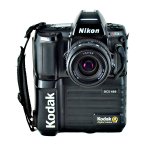
The Kodak/Nikon DCS SLR cameras from the 90's were the first digital cameras that I saw being adopted by mainstream newspaper and magazine shooters. The $28,000 Kodak DCS460 that arrived in 1995 used a APS-H (27.6 x 18.4 mm) 6 Mpx sensor that had a 1.3x FF crop.

Kodak_DCS_460.jpg
 
Technically speaking, the first "mainstream" digital images were introduced during the 1984 US political conventions, where one could also fax taken photos across the globe almost instantly. IIRC, it was a Nikon with a Kodak digital back, the images were around 300K and it took about six minutes to send one photo. But it surely beat film.
 
I think they could simply put out a C500ii with a S35mm crop of the sensor and call it the C300iii. That would be the most obvious option.

Saves Canon a fortune in R&D, offers a hugely appealing S35mm camera, and uses economies of scale to make the whole thing more affordable overall.

I don't really now how else they could craft something to sit between the C200 and the C500ii.
 
There's no brainwashing or conspiracy theories. It's simple; technology has advanced enough to make a variety of products with bigger chips.

Except full frame for video is actually a step down in most cases. I certainly don't find it to be an advantage.

I've never shot with my S35 cameras and thought "damn, I wish I had even LESS depth of field."

It's useful in a stills camera (even then, it's a luxury... APS-C cameras ran the world until the Canon 1Ds then 5D showed up), but for video it actually makes life much much harder (pulling focus with those razor thin DoFs is a struggle for most).
 
... I don't really now how else they could craft something to sit between the C200 and the C500ii.
They could just copy FX-9 on codec crippling or the in-camera 6K-into-4K a la S1 and Z6 (pre-external Raw upgrade). Or they could stick with s35 (though, they probably won't if FX-6 doesn't).

Then there's media - CFexpress or CFast 2.0.
 
Except full frame for video is actually a step down in most cases. I certainly don't find it to be an advantage.

I've never shot with my S35 cameras and thought "damn, I wish I had even LESS depth of field."

It's useful in a stills camera (even then, it's a luxury... APS-C cameras ran the world until the Canon 1Ds then 5D showed up), but for video it actually makes life much much harder (pulling focus with those razor thin DoFs is a struggle for most).

Except it's not or no one would be offering it including the leaders in Germany.

It's not about you or what you/people like, but about available technology. It changes products (in all industries).

And the shallow DOF argument is invalid because I mentioned S35 modes could be had in the cameras like RED, Kinefinity and Blackmagic (windowed under S35) have been doing for years. And you can stop down as full-frame sensors continue to improve with low-light imaging.

I don't care either way...it's not like it's my call and it doesn't matter to me. I've used FF cameras for like 10 years and I'm done with all of it.
 
  • Like
Reactions: jb.
Except full frame for video is actually a step down in most cases. I certainly don't find it to be an advantage.

I've never shot with my S35 cameras and thought "damn, I wish I had even LESS depth of field."

It's useful in a stills camera (even then, it's a luxury... APS-C cameras ran the world until the Canon 1Ds then 5D showed up), but for video it actually makes life much much harder (pulling focus with those razor thin DoFs is a struggle for most).

Except that "Full Frame" ruled in the film days for decades before that and "FF" digital has ruled for at least 15 years, again. And "medium format" digital is more readily and affordably available now, than ever. APS-C "running the world", was just a brief passing spring in the life of photography, with regards to the professional front(think sports and photojournalism). And I'm probably being generous with giving it a whole season. The only times I see still photogs with APS-C still cameras is either as a 3rd string back-up behind their second 1D, it's for video or it's some podunk outlet with no money.

There were tons of guys still shooting film in the late 90's and early 2000's. I remember runners coming by the stills guys at NFL games grabbing the shot rolls, at least every quarter. The 1Ds came out in '02/'03, so there were plenty of people that never had to touch an APS-C camera and went straight from "FF" film to "FF" digital.
 
Last edited:
So if a full frame camera has better low light such that you can stop it down to the same depth of field as S35 without getting a noisier image, while also having the flexibility to open it up to get shallower depth of field when desired, also with a cleaner image, and due to needing longer focal lengths to achieve the same framing the lenses used have less distortion, and the camera also has an S35 mode for use with S35 lenses, then what exactly is the disadvantage of a full frame camera?
 
It's not about you or what you/people like, but about available technology. It changes products (in all industries).

A good, real world example is 4K TV's and 8K TV's. That's where the production lines are moving and what's being built. It doesn't matter that there isn't some overwhelming demand for it or even content. You can buy an 86" 4K TV for less than $2K dollars today. What did a 55" HD set cost 10 years ago? And what will a 90" 8K set cost in five years?
 
So if a full frame camera has better low light such that you can stop it down to the same depth of field as S35 without getting a noisier image, while also having the flexibility to open it up to get shallower depth of field when desired, also with a cleaner image, and due to needing longer focal lengths to achieve the same framing the lenses used have less distortion, and the camera also has an S35 mode for use with S35 lenses, then what exactly is the disadvantage of a full frame camera?

Find me some zooms with a decent range and stop that cover full frame. Got a 5:1 T2.8 that's under $30K? Fly-by-wire lenses like the Sonys don't count.
 
Find me some zooms with a decent range and stop that cover full frame. Got a 5:1 T2.8 that's under $30K? Fly-by-wire lenses like the Sonys don't count.

In that situation wouldn’t you just switch to S35 crop mode in camera? I have to imagine that any new pro-ish FF camera is going to come with the option to choose FF or S35 mode.

If ARRI has gone FF I have a hard time imagining any other camera manufacturer is going to plant their stake in the ground and only produce pro-level S35 cameras moving forward.
 
Back
Top