Canon 50mm "Plastic fantastic"

ROCKMORE

Veteran
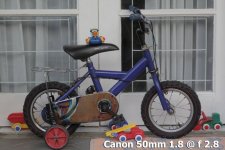
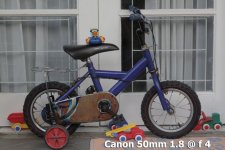
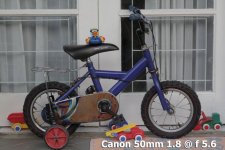
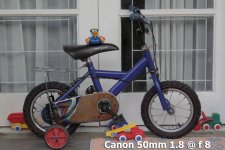
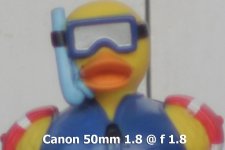
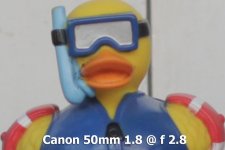
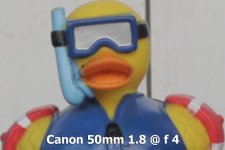
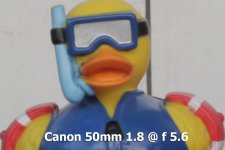
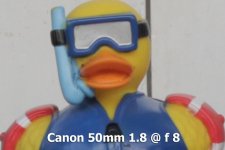
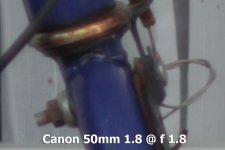
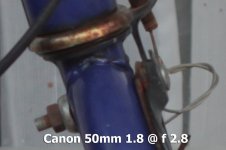
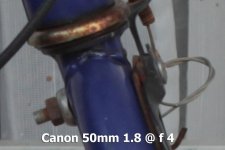
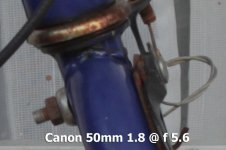
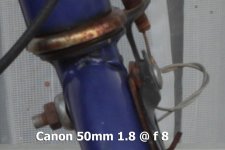
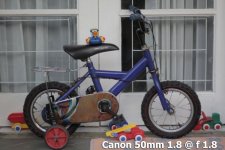
Here are some test shots with the Canon 50mm f1.8 in flat lighting with crops from f1.8 to f8

Shot with a 60D Neutral 0,-4,-2, 0

Posted images straight from the camera no contrast or color correction added.

Beyond f8 the image started to become softer due to diffraction so is didn't post them.
 

Attachments
  • Canon-f-1.8.jpg
    Canon-f-1.8.jpg
    76.6 KB · Views: 0
  • Canon-f-2.8.jpg
    Canon-f-2.8.jpg
    81.5 KB · Views: 0
  • Canon-f-4.jpg
    Canon-f-4.jpg
    82.6 KB · Views: 0
  • Canon-f-5.6.jpg
    Canon-f-5.6.jpg
    84.6 KB · Views: 0
  • Canon-f-8.jpg
    Canon-f-8.jpg
    85.2 KB · Views: 0
Last edited:

Here are the first set of crops
 

Attachments

  • Canon-f-1.8.jpg
    Canon-f-1.8.jpg
    38.4 KB · Views: 0
  • Canon-f-2.8.jpg
    Canon-f-2.8.jpg
    40.5 KB · Views: 0
  • Canon-f-4.jpg
    Canon-f-4.jpg
    41.1 KB · Views: 0
  • Canon-f-5.6.jpg
    Canon-f-5.6.jpg
    42.7 KB · Views: 0
  • Canon-f-8.jpg
    Canon-f-8.jpg
    41.4 KB · Views: 0
Here is the 2nd set of crops
 

Attachments

  • 1-Canon-f-1.8.jpg
    1-Canon-f-1.8.jpg
    39.1 KB · Views: 0
  • 2 Canon-2.8.jpg
    2 Canon-2.8.jpg
    42.3 KB · Views: 0
  • 3-Canon-f-4.jpg
    3-Canon-f-4.jpg
    44 KB · Views: 0
  • 4-Canon-f-5.6.jpg
    4-Canon-f-5.6.jpg
    49 KB · Views: 0
  • 5-Canon-f-8.jpg
    5-Canon-f-8.jpg
    51.2 KB · Views: 0
Did you compare them to any other lenses?

It might help if you give us your own summary. It is always a bit easier when you can play with images in Photoshop, on a large monitor, etc.

I need to create a standard set-up for testing. I sold a bunch of lenses, and I took sample pics on the back porch. But it is impossible to compare an 18 mm to a 200 mm with the different perspective.

Thanks!

Michael
 
Good pictorial example of why 90% of your shooting on MOST lenses should be in the 5.6 to 8 range. 2.8 and below is when there is no choice, to be avoided if possible.
 
Good pictorial example of why 90% of your shooting on MOST lenses should be in the 5.6 to 8 range. 2.8 and below is when there is no choice, to be avoided if possible.

Very true. Most lenses will perform the best at f5.6 / f8. This is also the great equalizer between lenses of different grade and cost. The 50mm 1.8 although only a fraction of the cost of it's big brothers 1.4 and 1.2. The results at 5.6 / 8 in the hands of a shooter who knows what they are doing will be very close.
Better lenses will of course perform better at the open end when needed in low light situations. The 1.8 starts to become sharp at 2.8 where the 1.4 will start to become sharp at 1.8 etc.
The biggest lesson is that beyond f8 / f11 most lenses will deteriorate in sharpness so learning to us ND filters is essential to get the best results in daylight.
The good news is that shooters starting out with a minimum budget don't have to sacrifice sharpness. They just have to learn how to use the available light in the best way and avoid shooting wide open to achieve it.
Also with today's sensors low light shooting is possible at 2.8 where in film days was more difficult.
 
Last edited:
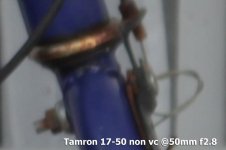
Attachments

  • 1 Tamron--17-50-f2.8.jpg
    1 Tamron--17-50-f2.8.jpg
    75.4 KB · Views: 0
  • 2 Tamron--17-50-f4.jpg
    2 Tamron--17-50-f4.jpg
    78.4 KB · Views: 0
  • 3 Tamron--17-50-f5.6.jpg
    3 Tamron--17-50-f5.6.jpg
    82 KB · Views: 0
  • 4 Tamron--17-50-f8.jpg
    4 Tamron--17-50-f8.jpg
    82.8 KB · Views: 0
  • 5 Tamron--17-50-f11.jpg
    5 Tamron--17-50-f11.jpg
    82.7 KB · Views: 0
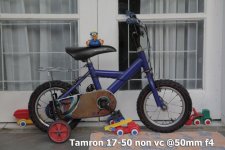
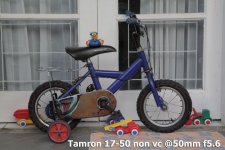
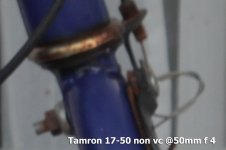
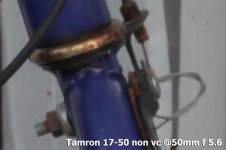
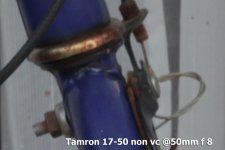
Tamron 17-50mm non vc @ 50mm crops A
 

Attachments

  • Crop-A-Tamron-f2.8.jpg
    Crop-A-Tamron-f2.8.jpg
    36.4 KB · Views: 0
  • Crop-A-Tamron-f-4.jpg
    Crop-A-Tamron-f-4.jpg
    38.6 KB · Views: 0
  • Crop-A-Tamron-f-5.6.jpg
    Crop-A-Tamron-f-5.6.jpg
    38.5 KB · Views: 0
  • Crop-A-Tamron-f-8.jpg
    Crop-A-Tamron-f-8.jpg
    39.4 KB · Views: 0
  • Crop-A-Tamron-f-11.jpg
    Crop-A-Tamron-f-11.jpg
    39.3 KB · Views: 0
Tamron 17-50mm non vc @ 50mm crops B
 

Attachments

  • Crop-B-Tamron-f2.8.jpg
    Crop-B-Tamron-f2.8.jpg
    37.1 KB · Views: 0
  • Crop-B-Tamron-f-4.jpg
    Crop-B-Tamron-f-4.jpg
    36.6 KB · Views: 0
  • Crop-B-Tamron-f-5.6.jpg
    Crop-B-Tamron-f-5.6.jpg
    38.9 KB · Views: 0
  • Crop-B-Tamron-f-8.jpg
    Crop-B-Tamron-f-8.jpg
    40.2 KB · Views: 0
  • Crop-B-Tamron-f-11.jpg
    Crop-B-Tamron-f-11.jpg
    40.7 KB · Views: 0
It might help if you give us your own summary.

All these shots full rez stills 5184 X 3456 to evaluate the lenses then cropped and all scaled to 1920 x 1280 for the posts.

These modern lenses are all capable of producing a quality image if the operators know what they are doing with them, regardless of the low cost, or plastic case they are housed in.

With auto focus, auto exposure and many with IS, they can accurately do much of the thinking that used to be all up to the skill and experience of the operator.

What I summarize is the only way you can't get a good picture out of them, is if you haven't tried.

Take any camera with any lens and start shooting. Experience is how to get great images. In this era of dirt cheap HD you can no longer blame low budget, no budget, or crappy gear, because those are excuses from the past.
I'm not pointing this at anyone in particular, I just want to encourage new people in the business to work with what they have "now" and don't expect that when you have more money to buy dream gear, your work will suddenly be any better. Take your T2 and 18-55 kit lens and shoot a feature today. You have nothing to loose and everything to gain.
 
Last edited:
I don't know if you folks have seen this on the new Canon 24-70 2.8 II:

http://www.lensrentals.com/blog/2012/09/canon-24-70-f2-8-ii-resolution-tests


Sharper at 24 mm than the best prime, the Canon 24 MM TS-E (which is very sharp.) Sharper at 70 mm than the 70-200 2.8 II.

I know a lot of folks tend toward prime's only. I am a bit contrarian and love my zooms (for run & gun, plus stills.)

I also like the Canon TS-E lenses for primes, as they are very high quality and have a very long throw - almost 300 degrees on my 90 mm TS-E. They are a bit slow at 3.5, but on full frame that is plenty wide for depth of field (Obviuously slow if you need high ISO.)

The tilt can also be used to use focus to isolate parts of the frame, or to increase depth of field.

I know for most video folks the investment is probably high (about $850 each for the 24, 45, and 90 mm Version I TS-E's.) But if you get a chance to use one they are fun lenses.

Best,
Michael
 
the new Canon 24-70 2.8 II:

For a 5D that would be a good range for what I need daily, but a Canon 16-35 2.8 II may be more useful for my work. Right now I carry the 60D where ever I go with a 17-50 and usually at the wide end on the cropped sensor. I'd like to be a little wider but in aps-c there aren't many better choices at f2.8. The Tokina 11-16 is too distorted to cover everything.
For hand held run & gun shooting it would be difficult to go back to a camera with a fixed view screen on the back of the camera. We'll have to wait and see what the rumored 6D will have to offer.
 
You are right about the APS-C and the zoom. The 24-70 is just a perfect for for a full frame. When I had a studio I used the older 24-70 about 85% of the time on full frame. It was always my go-to lens.

Nothing wider than the 21 mm Zeiss that is really good. And that zeiss is a ton of money for a special purpose lens.


For hand held run & gun shooting it would be difficult to go back to a camera with a fixed view screen on the back of the camera. We'll have to wait and see what the rumored 6D will have to offer.

Exactly!

I am hoping that we get a more video centric camera with the 6D than the 5D3. The 5D3 is pretty obviously a stills camera

There are a lot of features on the T4i that are also obviously going to be used on future cameras. The articulated LCD as you mentioned, touchscreen, face tracking auto focus. Even the C100 is going to be enabled for auto focus video with the Canon 18-135 STM lens, which says that technology will be pretty core in the future.

I can't believe that they are going to leave the STM lens kit at just the 40 mm and 18-135. And the T4i is too much of an entry level camera to really be their pro-sumer video camera.

So we need the little broither to the C100/1D-C. I am really hoping that it is essentially a 6D-C! :)

I am afraid, though, that the Nikon D800 will push them to release the 46 MP camera earlier and push back the video camera.


I have been using the T4i, which I like. I was hoping to stay with just that for stills, as it seems quite good. But I had to buy the 5D3 for some low light/high ISO shooting that I am going to be doing this fall.

I haven't needed the 5D3 for a stills shoot yet, so I have left it unused in the box just case I have to/want to sell it. I have about 10 more days before I need it for a shoot.

The problem with the 5D3 is that after I spend $3,000 for a stills camera (I actually got it at $2,700 - great deal !), I can't then turn around and spend $3,000 - $5,000 for a pure video camera too. So I can't afford more than about $1,000 for a non-Canon camera for video right now, with both the T4i and 5D3 needed on the stills side.

So most of my wishing is on the Canon side. I hope that we at least get Canon Log Gamma, and clean HDMI out on the next combo stills/video beast. If Canon went with 2 Digic processors on a 6D-C like the 7D, they sould have enough processing power for decent bandwidth, and better readout from the chip for binning/downsampling.

The good news is that in 2, 3, and 5 years we will have the C100/BMCC at the $2,000 then $800 price point. With sensor size reacjing a plateau, I hope we also get rid of Bayer interpolation like the C100 does (pure/true color sampling) and of course a bigger pipe to SD and out via HDMI for 12 bits, etc.

I know the T4i taht costs about $800 now is essentially the same quality in many wasys as the 1DII that cost $8,000 in 2004. That is just about where we are with video too, price wise for good quality Log/RAW, etc. Good times!

Thanks for the lens tests. I need to get a standard set up so I can repeat some lens tests, but if I get to it I have about 12-13 lenses right now.

Cheers!
Michael
 
It seems to be really really sharp, but I really wouldn't have mentioned the 24-70 II on a thread about a lens that costs $100... With the price of a 24-70 II you can buy over 20 plastic fantastics, which you can then use to... Well, not much, but you get my point :)
 
I really wouldn't have mentioned the 24-70 II on a thread about a lens that costs $100

Ironically that is one of the points I wanted to make. You can use a $100 lens against a $2,000 lens and if you shoot properly it may difficult to tell the difference. When I get my hands on a 24-70 2.8II I will surely test it against the Plastic fantastic.

You never know what you will see when you run your own tests. That's why I continually test every lens I get my hands on. I did test the 24-70 2.8I @ 24mm against my Tamron 17-50 @24mm and the Tamron came out ahead on CA. I never expected to see that. Here is the test/
http://www.dvxuser.com/V6/showthrea...24-70-L&highlight=canon+24-70+vs+Tamron+17-50

Hell, that camera shop should have the new 24-70 II by now. Maybe I'll take the "PF" over and give it a run for it's money.
 
Last edited:
I really wouldn't have mentioned the 24-70 II on a thread about a lens that costs $100

Whatever you can afford at the present time, I would still expect someone serious about image making to know about the tools available.

And to know how to evaluate those tools objectively. Roger at Lensrentals does a great job explaining what we are seeing in the Imatest results.

That is why I asked ROCKMORE about his interpretation of what he was sharing here.

Just looking at images out of context on the web, with no side-by-side to another lens, makes it hard to really compare quality to anything else. Even when I compare two lenses of the same subject side-by-side on myh 24" screen, it is very hard to look only at resolution, for example, rather than coloring and other attributes.

I find, for example, that I always judge that a warmer image has more resolution than a cooler one, for example when I compare my Zeiss lenses to my Canon. If I do an "auto color" in Photoshop to make them both have the same coloring, it is easier to compare on just resolution.

That was actually news that was just out, and it surprised **a lot** of people.

That the zoom was that good, and able to beat a very, very good 24 mm TS-E II that cost $2,300, and at the 70-200 2.8 II
 
FYI. Here's a great rundown by Roger on a number of 50 mm lenses.

Unfortunately, the 50 1.8 was not included. Still interesting reading:

http://www.lensrentals.com/blog/2012/01/the-great-50mm-shootout


This is a really interesting look at the $200 40 mm 2.8 Pancake. Obviously a bit slower than the 50 1.8, but a crazy good lens even on a full frame, at a good price point. Most of the new Canon lenses lately have been very, very good:

http://www.lensrentals.com/blog/2012/06/canon-40mm-pancake-how-did-they-do-that


The 40 mm is also an STM, wich is Canon's new silent auto focus system for video mode. It is "good" to "ok" on the T4i. But the C100 will also support STM, so I think we are likely to see it on most future Canon cameras. Roger does mention teh short throw and teh difficulty using manual focus. That part sucks

(I have been using the T4i with auto focus quite a bit in place of a camcoder recently. I won both STM lenses - the 40 and the 18-135 - specifically for that purpose.)
 
Last edited:
Hell, that camera shop should have the new 24-70 II by now. Maybe I'll take the "PF" over and give it a run for it's money.

I'd love to see that! :)

I do have the 50 1.8 and the 40 2.8, along with the old 24-70 and the newer 70-200 2.8 II.

Once I get a "standardized" test setup, I can do some tests. I have just been taking pics of the fence and trees behind my house from teh porch, but it makes it very hard to compare a 24 mm to a 200 mm with the drastically different scales.
 
I also want to see that test! I understand all this stuff you're saying, completely aggree, just wanted to point to the huge price difference ("this other one is sharper" may or may not be a relevant argument when one lens costs 20 times more than the other). And yes, the 40mm f/2.8 is an awesome lens, I just spent two weeks as a tourist in Japan and I can assure you that a 5D with the 40mm pancake, in a body-only neoprene pouch, is a really small package with a lot of punch. Finally, this is my "standardized" test setup, for sharpness and bokeh: http://www.similaar.com/foto/lenstests/lenstestsa.html http://www.similaar.com/foto/lenstests/bokehtests.html
 
Back
Top