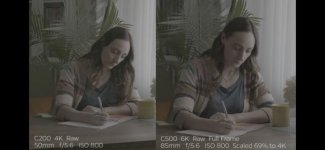
C500: C500 Mark II: Observations from a C200 point of view

If you are on a budget-conscious short, you can shoot on a DSLR/Mirrorless. Given you can shoot anamorphic in RAW on the C500MkII, and swap out the EF mount for PL, it makes it a good option if you can't quite stretch to an Arri LF. Not sure the FX9 comes into the equation.

Maybe including shorts wasn’t the best idea because there are too many variables and I could’ve given more details.

Yes the DSLRs/BM pockets are obviously great for ultra low budget but stepping up another level and the cameras become inappropriate (as a general mindset, of course with exceptions). The SDI alone being the biggest difference and a complete deal breaker. Realistically what’s left? Owner ops are more inclined to throw in their camera package for free for shorts for even further savings.

IMO raw is neither here nor there for a low budget short.

I think just by being cheaper and therefore with more owners in the wild, more short films will get shot on the fx9 than c500 ii.

Didn't the FX9's XAVC hang pretty well against cameras shooting RAW for color/shadows/highlights? Even with S-Cinetone Rec709 (not even log!)? From these tests it also looks like the FX9 is producing more real detail without aliasing. To blur down to e.g. C500 II 6K => 4K detail, perhaps a black ProMist 1/4 would be enough? Can also blur / perform diffusion in post. The extra detail provided by the FX9 can help with post punch in / reframing, which is also helpful for lower budget productions.

And perhaps a feature not being discussed much yet: the in-camera digitally controlled variable ND. This can perhaps help provide one-r shots not previously possible e.g. going inside/outside and vice versa (+ helpful for docs too).
 
There's a way to do crop with a higher pixel count if using a Quad Bayer sensor. So, the 17.6 MPX center crop would be 26.4 full frame, but then by switching the color filter array, 26.4 becomes 6.6.

Now, why would anyone do this? Well, if low light performance was the key, then 6.6 full frame would be quite exceptional.

And the rest could be upscaled into 8.8 a la Alexa.
 
Didn't the FX9's XAVC hang pretty well against cameras shooting RAW for color/shadows/highlights? Even with S-Cinetone Rec709 (not even log!)? From these tests it also looks like the FX9 is producing more real detail without aliasing. To blur down to e.g. C500 II 6K => 4K detail, perhaps a black ProMist 1/4 would be enough? Can also blur / perform diffusion in post. The extra detail provided by the FX9 can help with post punch in / reframing, which is also helpful for lower budget productions.

And perhaps a feature not being discussed much yet: the in-camera digitally controlled variable ND. This can perhaps help provide one-r shots not previously possible e.g. going inside/outside and vice versa (+ helpful for docs too).

The 300Mbps XAVC from the FX9 does look like a significant improvement over the FS7, the downsampling from 6k clearly makes a difference.

I’m interested to see it side-by-side with XAVC480 from the F55.
 
I would like to know how the cropped S35 4k raw on the C500 II compares to the S35 4k raw on the C200. Since the C200 is not cropped, I imagine that S35 raw mode on the C500 II would be a bit noisier and less sharp than the C200 4k raw, which is not cropped.

Still trying to determine if upgrading from a C200 is worth it. I actually think the 1Gbps raw data rate for the 4K raw on the C200 is the perfect sweetspot for playback at this stage. I prefer that to the 2.1Gbps of the 6k raw, which I really think is much too large. Most people’s systems won’t playback those files at all. You’ll either be transcoding or dealing with proxies. So if I got a C500 II, and wanted to shoot in Raw, I could really see myself just switching to s35 crop mode for that and keeping the files somewhat manageable.

I am more interested in the C500 II for the middle ground codec, the ability to use your own LUTs, the better lowlight and the slightly more useable 120fps. Not very happy about the lack of an interval/timelapse mode. Not sure why Canon thought that removing features from their flagship camera that are (and have always been) present on their lower cinema line was a good idea.

As the crop mode on the c500 is essentially the same as the s35 of the c200, you’d expect them to be the same. The 6k oversampled to 4K XF-avc should be quite an improvement over the compressed c200 codec. The ability to reframe for 4K output, even in 60p, is a big plus. The c500 brings flexibility into how you get your 4K, and that’s one big reason why I bought it.
 
Last edited:
I would like to know how the cropped S35 4k raw on the C500 II compares to the S35 4k raw on the C200. Since the C200 is not cropped, I imagine that S35 raw mode on the C500 II would be a bit noisier and less sharp than the C200 4k raw, which is not cropped.

Still trying to determine if upgrading from a C200 is worth it. I actually think the 1Gbps raw data rate for the 4K raw on the C200 is the perfect sweetspot for playback at this stage. I prefer that to the 2.1Gbps of the 6k raw, which I really think is much too large. Most people’s systems won’t playback those files at all. You’ll either be transcoding or dealing with proxies. So if I got a C500 II, and wanted to shoot in Raw, I could really see myself just switching to s35 crop mode for that and keeping the files somewhat manageable.

I am more interested in the C500 II for the middle ground codec, the ability to use your own LUTs, the better lowlight and the slightly more useable 120fps. Not very happy about the lack of an interval/timelapse mode. Not sure why Canon thought that removing features from their flagship camera that are (and have always been) present on their lower cinema line was a good idea.

The best I can tell from the footage I shot (it was not an extensive test with charts, etc.), is that the middle ground codec is really nice - with a minor color correction you can make it look just like the raw from the C200 except you get the convenience factor of a smaller file size and that the camera has already done a noise reduction & sharpen for you - so a definite win there. The ability to load your own LUTs is a really nice option. I didn't do low-light tests, but from what I can tell from the shadows in my tests - at least when comparing the C200 raw vs. C500 raw - is that the C500 raw in full frame 6K appears cleaner, but I think most of that is the fact that when the C200 is scaled 100% the C500 is scaled 69% to match, so you're scaling that 6K image down which is shrinking the size of the noise. When I zoom way in on the C500 6K raw the noise is looking about the same as the C200 raw.

The best I can tell from my tests is that any noticeable improvement in IQ is coming from two places:
1. 6K image being downscaled to 4K which shrinks the noise and gives the appearance of slightly sharper/detailed footage
2. Improved internal codec - C200 8 bit 4:2:0 AVC vs. C500 10 bit 4:2:2 AVC

Maybe there's somewhere else minor that the larger sensor is creating some sort of IQ improvement, but from what I'm seeing the full frame is just purely a visual preference (or handcuff as that's your only option to take advantage of 6K....).

Also of note, if you remember the comparison pics I posted on the first page of this thread, I was able to take all 4 grabs (C200 AVC, C200 raw, C500 AVC, C500 raw) and even though the C200 examples were slightly over exposed and the C500 were a stop underexposed by doing exposure correction in post and a little saturation boost on both AVCs I was able to get them to look exactly the same when viewing at 100%. It's not until you start zooming in (which no audience will ever do) that you start to see the difference. It was a pretty eye opening experience for me.

My big takeaway from that is: unless you don't completely botch your exposure by several stops, you should be in pretty good shape with any of those options. If you're shooting scenes that are very detailed or if you're doing an interview and want to punch in, the C200 AVC is going to start to show it's weaknesses pretty fast, but the other three options should hold up pretty well.

^I can also confirm this antidotally: On a documentary project I shot about beekeeping we were using both of my C200's, but we ran out of CFast cards on the final hour for Camera B so we had to switch to AVC for that camera. The scene was in harsh daylight filming beekeepers in bright white suits and then also filming lots of close ups of bees, frames, grates - all highly detailed objects. Our B-cam was over exposed by probably a stop or so as well. In post during that scene it was pretty hard to make the cameras match. I couldn't really pull any usable detail back from the overexposed highlights, I couldn't boost the saturation too much before it started looking wonky, and even when viewing at 100% I could tell (who knows if audience could) a drop in resolved detail. I ended up making the Camera A raw footage look worse to match Camera B for that scene - better to have everything match and not draw attention to quality differences for the sake of the story.
 
Last edited:
Didn't the FX9's XAVC hang pretty well against cameras shooting RAW for color/shadows/highlights? Even with S-Cinetone Rec709 (not even log!)? From these tests it also looks like the FX9 is producing more real detail without aliasing. To blur down to e.g. C500 II 6K => 4K detail, perhaps a black ProMist 1/4 would be enough? Can also blur / perform diffusion in post. The extra detail provided by the FX9 can help with post punch in / reframing, which is also helpful for lower budget productions.

And perhaps a feature not being discussed much yet: the in-camera digitally controlled variable ND. This can perhaps help provide one-r shots not previously possible e.g. going inside/outside and vice versa (+ helpful for docs too).

Yeah the vari nd would be really handy for steadicam type stuff, especially if you can set the extremes manually but maybe it's fine on its own.
 
The best I can tell from the footage I shot (it was not an extensive test with charts, etc.), is that the middle ground codec is really nice - with a minor color correction you can make it look just like the raw from the C200 except you get the convenience factor of a smaller file size and that the camera has already done a noise reduction & sharpen for you - so a definite win there. The ability to load your own LUTs is a really nice option. I didn't do low-light tests, but from what I can tell from the shadows in my tests - at least when comparing the C200 raw vs. C500 raw - is that the C500 raw in full frame 6K appears cleaner, but I think most of that is the fact that when the C200 is scaled 100% the C500 is scaled 69% to match, so you're scaling that 6K image down which is shrinking the size of the noise. When I zoom way in on the C500 6K raw the noise is looking about the same as the C200 raw.

Thanks for that detailed response! You're the one that did that fantastic C500 II review on Youtube right? At the end you mentioned you'll be releasing a second video talking about upgrading from a C200 from a C500 II, right? I'm very much looking forward to that video. Most retailers are saying the C500 II is still backordered about 2 months, but I've got one guy that said he'd slide me to the front of the line. Still on the fence though. Been checking every day for new reviews and new footage. It's such a massive price jump. Especially when used Amiras are starting to pop up in the same price range.
 
"Should I sell my canon c200 and upgrade to the c500 ii? I'm really hoping the answer is yes".

Shouldn't you be really hoping the answer is no!?
 
Added Video #2 which has my image quality tests:


Hey Chris,

Thanks for putting together this comparison. I’m sure a lot of people are in the same situation as you, and so this will be a helpful set of data.

Some questions have come up in “c500ii by way of c300ii” thread regarding the noise in both cameras in that last set of tests (both exposed the same (?). I’ve compared to a similar sample of my own, and am not seeing anywhere near that kind of noise, and so I’m curious as to the cause (image is under exposed and pushed? Sharpened? or is it something being being brought on by the lut?) Would you be interested in sharing the raw clips, or a ProRes in log from just that last test. I’d be interested in taking a look.

The labels say that the C200 was shot at f/3.5 and ISO 800 while the C500II was shot at f/5.6 and ISO 800.
 
"Should I sell my canon c200 and upgrade to the c500 ii? I'm really hoping the answer is yes".

Shouldn't you be really hoping the answer is no!?
I really want to fast forward to the decision if it's already been made and pick up the pieces later.
If it's worth $11,000 for the codecs and punching in, evf removal, (Although I'm not sure I'd buy an EVF for a C500),maybe time code then yes. But it is a power pig.
Looks like the IQ is about the same.
You can get some fast glass and do the shallow DOF for a lot less.
 
I think the price difference is more like $9500, but regardless, I think coming from the C200, the decision to go C500II is a difficult one. I think one has to want the better internally compressed 10bit 4:2:2 codec, (something canon has always charged more for in the C300II and C700) combined with a cleaner 6k>4k downsample for starters, and the ability to shoot 5.9k for reframing and still frame extraction is important as well. A true modular design makes the newer camera more versatile, but not everyone needs that. I think the stabilization can add benefits to certain types of shooting, and just having the option for 4k at two different crops gives even more flexibility relative to lenses used. Better monitor, timecode and 4 channel sound could play a role as well.

It's easy to look at this as an expensive upgrade from the C200, especially if that's where you're coming from. One could also look at it as getting a C700FF for half price, which is basically is, with the added benefit of internal CRL recording and state of the art recording media. I have to say, that's where I was coming from in my decision, but I didn't own the C200.
 
Back
Top