C200 images

Well, most people would never want to do that on purpose... ; ) Actually, they should make it almost impossible to activate(must be turned on EACH time the camera is turned on and must click YES 23 times). I'm sure someone has gotten burned by it.

Slightly different, but I've seen people have shoots ruined using external recorders and they didn't realize they were taking the "dirty feed" from a camera.

Yes, I have been alternating shoots between using the Blade on my C100/300 and shooting internally for two or three different projects. Fortunately I always check the Blade by turning off all of it's overlays and double checking that I turned them off from camera output. You have to be methodical about stuff like this. I never set up camera on set anymore because of things like this. I always build the camera back at the office and bring it to set, ready to shoot and if I am traveling, I build it the night before in my hotel room and carry the camera to set, setup properly and fully built. Too many distractions on set where things like this can hose you down the road.
 
There are even end-to-end production pipelines that support real-time de-Bayering and grading of LIVE 4K RAW from Canon C500,
support for C200 flavor of RAW will be released when the camera hits the streets.

Regarding proxies, no Prores on SDXC, just 8bit 4:2:0 MP4 and 4:2:2 XF-AVC in free future firmware upgrade.

is XF-AVC guarenteed to be is 4:2:2? if so 8bit or 10bit? id be happy enough to at least have it 422 8bit at minimum.

david
 
It's 10-bit in 1080p.

Do we know it will be the same in the C200? Given EVA1's superiority in recording codecs I think it would behoove Canon to be more transparent about what the C200 XF-AVC implementation is going to be. EVA1 seems to be generating a lot more excitement now. Canon's sluggishness and silence is helping it.
 
Do we know it will be the same in the C200? Given EVA1's superiority in recording codecs I think it would behoove Canon to be more transparent about what the C200 XF-AVC implementation is going to be. EVA1 seems to be generating a lot more excitement now. Canon's sluggishness and silence is helping it.
I don't know about "superiority in recording codecs". EVA1, unlike C200, doesn't record Raw (Light) internally. Horses for courses.

PS. How in the rare earth can this odd divergence happen, one might ask.
 
Thanks for sharing. The RAW footage looks like LOG footage when they pull the curtain back. I have only worked with RAW stills so I do not know how video looks when it gets to the NLE. Definitely crisp footage.
 
Thanks for sharing. The RAW footage looks like LOG footage when they pull the curtain back. I have only worked with RAW stills so I do not know how video looks when it gets to the NLE. Definitely crisp footage.
Sure the Eos C200 produces nice images. But I'm little worried about the Cfast cards, in the article of Cinema 5D, they mentioned that Canon would suggest the Sandisk 256GB Cfast card (30 minutes), I've found the Lexar of 512GB (1 hour of footage) while the Sandisk are stuck with 256GB. So Lexar ones are capable of 512GB, but it seems that they are not advised by Canon. I wonder if the Lexar ones work with EOS C200 or they can miss some data?
 
I am sure testing will take place to see which cards work well. In my experience Canon has some sort of affinity to Sandisk products and have recommended way overkill card specs in the past. That does not mean the Sandisk cards are not the best option just that other cards with the correct data speed will probably be fine.
 
I am sure testing will take place to see which cards work well. In my experience Canon has some sort of affinity to Sandisk products and have recommended way overkill card specs in the past. That does not mean the Sandisk cards are not the best option just that other cards with the correct data speed will probably be fine.
Thanks! There's a chance that Sandisk will introduce 512GB Cfast cards for the end of year? I plan to buy this camera between November or December, I hope that Sandisk will do something about this problem. I'm also considering new cameras like Panasonic Eva-1 or new FS5 Mark II so I will wait news about them till my decision at the end of the year.
 
Do we know it will be the same in the C200? Given EVA1's superiority in recording codecs I think it would behoove Canon to be more transparent about what the C200 XF-AVC implementation is going to be. EVA1 seems to be generating a lot more excitement now. Canon's sluggishness and silence is helping it.

I somehow don't think Canon is too concerned about what Panasonic is doing right now since the EVA1 doesn't exist really until the Fall. B&H is one of the biggest dealers in the world and pre-orders for the C200 are a veritable tidal wave from what a reliable source tells me.

Screen Shot 2017-06-09 at 11.43.26 AM  June 9.jpg
 
Thanks! There's a chance that Sandisk will introduce 512GB Cfast cards for the end of year? I plan to buy this camera between November or December, I hope that Sandisk will do something about this problem. I'm also considering new cameras like Panasonic Eva-1 or new FS5 Mark II so I will wait news about them till my decision at the end of the year.

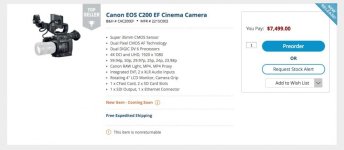
More interestingly, a company called EgoDisk is going to begin shipping 512GB CFast 2.0 cards that may work with the C200 for about half the price of Sandisk. Trust me, there is going to a flood of quality, cheaper CFast 2.0 cards hitting the market by the end of the year, shooting Cinema RAW Light is not going to be as big of a deal as people are making it out to be. Sure, you need a pile of CFast 2.0 cards and some major hard drive space but all of that will quickly come down in price. The only semi-mainstream popular digital cinema camera that shoots CFast 2.0 cards has been the $16k, then down to $12k C300 MKII, the BMD Ursas (niche hobbyist camera, really, very few pros are using it as their main camera) and Arris, which are far above mainstream and are super high end. The fact that Canon is shipping a $7,500.00 camera that can shoot such high end pictures will result in a big change in the market, I am convinced. The card manufacturers see that there is a lot of money to be made but they need to up sizes, production and lower costs. It will happen.
 
I am sure testing will take place to see which cards work well. In my experience Canon has some sort of affinity to Sandisk products and have recommended way overkill card specs in the past. That does not mean the Sandisk cards are not the best option just that other cards with the correct data speed will probably be fine.

Not necessarily. I used to think the "approved media" lists were BS and that as long as you used a major brand card that met the specs/speeds, you would be fine. When the SD 664 was brand new and I was buying cards for mine, I ignored the approved list and just bought Lexar Professional cards. I had been using Lexar Pro cards for years in my still cams and with my Nano Flash with no issues. Upon testing, the Lexar cards, despite surpassing the min. speed requirements, did not function properly. At first I thought it was an issue with the 664. Called my dealer. Called SD. Even sent SD the files and everyone was kind of at a loss, until I told them the cards I was using. Switched the cards out for approved ones(thank goodness B&H is so easy to deal with, with exchanges/returns) and everything was fine after that. It only took experiencing a problem with unapproved media ONCE, for me. Thank goodness it was discovered during a test and not during job.
 
More interestingly, a company called EgoDisk is going to begin shipping 512GB CFast 2.0 cards that may work with the C200 for about half the price of Sandisk.
I hope that this EgoDisk Cfast cards will be available worldwide because if it's a small company would be a problem to sell them, I think they could be available just in USA.
 
Back
Top