Blackmagic Video Assist 4K Recorder/Monitor Now Shipping @ Texas Media Systems

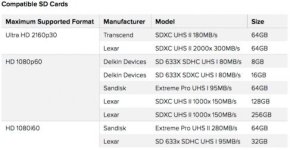
Transcend has a 180 MB/s write rated card that BMD suggests for this monitor for recording 4k. That should be plenty of speed...
That's the maximum -i.e, burst - bit rate. The max rate depends on the buffer within the card. Once it fills up, the bit rate will slow down, often drastically. The constant recording rate is not known or published.

This is why the SD group came out with the video recording standards that specify precisely that, the minimum sustainable recording bit rate as indicated by the ratings on the card. There are several classes, as from the link I provided. It starts at 6 (a V6 category) and ends with 90 (V90), all in minimum rates expressed in Bytes per second. Presuming no manufacturer wants to be accused of an outright fraud, a compliance with these standards will ensure a consumer that any card s/he decides to purchase will perform exactly as stated. The current labeling of the max bit rate recording does not accomplish that.

And, again, I bring this up because ProRes 4:2:2 HQ is 880 Mbps/110 MB/s, which exceeds the maximum sustainable bit rate of the latest generation of SD cards (in fact, I haven't seen the V30/60/90 class cards yet even advertised). So, if VA4K advertises itself as ProRes 4:2:2 HQ capable, it's - to use the most generous of interpretations - only applying the max/burst rate without any indication of how long this burst rate can last.

This criteria also apply to the card manufacturers. The burst rating was fairly suitable for photographers but nigh useless for videographers. Which is why the SD card manufacturers went Sue Grafton and created a V-rating, where V stands for Video.
 
Blackmagic Video Assist 4K & Multiview 4 Arriving Monday @ Texas Media Systems

Blackmagic Video Assist 4K & Multiview 4 Arriving Monday @ Texas Media Systems

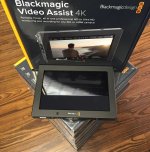
Our first shipment of Blackmagic Video Assist 4K & Multiview 4 are tracking to arrive in Austin on Monday:

Blackmagic Video Assist 4K Recorder/Monitor BMD-HYPERD/AVIDAS74K $895

BLACKMAGIC DESIGN MULTIVIEW 4 - HDL-MULTIP6G/04 BMD-HDL-MULTIP6G/04 $495

https://www.blackmagicdesign.com/tw/products/multiview


blackmagic_multiview4_a_web.jpg

blackmagic_multiview4_c_web.jpg


diagram.png
 
That's the maximum -i.e, burst - bit rate. The max rate depends on the buffer within the card. Once it fills up, the bit rate will slow down, often drastically. The constant recording rate is not known or published.

This is why the SD group came out with the video recording standards that specify precisely that, the minimum sustainable recording bit rate as indicated by the ratings on the card. There are several classes, as from the link I provided. It starts at 6 (a V6 category) and ends with 90 (V90), all in minimum rates expressed in Bytes per second. Presuming no manufacturer wants to be accused of an outright fraud, a compliance with these standards will ensure a consumer that any card s/he decides to purchase will perform exactly as stated. The current labeling of the max bit rate recording does not accomplish that.

And, again, I bring this up because ProRes 4:2:2 HQ is 880 Mbps/110 MB/s, which exceeds the maximum sustainable bit rate of the latest generation of SD cards (in fact, I haven't seen the V30/60/90 class cards yet even advertised). So, if VA4K advertises itself as ProRes 4:2:2 HQ capable, it's - to use the most generous of interpretations - only applying the max/burst rate without any indication of how long this burst rate can last.

This criteria also apply to the card manufacturers. The burst rating was fairly suitable for photographers but nigh useless for videographers. Which is why the SD card manufacturers went Sue Grafton and created a V-rating, where V stands for Video.

There are actually plenty of SDXC cards that greatly exceed the specifications. We can look at numbers and specs all we want. BMD has tested these cards and they apparently work perfectly fine for 4k ProRes422 HQ. The 110MB/s needed is pretty low compared to the 180MB/s maximum so even if it can't sustain 180Mb/s it is likely still capable of at least 110MB/s. BMD would not suggest recording to a data rate that high if they couldn't achieve those speeds. From what I understand SDXC has been capable of these speeds for a long time but there are not a lot of devices that support those speeds. The 4k VA likely pushes what these cards can transfer to their max.

Instead of speculating based on specs I tend to think BMD knows what they are doing and if they say they can get 4k Prores422 HQ on a SDXC card then I'm sure they can.
 
... Instead of speculating based on specs I tend to think BMD knows what they are doing ...
As is your wont. When it comes to the BMD products, I tend to stay on the side of caution.

PS. This applies to the card manufacturers as well. Many have been tested and most specs did not live up to the actual performance.
 
That's the maximum -i.e, burst - bit rate. The max rate depends on the buffer within the card. Once it fills up, the bit rate will slow down, often drastically. The constant recording rate is not known or published.

Cameras and hard drives have buffers. Cards essentially do not. Any buffering of data would happen before it got to the card. If the data rate is 110 and the card rate is 180 it will be more than adequate.
 
That's the maximum -i.e, burst - bit rate. The max rate depends on the buffer within the card. Once it fills up, the bit rate will slow down, often drastically. The constant recording rate is not known or published.

This is why the SD group came out with the video recording standards that specify precisely that, the minimum sustainable recording bit rate as indicated by the ratings on the card. There are several classes, as from the link I provided. It starts at 6 (a V6 category) and ends with 90 (V90), all in minimum rates expressed in Bytes per second. Presuming no manufacturer wants to be accused of an outright fraud, a compliance with these standards will ensure a consumer that any card s/he decides to purchase will perform exactly as stated. The current labeling of the max bit rate recording does not accomplish that.

And, again, I bring this up because ProRes 4:2:2 HQ is 880 Mbps/110 MB/s, which exceeds the maximum sustainable bit rate of the latest generation of SD cards (in fact, I haven't seen the V30/60/90 class cards yet even advertised). So, if VA4K advertises itself as ProRes 4:2:2 HQ capable, it's - to use the most generous of interpretations - only applying the max/burst rate without any indication of how long this burst rate can last.

This criteria also apply to the card manufacturers. The burst rating was fairly suitable for photographers but nigh useless for videographers. Which is why the SD card manufacturers went Sue Grafton and created a V-rating, where V stands for Video.

again, you need to realize that they haven't set any higher standard, the highest is 90mb/sec, just because that's the highest 'official' achievement a card manufacture can claim, it doesn't mean that the manufacturer can't build cards which vastly exceed the current maximum standard. there are cards approaching 300mb/sec. and i've done enough tests on cards to see that 'burst' rate isn't apples to apples, many cards rated at X mb/sec can hold near that during transfer/tests

suffice it to say, i really don't see any issue with the data rates, except of course the occasional dunce who will pop in a class 10 card and blame the recorder for not working at prores 880. I think that's one of the main reasons manufacturers don't seem to like to use SD slots, because it leaves too much opportunity for user error.
 
From the updated BMD VA manual. BMD also suggests in other parts of the manual that cards that are rated to go over 110MB/s should be ok for UHD capture.

I agree BMD may sometimes have a loose definition of things working when it comes to cameras but they tend to get their recording devices working right. If they say these cards work for HQ 4k then I'm sure they know more about the subject and what their devices can do than the rest of us do right now.

Screen Shot 2016-04-21 at 10.38.15 AM.jpg
 
I decided to pop into BMD's own forums and found a discussion from October, 2013 on what SD cards worked or did not work with the Pocket Cam ProRes HQ (220 Mbps/27.5 MB/s) and the top of the line SanDisk Pro (80MB/s) cards worked pretty much every time but many others rated in proximity and usually exceeding the maximum specs did drop frames. Everything from the I/O controllers to buffers to the non-sequential files were blamed. BMD did publish a list of what cards it approved but the users had their own cards and those didn't always work as intended.

In any case, I am sure some cards will work better better than others. On a leap of faith, if not anything else.
 
We regularly find that media rated for a given data rate will fall to less than half that data rate after the card is 50% full. This is common and is the reason that only qualified media is allowed to function in our products. A published recommended list is not sufficient in our opinion. Either it works or it is useless. There is only one thing worse than a tool that doesn't work and that is a tool that sometimes works. You'll try to rely on it and you'll get burned.
 
I just got back from NAB and had a chance to speak with Nicolas, who is the product manager for the Video Assist series. Super nice and answered some of my questions:
From what he told me, which would all be "speculation"
  • I asked him about LUTS and he said "Wouldn't it be cool if you could load them in the flash memory, and have up to 6 to choose from."
  • More tools such as false color, vector scope, are a possibility.
  • They are listening to our concerns with this and the 5" version -different peaking color other than green. He understands that shooting outside against a green landscape doesn't help too much -they are aware of the "green tint" and hope to add tools to adjust color on the monitor to address that
  • look for something this summer with a firmware upgrade
  • he said just like the 5" Video Assist, from what it's initial release, it will look like a different monitor late this summer with firmware upgrade.
All "speculative" from his mouth.

Anyone who hasn't learned their lesson yet with BM had better wake up and smell the coffee.
BM's practice of releasing half finished products is tiring to say the least.
Any monitor "that will be completely different when the firmware upgrade comes in the summer", is a monitor that deserves to wait to be bought until after the summer.
 
Tony..talking with a hood?

No, of course without, just as it come.
But egen with a hood, on days of full sun, it ia difficult to see even with a cover on sub 400nits. Just see and look atomos and why 1500 , 1500 exceeds, but until flame, their shoguns are 400nit and not too much brightness on outsides.
 
I mean I think is waste of money to buy a monitor with less than 400 or 450cdm2. There are a lot of shots on exteriors and this kind of low bright displays are not good for. Eyy not only BM assist, even red toych 7" is 350nit and all red touchbusers complain that is not good for outsides.
 
I think it really depends on the environment. I use the Shogun outside all of the time and get by, but I can see it being a problem in the desert or something.
 
Back
Top