Black Friday Specials

I believe we're in agreement. I think the only outstanding question is if the shoulder-mounted position is considered the default,

Wether handheld, small gimbal, or shoulder, the side controls can be in the same places, because the left hand is going to be the free hand in most of those scenarios.

But the controls should be like Hasselblad and ENG cameras: on the side, but wrap around to the front to fit the form of the human hand. When an ENG camera is on a tripod, the controls are all in one small area so that the left hand doesn't have to move far for image controls and menus. (audio is another story).

Controls in that region work across a wide variety of most common camera operating styles. For everything else there is the flippy touch screen and wifi connect or whatever.
 
Last edited:
I believe we're in agreement. I think the only outstanding question is if the shoulder-mounted position is considered the default, and if an alternative default was the reasoning behind some of these wacky camera choices, such as the c300 clamshell audio and, similarly, the FX6 audio inputs on top handle. Both those designs suggest to me that they expect people to spend a lot of time holding it by the top handle. Which I rarely do except for transport, and those choices displease me.

BUT if the shoulder mount is not default, the cable placement is somewhat less of a disaster to stick out the left side. Doesn't bother me at all on gimbal, for example, until I have to rotate the camera 90 degrees for vertical shooting (which the RS2 solves by having a vertical mode)

Wether handheld, small gimbal, or shoulder, the side controls can be in the same places, because the left hand is going to be the free hand in most of those scenarios.

But the controls should be like Hasselblad and ENG cameras: on the side, but wrap around to the front to fit the form of the human hand. When an ENG camera is on a tripod, the controls are all in one small area so that the left hand doesn't have to move far for image controls and menus. (audio is another story).

Controls in that region work across a wide variety of most common camera operating styles. For everything else there is the flippy touch screen and wifi connect or whatever.

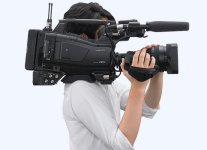
With a real ENG camera, most of the controls are in the optimal position whether it's on your shoulder or stix.
 
With a real ENG camera, most of the controls are in the optimal position whether it's on your shoulder or stix.

Yes! I may have stressed the tripod aspect because most people seem to assume it is good for shoulder work, but i find i even like it for tripod and other handheld positions. Easy to get to the controls and much easier to get the right control quickly.
 
Part of the issue with some of these cameras is the lack of depth, no? Like the P4k which is wide and relatively shallow. But supposedly people like the controls layout on that one
 
Width height depth? Isn't the expanse of side controls on some of the eng cameras you mention broader than the side of some of these small cameras like the P4K?
 
50681701756_4a038c4a15_w.jpg
 
There are two user buttons and a mode check button further back, and then the headphone and alarm volume controls. But most camera users would not expect physical controls for that these days. An alarm volume control, you kidding?

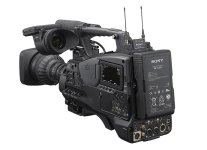
On the rear quarter of the body, near the audio i/o and wireless hop, there is a dedicated audio panel. Where you can set audio levels visually and close the panel from accidental changes.

But the core camera controls are not far back because the thing has to work on the shoulder and no use having essential controls behind the ear.
 
Some of the bigger cameras have the most efficient layouts. Perhaps because they don’t try to squeeze non essential functions in with the essential ones? Idk. DSLR’s right hand grip is another incredible use of space and efficient layout.

50681010313_352e5a3351_n.jpg
 
Last edited:
This was my A7s2 rig.

49874754213_089c90502f_n.jpg


There are no real controls on the operator side, so i can have it pretty short, and the camera is at my ear pretty much. It operates a bit more like a movie camera in that sense. Just record and go for a take. Reset. Go again.

Any of the short body “cine” cameras would be better for shoulder work than a mirrorless camera. C200, Fx6, EVA1 etc, all have some or all the core controls on the side. But something like a C70 is about as big as is needed to function like a mini ENG camera.


However, they have to rig up a little longer to get good balance on the shoulder and have the camera controls forward of the ear, near the jaw. Means the battery and such have to scoot way back. The Fx9 can make the balance a little less awkward looking and a little more solid. But it all depends on the operator of course and what they are doing. If i’m shooting a documentary and it’s the type i have to be ready to shoot at a moments notice, anywhere at anytime, i’m not going for a long body camera.
 
Last edited:
Abe, in pictures, if you are used to FF35 lens mounts, the B-mount is by comparison tiny, so the ENG cameras look much larger in pictures.

This is not a proper 1:1 sort of sizing, but shows roughly the comparison. Looking at the vct mounting points, a general idea of scale can be seen.

50681347863_4880d0f289_w.jpg
 
Pick your poison. Amazing how much cleaner and more functionality an ENG camera has.

50682133006_4a4b906acf_n.jpg
 

Reminds me of the cluster of controls within reach of thumb and forefinger on a DSLR

Maybe they could design an extended right hand grip with some of those controls in reach of a finger stretch. You already have a few extras on the FS7 grip

Or maybe a control box that can mount on rails or hot shoe in reach of left hand.

Or - like you're saying - put the controls where the left side ports are. And then ports can go out the top? That probably wouldn't be too disruptive although I'm guessing the current design is about shaving costs and, like you said, body beauty
 
Pick your poison. Amazing how much cleaner and more functionality an ENG camera has.

50682133006_4a4b906acf_n.jpg

Still seems like mostly a doc/eng problem to me (which is a ton of shooting, granted). Every camera I ever built as an AC was a frankenrig, whether it was an alexa, epic, or 5d. Usually the real camera builds were worse because you get tasked with adding even more accessories like cinetape
 
I bet most users here have never shot shoulder mounted with a 2/3" three chip with a B4 lens.
Every time I do a long day shoulder mounted with our C200 or C300 MKII, it just sigh, they are
so awkward, the C200 blows hot exhaust air into my ear, I have to constantly adjust the eyepiece
and the whole thing just feels like a hack.

While I liked the big ENG layout cams like the classic Varicam, the 2/3 size of the Sony DSR-500 was the ultimate,
it was like a mini Betacam, but was light, small. Ergonomically, the best overall camera I ever owned, even better than
my Arri SR2, which was also pretty nice to shoot shoulder mounted. Today's "boxes with a bunch of crap" hanging off of them
are an ergonomic nightmare and not everyone wants to fly their camera on a gimbal, or Steadicam, which is the excuse that people
use to justify shooting with an electronic shoebox.
 
An ENG style camera with a full frame sensor and a cinema zoom would be a tad unwieldy and a tad hefty. A half-way solution, to please the DVX User bunch, would have an elongated body for shoulder mounting and the button placement. FX-9 with the back extension or something in that vein.

On the technical front, buttons can be substituted for voice commands. And most manufacturers now have apps for control via smartphones or iPad/laptop type devices, though a separate touch control interface could also work.

And the box shape allows for a greater modular expansion, which is a budget/performance constraint.
 
DLD, how are you going to talk to your camera while sound recording is happening?

Although I read a few years back that the military had some sort of invention where you could speak through your walkie without vocalizing. Something like the device would interpret your mouth and jaw movements and translate it into speech on the receiving end of the transmission so you could just mouth what you wanted to say

But nothing beats Neuralink
 
Back
Top