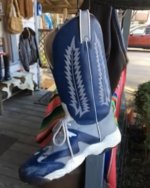
Best shoes for gimbal walk?

ahalpert

Major Contributor
What do people think are the best footwear for nimble gimbal/steadicam walking? I'm considering buying some "barefoot" style zero drop shoes. I'm not happy with thick soles as far as coming down on the floor with control. I used to have some "toe shoe" running shoes (not a professional look) and they really gave me situational awareness of the ground, pretty much like being barefoot.
 
I know a few Steadicam operators who prefer those barefoot type shoes, I always thought it a little counterintuitive myself because of the added load on the body requiring more support/cushioning (running is a different story, since no added load). I also consider the footwork different between handheld and Steadicam where the former has a more direct affect on the frame--gimbal work can fall into either category depending on whether an isolating bodymount is being used.

In my Steadicam career I started out with New Balance sneakers for Steadicam and handheld, and later went to hightops for Steadicam to protect my ankles (and indeed, never had a rollover). Even ten years out of the rig, when watching rehearsals of a walk-and-talk I still tend to backpedal like I'm wearing a Steadicam, much to my operators amusement (one foot going behind the other to maintain a straight line).

Here's some discussion on this from a while back. Most of the talk moved to the Facebook Steadicam group years ago but you have to be a member to read.
https://steadicamforum.com/index.ph...ller=topic&id=4868&tab=comments#comment-24283
 
What do people think are the best footwear for nimble gimbal/steadicam walking? I'm considering buying some "barefoot" style zero drop shoes. I'm not happy with thick soles as far as coming down on the floor with control. I used to have some "toe shoe" running shoes (not a professional look) and they really gave me situational awareness of the ground, pretty much like being barefoot.

I know a few Steadicam operators who prefer those barefoot type shoes, I always thought it a little counterintuitive myself because of the added load on the body requiring more support/cushioning (running is a different story, since no added load). I also consider the footwork different between handheld and Steadicam where the former has a more direct affect on the frame--gimbal work can fall into either category depending on whether an isolating bodymount is being used.

In my Steadicam career I started out with New Balance sneakers for Steadicam and handheld, and later went to hightops for Steadicam to protect my ankles (and indeed, never had a rollover). Even ten years out of the rig, when watching rehearsals of a walk-and-talk I still tend to backpedal like I'm wearing a Steadicam, much to my operators amusement (one foot going behind the other to maintain a straight line).

Here's some discussion on this from a while back. Most of the talk moved to the Facebook Steadicam group years ago but you have to be a member to read.
https://steadicamforum.com/index.ph...ller=topic&id=4868&tab=comments#comment-24283

Several years ago, the Steadicam op for the broadcast who was doing the live entrance with a college football team who makes an insane, running entrance down a steep "double hill", did so barefoot.
 
I prefer to do the moon walk when flying a steadicam.
;)
Back when I was in marching band we had to do the glide step with one foot in front of the other. So I do that actually. Funny thing is back then we wore really lousy bando shoes which had basically no cushion or support. Just thin black shoes. Today I like some cushion when doing video work but no slip
 
Still have an ancient pair of Vans that roll pretty soft. Pretty much anything that fits your foot well, doesn’t flop around, and doesn’t clonk.
 
Several years ago, the Steadicam op for the broadcast who was doing the live entrance with a college football team who makes an insane, running entrance down a steep "double hill", did so barefoot.

That's pretty interesting, because the way I see it - running full-tilt is the one situation where I WOULDN'T want to be barefoot or in barefoot shoes. Because I can go faster coming down on my heel (as people typically do in shoes), but you don't come down on your heel when running barefoot (because it hurts). So, I feel like I would run more slowly that way. But maybe the guy is more practiced.

I know a few Steadicam operators who prefer those barefoot type shoes, I always thought it a little counterintuitive myself because of the added load on the body requiring more support/cushioning (running is a different story, since no added load). I also consider the footwork different between handheld and Steadicam where the former has a more direct affect on the frame--gimbal work can fall into either category depending on whether an isolating bodymount is being used.

In my Steadicam career I started out with New Balance sneakers for Steadicam and handheld, and later went to hightops for Steadicam to protect my ankles (and indeed, never had a rollover). Even ten years out of the rig, when watching rehearsals of a walk-and-talk I still tend to backpedal like I'm wearing a Steadicam, much to my operators amusement (one foot going behind the other to maintain a straight line).

Here's some discussion on this from a while back. Most of the talk moved to the Facebook Steadicam group years ago but you have to be a member to read.
https://steadicamforum.com/index.ph...ller=topic&id=4868&tab=comments#comment-24283

Thanks for the link, Charles! Supremely interesting. And it's interesting to see that a number of those folks were turned onto the barefoot shoe thing.

I'm only flying a Ronin-S rig without an arm/vest, all together probably 12 lbs or less. So, the duress/strain is not the issue I'm trying to solve.

Specifically, I was shooting a 20-minute take following some art historians around a gallery the other day. No trouble on wide following shots. But when I came in close to the paintings, sidled up to them, and did slow pivots coming from a frontal angle to a 3/4 angle at close distance, I felt like I needed to do very delicate footwork to keep my balance and move slowly into position with control, seeing as how my rig/arms were locked to my core, so I was moving the camera by moving my core.

And those vibram five fingers - I used to really love those shoes. they just looked weird as hell and took on BO very quickly.

there are a few nice things about the barefoot thing - you feel more what's going on with your toes/feet and when/where you touch down. you typically come down on the front part of your feet which acts like a spring, or else rolling along the outer part of the foot towards the front. either way, it softens the impact. children naturally start walking on the front of their feet ("foxwalking"). so you get a lot of control, and it's very comfortable.

I feel good about my situation now doing walking/jogging takes at moderate distance from the subject (3'+). my difficulties are at close range, macro-type shots, where I typically just pull out a slider. my bobbing and swaying is not diminished by the gimbal. although that's a slightly different issue than the dance moves I described above. I've considered getting a steadimate-S, but I'm not that impressed by the footage I've seen, and I'm not sure that the advantages would outweigh the drawbacks.

I think these are the shoes I really want - https://www.vivobarefoot.com/us/mens/everyday/ra-ii-mens?colour=Dark+Brown

Especially since I need dressy shoes for a lot of things. But I'm too cheap and they're not on sale, which was the point of buying right now.

So I'm thinking of getting these, which look more like regular sneakers - https://www.lemsshoes.com/collectio...products/mens-primal-2?variant=23307304763450

and are on sale for just over half the cost of the other ones...
 
Last edited:
Heelys!

HES10360-1_1200x1200.jpg
 
So, I took my new Lems Primal 2 barefoot-esque shoes on their maiden voyage last week https://www.lemsshoes.com/products/mens-primal-2?variant=23307304763450

They were very nice! First of all, the wide toe box of barefoot type shoes is really great. Like going from coach to first class. More comfortable and improves balance.

Not having a cushioned heel may impact those who come down on the heel, but you can roll along the outside of the foot which is more what you're supposed to do. at any rate, I wasn't having an issue before with gimbaling at a full pace stride and I'm not now.

The issue for me was delicate pivoting at close range where I have a hard time maintaining adequate stability. These shoes definitely help with delicate footwork, planting my toes, and not losing my balance. Hurray! The vibram five fingers with separate toe sockets might be a little bit better, but I'm not going to wear such weird-looking shoes to work.

The only downside is that zero-drop shoes do nothing to enhance my 5'7" stature, especially when everyone else is wearing shoes with a thick heel. But people judge me by my footage, not my height. :) and anyway it makes it a wee bit easier to get low angle shots.

All in all I'm very pleased!
 
Quality footwear is so expensive these days. I have planter fasitis so I need heel cushion with arch support, Asics and Brooks running shoes are my go to but the narrowed toe area makes side to side and turning less stable for gimbal work.

I just completed an organ concert where I used my phone 12 on osmo om3 for gimbal work. I still need to improve on the fly decide on a move and execute it. Holding a starting point, slowly but decisively moving to the ending point, and holding that shot for a few seconds. It's a bit like performing Tai Chi
 
Last edited:
. It's a bit like performing Tai Chi

Haha so true. In the last year I've been doing a lot of one-shot gallery walkthroughs where I follow an expert around in a wide shot and then move in close on the piece they're talking about. When I'm doing close-ups it's very tai chi with slow deliberate leg bends and lunges, slow pivots of the torso or arm raises, like I'm moving through water. And I still have trouble making it steady enough for my tastes although the client has not complained
 
The slider is the better tool for closeups because you'll notice all the imperfections of a gimbal, but slider takes too much time and work if you're doing more than a couple of things. Sometimes it's better to snap a high res photo and then you have full control in post as to speed, movement, and duration. More work in post and don't get the perspective change. I was doing broll of the music sheets and the phone did that focus pulsing which I wasn't expecting.
 
Yes slider is better for close-ups because the gimbal can't solve up/down side/side or forward/backward swaying of my arms.

But that's the nature of the beast of doing a continuous take. You're going to be on one rig the entire time (although I've thought about having a monopod or light stand on the bottom of my gimbal or ready to connect when I set down for a close-up. But ultimately I think it would cause more problems than it would solve, so I'm just focusing on maximizing stability on the gimbal.)

This is the recent video I shot where I finally feel like I can adequately magnify details on this set-up due to zooming into 24mm + using 2x clear image zoom. The only problem is that zooming the lens on my Ronin-S with focus motor is a bit rough and I wish I could find a zoom rocker to work with it. I applied a bit of stabilization throughout. There are a few edits where I had to fix stops/starts of specialists talking or where I transition between different types/amounts of stabilization, but it's supposed to FEEL like a live shot and the client was very pleased - https://vimeo.com/501597713/a920698c57
 
The best Steadicam op I've ever seen for smooth fluid movent was a guy I trained to use my Steadicam. He was an ex member of the Polish National Ballet and a representative ice skater. He used ballet training shoes. He could move with blistering speed, coordination and balance with a Steadicam like I'd never witnessed before. He said anything more solid than his ballet shoes felt too restrictive with minimal feedback. Intuitively knowing where his feet were and "feeling" the surface underfoot gave him the utmost confidence in his movement and the ability to change direction and balance smoothly. In one week of training and a month of daily practice he was as good as guys I've known who had being running Stedicam for years. Somewhere I have a video I shot on his second day of training as he was such a surprise.

Chris Young.
 
The best Steadicam op I've ever seen for smooth fluid movent was a guy I trained to use my Steadicam. He was an ex member of the Polish National Ballet and a representative ice skater. He used ballet training shoes.

Ah, so I'm on the right track. There's no way I'll be using ballet shoes, though. I doubt those could even take a sharp object on the floor, and not everywhere that I walk will be safe for that. But barefoot style shoes have extremely flexible soles, so at least there's that. With the vibram five fingers ("toe shoes") I had great ground feedback. But these Lems aren't bad either
 
Back
Top