Best Documentary Camera

I feel the most important thing about working with people is to understand filmmaking and video making is a collaborative work so communication has to be very good and both sides should listen very carefully.

What you are describing is mainly a communication issue (not clear from which side).

All that dop had to do is:
1) Shoot at 5K HD mode which is 16:9 native and equivalent to super35.
2) connect an external mic to his camera via XLR adapter to have good scratch audio track (very easy and he could have hire one or buy one if doesn't have it)
3) bring along any kind of external recorder like Samurai blade or similar and record 1080p HD Prores or similar for easy hand off.
4) bring along vari-ND or just stick ND filter in a light weight matte box and make sure it's ON.

He should of known that and done it if communication was good, if he wasn't listening someone should've picked that up before he was hired and hire someone else.

I think it was not so much a communication problem as an ego problem. He is an extremely talented and experienced guy, not your typical "mum bought me a RED so now I'm a cinematographer" type of guy who is all too common lately. He was made aware of what we required, but in his infinite wisdom chose to go against it. Because why would you buy a 6K camera to shoot anything less?

Yes, a lot of his personal choices affected the outcome, but your "solutions" don't exactly prove that his camera was the best one for the job. Instead of buying a 6K camera, adding a recorder to to shoot 1080p, an XLR adaptor for SCRATCH sound (which still doesn't even give you true doc-friendly on-board sound!) and a matte-box, why not use a camera that includes all those things in the first place? This is the essence of the OP's question - not "how can I make XXX camera work?", but "which camera is best in this scenario".

Not to mention all of those things - external ND's XLR adaptors, External recorders, etc all take extra time to set up - time which he already did not have enough of for this type of shooting.
 
But this is all getting the cart before the horse ain't it? Just because some DP gets a great camera for doc won't help him if he didn't get properly trained in doc shooting. I know. I have to cut the young ones' footage! Interviews are OK, b-roll is OK, but if they have to do reality and provide me with a wide variety of coverage, wow, they are clueless. No one taught them and it's really hard to learn doc shooting by yourself.

It's not their fault though, they are all self taught now. When I started you had to assist for an older guy who knew what he was doing and trained you, because the gear was so expensive and complex. And my early years of sports (predict who is going where next and passing to whom and plan focus), plus nature (stealth and be ready to roll is a second) and news (position yourself for what's about to happen plus have a Plan B,C,D,E...) all these things make one better at doc. Now they ingrain bad habits. Also, their instinct is to make a 2 minute video whereas with docs the shooter needs to hang much longer, have many cut aways so the editor can elongate for VO. Maybe if they had to cut a few docs before trying to shoot one? Then they would be more successful? Oh well...

Agreed. The biggest thing so many of these shooters struggle to do is shoot for the edit. They are great at shooting a pretty image but have no clue how to make they shots fit into a broader sequence.
They don't understand that a wide to CU can cause a jump cut if you don't also physically re-position the camera between shots.
They don't understand that you can't cut a L-to-R pan to a R-to-L pan or to a tilt; you need a static shot in between.
They don't think to get CU's of hands moving, etc which can be used for cut-away's to hide jump cuts in interviews.
They don't understand that having your CU cam panning back and forth between a presenter and interviewee between questions negates the whole purpose of it - because the moment they are whip panning and pulling focus from one to the other, is precisely the moment you need the cut to occur to get rid of the "um, ah" at the beginning of every response.
They think that just because something was shot with 2 or 3 cameras, they don't also need to get noddies (actually, I don't even think they know what noddies are).
They tend to get a dozen pretty shots at each location without thinking about the relationships between each one (eg good balance of wide/medium/CU, static/motion etc) or even whether the individual shots are remotely related to the subject that the interviewee was talking about 15 minutes earlier. They just have a look around and think "that looks cool" without thinking about the context.

Having said all that, while I think it is definitely a product of the Canon 5DII/RED 2 minute montage "cinematographer" trend, you'll likely run into this problem whatever camera you give those people.
 
Last edited:
I think people who say ENG cameras are faster tend to mean faster for shoulder mount work, which of course they are. But what if you rarely do shoulder mounted handheld shots? I rarely do. I'm finishing up a doc style project now with the C300 Mark II which I never used my shoulder rig for. It has a few bare handheld shots in it, mostly at waist level with some side to side movement (which wouldn't have worked well if it'd been shoulder mounted), and is heavily made up of Steadicam, slider, monopod, and tripod shots.

As I mentioned, my Steadicam Zephyr takes 5-10 minutes to setup and can handle an ENG camera, while my Glidecam takes 1-2 minutes to setup and can handle a C300. There's no way around this fact that for Steadicam shots the C300 sets up faster since it's smaller and lighter, and the smaller C100 sets up faster than the C300 for Glidecam work.

I have a large rolling bag which fits a tripod, monopod, slider, three C-series cameras, a couple lenses, some audio gear, and a couple on-camera lights in it. Lots of gear in one bag. With multiple ENG cams, they're not going to fit in the same bag. An O'Connor 1030 is not going to fit well in that bag. The MYT Works 4' slider (How much does that cost? I couldn't find a price on their website.) is certainly not going to fit in that bag. Which means what? To use this larger and heavier gear, you'll need more bags, a bigger car (my small SUV is getting full as it is), and more trips unloading gear, which means more time. So again, if you're showing up with just a tripod and camera, and doing mostly shoulder mounted work, ENG is a great way to go, but if you want a variety of support gear and multiple cameras, I still don't see how it could possibly be quicker than using a smaller camera with smaller support gear.

Let's also consider jib shots. With the C100 I can mount it on my Kessler Pocket Jib Traveler. Takes about 3-5 minutes to setup, or two minutes if I've pre-configured various adapters prior to the shoot. The setup is pretty light - seven pounds for the camera, six pounds of counterweight, 5.5 pounds for the jib, five for the tripod - so about 24 pounds total. I can lift this entire unit by myself to position it in different locations without tripod wheels (up and down stairs, etc.). Now say you have an Amira at 20 lbs, 40 lbs of counter weight (since most larger tripods I see don't extend as far out the back as the Kessler traveler), 6.2 lb tripod, and 10 lbs for the jib. Now you've got a 75 lb setup that I'd have trouble seeing a person moving from room to room, up and down stairs, without wheels by themself without disassembling.

Of course larger support gear also tends to be more stable. An O'Connor 1030 is smoother than say a smaller Vinten Vision Blue (which I use), Sachtler FSB-8, Miller Compass 15, etc. Same with Steadicam; more weight equals more inertia, smoother moves, etc. The Kessler Pocket Jib Traveler has never been that sturdy, but is often good enough to get the job done getting some good and usable shots. Coming from the approach that you'd use the heavier support gear even with smaller cameras to reap the benefits of the added stability, then sure, that would level out the playing field in terms of how long they take to setup. But the smaller cameras give you the option to use smaller and less stable (but often still adequate) support gear which I would think actually sets up quicker.

I'm still much faster on a set of stix with an ENG camera than a set of stix and C or F cam with a prime or still lens. My tripod sets up just as fast or faster than a tripod designed for a smaller cam. The one designed for a lightweight cam may indeed be easier to transport because it's lighter and smaller, but again, I don't need to transport multiple cameras and tripods in one bag. You may have a point about putting a small cam on a Glidecam or small jib or being able to pack a few cameras in a bag at once, but I think we're starting to get into very specific criteria here. Hell, I can pack about 50 GoPro's into the backpack I carry my support gear in for my cams, but who cares. Unless I need 50 GoPro's for something. But IF you need to easily carry multiple cameras easily in a backpack, you're not gonna achieve that with an Amira, Alexa, VariCam or the like. Again, different needs, different tools.

My point of view is different from yours. And that doesn't make either bad or wrong, just different. We live in different worlds. I don't shoot docs with the those type of requirements, or docs period. When I'm on a shoot that needs a jib or Steadicam, they bring in a jib and op or Steadicam and op, not one or two people trying to do the work of six. I understand that everyone wants to do more with less(MUCH less) than they used to. I go through it all the time now, too, but it's not ideal or fun and there is always something being compromised when you have to worry about so much by-yourself. The last thing I want to have to worry about is "fighting" my camera, instead of it working with me.
 
I'm still much faster on a set of stix with an ENG camera than a set of stix and C or F cam with a prime or still lens.
Why do you keep comparing to the C or F cam with a prime or still lens? They can use zooms, including cinema zooms, just like an Arri Amira can, and have the same mount options as the Amira. From what I gather the F55 has quite good ergonomics for shoulder mount use with the Canon 17-120. Sure, the cinema zooms aren't as small and light, don't have as much range, and tend to cost more money than a small sensor ENG cam's zoom lenses, but then I personally tend to think the small sensor ENG cams like the Sony F800 don't have image quality that is good enough for high end doc work, regardless of how much quicker the greater zoom range helps.

The Canon 18-80 cinema zoom will be a nice addition to the large sensor camera zooms as well, being how it is smaller, lighter, has auto-focus, and IS.
 
It shouldn't be this complicated. If a producer were to come to you the DP and ask what one camera you would like them to rent for their documentary...you ask what kind of documentary...they say they don't have details yet, but would still like a camera recommendation now. Then you recommend them a camera based on your best generalized guess based on your generalized experience with documentary filmmaking.

It's the same concept as buying. If I'm asking what camera to buy for high end documentary filmmaking (which I pretty much am), the answer isn't "every camera because every camera can serve best in their own specified roles." No, the answer is one camera. Maybe two or three at most. But not every camera.

The Arri 65 is a bit large, with a difficult workflow that would slow down the production of a documentary, as, generally speaking, documentary filmmaking is fast paced and needs a camera setup that can keep up with the pace. Also since, again, generally speaking, a lot of documentaries are filming non-actors, having a full crew to support the Arri 65 may negatively intimidate the people you'd be filming. That, and I don't know of any docs being filmed with the Arri 65 as their A-camera.

I try not to make gear decisions until I know what I'm getting into, and yes, I've had this discussion.
If they refuse to let up I point out they're trying to force me to make uninformed decisions right out of the gate.
I've submitted gear lists where I 'copy all' and the 1st line reads 'all gear subject to change' so at least it's in an e-mail chain somewhere. Sometimes that's the best you can do.

All that said, I like the Amira but it's a beast, so if I need slow-mo and low light sensitivity I'd be very happy with an FS7. If the camera will remain rigged on some kind of support then the Amira wins. Of course I employ the Canons all the time where we're mostly shooting interviews and b-roll. They've been rugged and reliable for me and pack easily.

My next project (prepping now) will have Phantom Flex4k, Amira, Alexa mini, GoPros and DJI drones, so it's all subject dependent.
 
Ive sort of followed this thread.. maybe the answer is that there are no really good documentary cameras or no cameras that bring together recent technological developments with traditional ergonomics that are proven in the field.

ENG cameras miss wide dynamic range (log or raw) generally dont have high frame rates and are heavy.

F5/55/Varicam are full of ergonomic quirks and dont offer the zoom range (why no digital zoom like the FS5?)

The FS7 is close to good, but misses that digital zoom (which would work great for HD aquisition) and is full of ergonomic quirks

The Canon 17-120 lens just doesnt really have the reach or built in doubler.

The FS5/DVX have weak codecs

The BM range have great codecs but dated sensors, and other issues.

What about the C300ii? Yes I hate the shape but it is quite light, has AF, HFR, decent codecs, I dont know it.. I dont know the quirks (like shut down to swap lenses? unacceptable)

This has to be the camera in pole position for 'best doc camera' does it not?

Ive not used one.. I cant afford it but realistically (yes realistic people want AF on occasion) this is the camera to check out - Id swap one for my FS7 instantly.. if I were in a no cost situation.

Overall really I think that camera design is, however, depressing because it seems we have all the bits but not in one package.

S
 
Last edited:
Dateline: Libertyville Dog Park

But what if you rarely do shoulder mounted handheld shots? I rarely do. [/COLOR]


But Eric....you started the thread with the word Documentary and that terms implies: There will be shooting situations where you have to capture reality and not know what's going to happen next. Back out the interviews and set up (nice) establishing b-roll shots (ala Making of a Murderer) and there are invariably scenes where you must be able to move 360. Perhaps it can be handled by a Stedicam? But it is usually shoulder mounted since you have no idea what's next, such as jumping into the passenger seat of a car, running up to a roof to get an overhead wide, etc. It's more newsy style.

I have worked with many local DPs where they show up at the same event as I'm working, or every now and then I have to hire and refer them and the take away is: Everyone has their own speed. Some guys can't go with the flow quickly, they come from a background of spots, drama, set up the shot "properly", etc. If I try to speed them up there's a friction that develops. I tell the prospects considering hiring me that I have 4 speeds: Slow, Medium, Fast & Turbo. Most DPs have one or two and if they have no Turbo gear on their transmission then they can't do docs because some reality shooting is involved. I actually love a shoot where I don't know what's going to happen next, where I have to move fast which means Handheld. Perhaps I have been doing this so long, every week for 38 years, the normal shoots are now boring? So to me, Documentary=Handheld. Shooting fast is essential.

Real doc there's no time to change lenses so God made us this:

http://www.newsshooter.com/2016/06/...-zoom-first-sample-video-pre-production-lens/

This gear case you're talking about, please post a photo and what does it weigh? I pack for each job individually the night before and I often will work out of back packs, especially if I am solo (see photo from last summer below). I literally re-pack my gear in different cases, including my belt pouches, depending on what I learned from the client in pre-pro. I often buy used cases on CL that I know will work for a specific situation so when I show up I am ready to move efficiently. In Chicago the threat of theft is always high on my mind based on experience so depending on the neighborhood I take just what I need plus appropriate back ups which will be hidden in the vehicle.

In terms of choosing a doc camera you need something you feel comfortable with handheld, which is a strong point of mine. As a doc DP I am often told instructions that are vague, such as "Tom (main subject) will be getting out of his car and walk into the front yard where his 78 year old mother is gardening, she doesn't know he's coming, he just got out of prison after serving 30 years, and when they hug we'd like you to have a two shot but favor her face, OK? Now get in the car. Good luck." So having an ergonomic, balanced camera with servo zoom and integrated VF is paramount.

It's always something like that, especially a Dr Phil job and such. Lots of backpedalling. You never know. I really, really hate to cut other peoples footage but quite often my clients need to hire out-of-town shooters (and I'm usually the one to find them on PH), and when I get the footage back the interviews and b-roll are "OK", but the cinema verite follow reality handheld footage usually sucks from a smoothness perspective and adequate coverage, meaning Wide, Medium, Tight, Cutaway, Repeat. Some of this is generational, lack of training, servo zoom vs still lenses, ENG vs Frankenrig. So if one wants to accept doc work he or she must develop a local reputation as to being "good at handheld". Like you I do a lot of fundaraising documentaries for non-profits and there are many situations I must be 100% handheld. There's no time or space for sliders, jibs, various stabilizers, etc. just throw it on my shoulder and GO. On those days I prefer the ENG, in fact, I often will shoot the interviews and b-roll with my C100 or a rented C300, BMC, and then for run n gun use my HPX300 with the highest ND in for shallow DoF and I don't miss any shots because I'm handheld, which gives me the freedom to go 360 instantly. Much of my work ends up with out-of-town editors so my goal is to give them great cinema verite coverage and I need to do that handheld if I'm doing "reality" coverage, which is the point of making a doc visually interesting.

Some guys are afraid of water because they can't swim and you can say the same about many self taught shooters who were not traditionally trained in handheld, so they're afraid to throw it on their shoulder because they will "lose some control" and they know the footage will suck. I can tell as soon as I import their footage: They stayed back too far handheld and zoomed in so the footage is too shaky. Perhaps they are shy and introverted? Who knows. Me, I go wide and I get close, simulating the human POV for I know that this will make my handheld less shaky. News teaches you that, get in there so you don't miss the shot. So in sum, if you want to do docs you MUST be good at handheld and if you love your doo-dads you must go quickly from them to the shoulder config.

Lastly, the reason I love a true doc is when I arrive on location I feel like a Video God, they all have to count on me "getting the shot", whereas on a marketing or training video I feel more like a technician, a button pusher. In doc, after the interviews and b-roll establishing shots, when they need me to capture a reality situation that is my forte, it's usually handheld because no one has an idea as to what's going to happen next or where. In my marketing copy on websites, brochures, etc., I always have the phrase, "I'm your B-Roll Bulldog". You take the leash off my collar and let me go and I will get what you need. The real b-roll, not just the establishing b-roll shots, is the real heart of a documentary, especially a character driven one rather than an issue one, is being able to "get the money shot" and since we never know where our angle will be that means Handheld. Once you prove yourself to a non-fiction TV show, producer, agency, production company that you "always get the shot" you become their "documentary DP", you get loyalty that doesn't exist in other parts of our biz because handheld is something very few guys are good at, and to get back to the thread title, a heavier shoulder designed piece with integral viewfinder gives better ergonomics and less fatigue. You are not holding stupid handles, you're holding THE CAMERA! You do not need to release your hand to zoom, your fingers are ALREADY on the zoom (new Canon 18-80). We are seeing a trend of manufacturers going back to to the old ENG ergonomic form factor design (ala Varicam, etc.) so I would not buy any stock in Zacuto! Clients may have many of your competitors to choose from for their upcoming gig but if it is in documentary style that really narrows the field. And in terms of getting the BEST doc camera, to me, what's most important is that it is good handheld (also popular).

Here's something everyone on this forum should get a free paper edition subscription to: TV TECHNOLOGY. They do reviews of the latest cameras and although they favor news gathering their reviews of What's Next are great. Perfect for the bathroom or waiting for freight trains to cross, learn about new trends. Oh! 4K is just a stopping point, get ready for 8K in 2018. If I were just starting out I would ditch regular video and go into 360 VR:

https://www.b2bmediaportal.com/dyna...NEW&key=J15FHD1&AspxAutoDetectCookieSupport=1

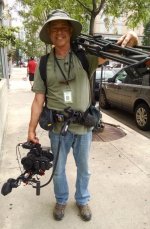
This is what I call my Migrant Video Worker set up. Last summer shooting solo for Russian doc TV show. Had they not needed PAL I would have used my ENG camera to make my life easier, no lens swaps, always know where my focus is, etc.
 

Attachments

  • MIGRANT VIDEO WORKER.jpg
    MIGRANT VIDEO WORKER.jpg
    85.9 KB · Views: 0
Last edited:
Ive sort of followed this thread.. maybe the answer is that there are no really good documentary cameras or no cameras that bring together recent technological developments with traditional ergonomics that are proven in the field.


I'm going back to what I said very early on, there is no one ring to rule them all. If you have but a single camera to use, it will eventually be a big compromise to the production in one way or another.
 
The concept of an owner/operator is that the owner/operator doesn't own EVERY camera to be suitable for every job. Sure, compromises may be made to use their gear so they can continue to profit off of their investment over renting a better camera for particular jobs, or a job that needs a different camera may not be a job they want to accept or are suitable for. A typical owner/op owns one particularly expensive camera, and perhaps one or two cheaper cameras. But no owner/ops own all cameras unless they run a full-fledged rental house on the side, so they have to choose specific cameras, which some people in this topic seem to have a hard time grasping that concept. And it's silly to keep asking me what the nature of the project is when I don't have a crystal ball to see all the projects I'm going to be doing over the next few years, so as owner/ops we make educated guesses on what the best cameras to purchase are.

I think people with this attitude are probably not heavily invested in owning gear, and tend to rent the right gear for the right job on a project to project basis, hence saying there is no one camera to rule them all and it's project dependent. Nothing wrong with that attitude from that point of view; it's just useless advice to give to an owner/op looking for their next purchase.
 
Last edited:
Ned, I'm just not convinced that handheld is the way docs have to be shot. You've seen some of my doc style work. Mostly not handheld, but I still had enough time to get the shots I wanted. I also generally produced the ones I've posted here, so I produced them in a way that enabled me to have enough time to use various stabilization gear, and when I freelance for producers I tend to film the same way and it's worked well. Most of my stabilization gear sets up quickly (1-2 minutes), though of course not as quickly as shooting everything from the shoulder would.

Most doc work I do is 2-6 minute docs, so each clip is generally 3-5 seconds long, maybe 10 seconds at the longest. Not one minute clips, no long conversations to follow, etc. So, the main times I pull out my shoulder mount to use all day tends to be for reality TV work, of which I only do about two or three of those jobs per year. But I tend to think doc work is more stylized and edited than reality TV is.

I'll plan to post a photo of my gear bag later.
 
Sure. What is the best documentary camera to own if the goal is to make the best documentary work.

The original question was best documentary camera in general, but since the consensus is that there is none, let's go ahead and specify it to the best documentary camera to own, which I guess is what I meant originally anyway since I'm considering an Amira, Varicam LT, and C700 as a next camera purchase, but may just stick with what I currently have and invest in cinema lenses instead.

So I guess the specific question for me is, is the Amira a better doc camera than the C300 Mark II for an owner/op?
 
Last edited:
Hey Eric,

I hate reality shows, hate the term reality, but I have done so many of them that when someone would ask me what I have been up to I'd say "doing a documentary for TV" because to me the term "reality" is a pejorative. Means sloppy. They'd have 2 or 3 cameras going hoping that someone would have something useful, whereas our (the DPs) main goal would be to keep each other out of the shot, and the soundman too. Then when the production companies smartened up they would buy their own cameras (mainly Sony EX3s) and fly them around the country hiring local shooters who would agree to use their cameras and charge just labor, which was cheap. But there were other reasons I started to hate it: they all tend to be LA based Type A, fast gum chewers, workaholics who think their subject matter is extremely important and a work of art, but it is usually crap. Also, they, being from LA, they would want us to not include lunch on the clock so a ten hour day became an 11 hour day, plus you add a three hour commute in Chicago and before you know it you really were doing a 14+ hour day. BTW, did you all know the leading cause of death for cameramen is Falling Asleep At the Wheel? See:

https://vimeo.com/63127085

But I digress, just wanted to mention I hate reality show shooting...

I think it would be very difficult to put your shingle up as a DP and include Documentary, and then on a gig when a situation arises that demands handheld you try to steer a client into something else. I know I would have a hard time with that if I was producing and knew it was time for the shooter to go 360 cinema verite and he pushes back, not wanting to go handheld. My first thought would be his back hurts him. We all have our weak areas and strong niches. If someone asked me to do a cheese pull, or fashion ad, I would have to turn it down for ethical reasons, meaning: I don't want to screw your project up. So, if handheld is not your thing, and there is no shame in that, then you should be honest and tell the prospective client you'd do it but not if there is a lot of handheld, is that OK? Perhaps they'll say yes. The nature of docs, when you back out the talking heads and b-roll is following some situation handheld. It has to be handheld because no one knows what's about to happen. You could try Stedicam but often the clients don't want the visual distraction. Have you ever seen a Ronin at a wedding? I have and I thought it was the rudest thing I'd ever seen. When everyone should be watching the lovely bride walking they are quizzically watching the Ronin. But I digress...

I am a doc watching junkie and saw a fascinating new one on Netflix called "What Our Fathers Did" about WW2. If you don't have the time just fast forward about 2/3rds through. The DP has 3 adult male subjects, sometimes there's a 2nd camera, but he has to make decisions constantly as to who to keep in frame, when to go wide for a two shot, when to reverse, etc. Absolutely impossible to do if not handheld because he has to be 355 degrees. The last 5 degrees is where the soundman is standing. I'm trying to think of some docs where, as you say, there's not a lot of handheld but can't. Send me some titles of recent docs where there's no handheld.

However, when you are also the producer (as you and I sometimes are) you can dictate the style, if and when you want to go handheld, make time in the sked to set up doo-dads like sliders, etc., or avoid hand held altogether. That's the beauty of being in charge but often you're dealing with live events so you have little schedule control and the only way to keep up is by being Run 'n Gun. But if you want to make it freelance and pitch to the documentary market, they would expect you to be good at handheld, it just goes with the territory. I have 4 areas I troll and it's the headline of my (outdated) website:

Non-Fiction TV Shows • Documentaries • Corporate • Live Events

So in sum, when some of these posters suggested otherwise excellent models but they would have required a cage, or erector set Frankenrig with all kinds of add ons and cabling, like a BMC in a cage, well...they couldn't keep up with the kinds of doc situations I find myself in. Even if it is not a reality show we are basically keeping up with reality, right? I'd tell some stories but I'm afraid the Chicago area subjects would recognize themselves, but suffice it to say I have hired other DPs to be with me on multi camera shoots and the way they have to wire their rigs together, it looks like an electrical engineering project from MIT graduate school. Very slow moving. I had one shoot that had multiple locations and the DP I hired had to disassemble a Red Scarlet for each company move because he didn't want to seat belt his baby into the passenger seat. Eeeesh....major time suck.

That's my .02¢ but I think you're smart enough to see the real future financially is in the producing, although shooting is more fun and creative. Gear is an addiction, look what happened to Erik Naso...

Later,

Ned
 
Last edited:
So I guess the specific question for me is, is the Amira a better doc camera than the C300 Mark II for an owner/op?

I'd go C300 mkII. It's more versatile. Both shoot impressive images but you can easily fly the Canon on a gimbal or mount it to a car or lightweight slider or build it out with a rig so it behaves more like an ENG camera or cine camera. Plus with the money I save, I'd buy glass.
 
Ned, I never said I was bad at handheld or pressure producers into going handheld; I just often don't like the unpolished look it gives, even when done well. Actually, I find I have more of the opposite problem. A lot of producers see my Steadicam reel, get excited about it, and their reaction is, "Let's do everything on Steadicam." I have to then talk them out of Steadicam for various shots depending on what it is, often saying things like, "Well a slider/dolly can give you slower and steadier moves when you want that look." I had to explain to a recent client on a corporate event who wanted the b-roll to be 100% Steadicam that I can't get tight reaction shots from far away with the Steadicam; I'd need to go on a tripod or monopod with the Canon 100-400 and 70-200 for those shots. They said okay. Another case I had was the client wanted me to do Steadicam (without a wireless follow focus) on a small boat for a 10 hour reality TV show; that didn't make sense, as I wouldn't be able to maintain a good shot often enough, so I convinced them to go handheld/shoulder mount, even though my Steadicam reel was why they initially hired me for the job in their job posting which had requested a Steadicam operator.

I equate handheld with cheap and low production value. Not always, but often. Most Hollywood movies employ a lot of stabilization methods, not just handheld. That's how I like to do my docs, like a Hollywood movie in the stabilization sense; variety. I like the more polished look. Some docs are better served by a more raw look, so go handheld, or just need the speed of filming by going handheld. Maybe others do it out of laziness, lack of equipment, or lack of skillset to use other tools. Different style than what I like.

Too many "high end" docs I see have cruddy production values. I'm not sure if that's because quality equipment that is quick to use used to not be available for doc shooters, so they shot crud and people then associated that with the "doc look," but I'd imagine as time progresses, just as Hollywood is moving away from the less sharp film look to the more polished digital look, that docs may move toward the more polished look as well, and already have to some extent. Stillmotion and Philip Bloom tend to be less on the handheld side of things for their doc work. Bloom uses all kinds of tools, obviously.

I watch a ton of narrative films, but not a lot of feature docs. Probably should watch more for educational reasons, as you say. I do watch a lot of short docs on Vimeo.
 
Last edited:
Why do you keep comparing to the C or F cam with a prime or still lens? They can use zooms, including cinema zooms, just like an Arri Amira can, and have the same mount options as the Amira. From what I gather the F55 has quite good ergonomics for shoulder mount use with the Canon 17-120. Sure, the cinema zooms aren't as small and light, don't have as much range, and tend to cost more money than a small sensor ENG cam's zoom lenses, but then I personally tend to think the small sensor ENG cams like the Sony F800 don't have image quality that is good enough for high end doc work, regardless of how much quicker the greater zoom range helps.

The Canon 18-80 cinema zoom will be a nice addition to the large sensor camera zooms as well, being how it is smaller, lighter, has auto-focus, and IS.

Because you own a C series (and I own C and F) and I don't think I've heard you mention that you own/use any cine zooms. If you want to go with an Amira, Vari, etc., I encourage you, because I think they will allow you to work faster.

The 55 isn't bad(nowhere near as bad as the C series), but it's still not perfect. I've had the 17-120 on my 55 and it's still a bit of a hassle. The lens, while beautiful-and I came close to buying one, is a PIG. The camera and lens combo just kept wanting to roll out of my hand because of the balance of the weight distribution of the lens itself and the small, lightweight body of the 55. Having a zoom helps a lot for speed and variety, but you don't have the reach and range and as far as cost, you're in the same range if you are buying top-end, high zoom ratio 2/3" ENG lenses. Price out new 2/3" W/A's and 22x-23x lenses and you're in the $30K neighborhood.
 
I watch a ton of narrative films, but not a lot of feature docs. Probably should watch more for educational reasons, as you say. I do watch a lot of short docs on Vimeo.

There is a massive difference between a 10 minute short film on Vimeo, or even a 23-minute TV spot, and a feature doc. You can punch out a short film in a day even when going slow to set up each individual shot, and it's mostly posed scenes. It's usually a much smaller subject matter (eg an individual artist, athlete, etc) who you have the freedom to direct, and usually it's more a "vignette" style where there is no unfolding of events over time with unknown outcomes, rather just a recount or bio.

Moving onto feature doc's you lose all that control. You need to be switched on 12 hours a day for sometimes months on end. Events are bigger and out of your control, and you're often just trying to keep up. Of course there is going to be opportunities to slow down and get those beauty shots and fancy b-roll (although on the unlimited budget projects you mention, they'll have a 2nd unit doing these shots anyway), but the longer the project is, the more time you're going to spend chasing the action without a clue what is going to happen next.

In response to your original question, there probably is no answer. For the type of high-end projects you're say you're targeting (where do these massive-budget doc's even exist?) they are hiring well-known names only, regardless of the camera you or they own. On the type of jobs you're talking about, they're also hiring crane operators and drone specialists (or helicopters) and steadicam operators and underwater cinematographers and all other types of specialists for those "beauty shots", and what you're left with is the legwork (ie Johnny-on-the-spot, run-n-gun stuff), and the interviews.

You're unable to tell us more about the actual projects, so without knowing that, it's hard to recommend a particular camera. Lots of people have tried, but you've opposed all their suggestions because they don't fit your vision of the jobs that you can't actually describe to us. So it's hard for us to say if an Amira is a good choice for you based on the info you've provided. Perhaps the best advice I can give you is to research recent examples of the types of projects think you'll be shooting and find out exactly what they were shot on. My guess is not many docs actually use Arri as the primary field camera.
 
Ned, I'm just not convinced that handheld is the way docs have to be shot. You've seen some of my doc style work. Mostly not handheld, but I still had enough time to get the shots I wanted. I also generally produced the ones I've posted here, so I produced them in a way that enabled me to have enough time to use various stabilization gear, and when I freelance for producers I tend to film the same way and it's worked well. Most of my stabilization gear sets up quickly (1-2 minutes), though of course not as quickly as shooting everything from the shoulder would.

Most doc work I do is 2-6 minute docs, so each clip is generally 3-5 seconds long, maybe 10 seconds at the longest. Not one minute clips, no long conversations to follow, etc. So, the main times I pull out my shoulder mount to use all day tends to be for reality TV work, of which I only do about two or three of those jobs per year. But I tend to think doc work is more stylized and edited than reality TV is.

I'll plan to post a photo of my gear bag later.

After reading this and some of your other posts, personally I would classify what you are doing as packages or (network tv)features(you know, the pretty little few minute long pieces on network TV and sports channels on an athlete or some tear jerking subject matter) than true doc work. I do a lot of it, but lets get the terms straight.
 
Just to clarify, by "unlimited budget" what I really meant was a budget large enough where the producer wants and can afford the best camera for the job, instead of going with second rate gear. There are plenty of projects out there like that.

When I shoot a wedding by myself I use C100s and leave my C300s at home, because since the C100s are smaller and lighter, I prefer them, and feel they are the best camera for that job. Doesn't mean it's an unlimited budget wedding, just that the budget is enough to afford the best cameras for the job. If a producer wants to film with the best camera, finds a DP they like who has the second best camera, they may want to hire the DP and rent the best camera separately. Then the DP doesn't make any money off of the camera they already own. So one option is to then buy the best camera.


You're unable to tell us more about the actual projects, so without knowing that, it's hard to recommend a particular camera. Lots of people have tried, but you've opposed all their suggestions because they don't fit your vision of the jobs that you can't actually describe to us. So it's hard for us to say if an Amira is a good choice for you based on the info you've provided. Perhaps the best advice I can give you is to research recent examples of the types of projects think you'll be shooting and find out exactly what they were shot on. My guess is not many docs actually use Arri as the primary field camera.
Well you can feel free to go to my Vimeo page to see what kind of doc style work I do. Aside from projects I'm doing and projects I've done, as I said, I don't buy cameras for particular booked projects, but for general projects in the future, of which my crystal ball still isn't working, so I don't see why you expect me to describe my unknown future work to you. I'd say I do short doc style projects now, and am interested in doing a feature length doc or docs at some point.
 
Last edited:
After reading this and some of your other posts, personally I would classify what you are doing as packages or (network tv)features(you know, the pretty little few minute long pieces on network TV and sports channels on an athlete or some tear jerking subject matter) than true doc work. I do a lot of it, but lets get the terms straight.
Not saying I'm an expert on terms, but I'd think a "short doc" is still a doc. "Packages" and "features" are TV terms and I don't do much TV work.
 
Last edited:
Back
Top