I just bought my GH2 14-42mm kit, Panasonic Leica 25mm 1.4 lens and Sandisk 64GB Extreme Pro card. My GH2-X (love that...) will be used mostly for narrative shorts. And with so many people actively shooting and testing I wondered if anyone has found a high quality, high reliability, field mixer / digital recorder combo? I'd like good audio quality but still keep within a decent budget. Shotguns, lavs, fishpoles and cables are all covered.

Navigation
Install the app
How to install the app on iOS
Follow along with the video below to see how to install our site as a web app on your home screen.
Note: This feature may not be available in some browsers.
More options
You are using an out of date browser. It may not display this or other websites correctly.
You should upgrade or use an alternative browser.
You should upgrade or use an alternative browser.
GH2 Audio Gear for GH2 Shooting
- Thread starter JMZ
- Start date
Sound Devices MixPre + BeachTek DXA-2s + Sony M10 + Sony 7506 Headphones
- The MixPre has great pre-amps, a loud headphone amp, runs all day on two AA rechargeables.
- BeachTek DXA-2s ( or DXA-2t ) is a passive XLR audio adapter, so it does not alter the audio signal, no added noise, has two pots to adjust levels, and a ground-lift switch to kill hum
- Sony M10 digital recorder has a very low noise floor, is quite compact so it can be tucked in to the same bag as the MixPre, runs all day on one set of batteries
- Sony 7506 headphones are industry standard, have good sound isolation so you can hear what you are recording, and are affordable
With this set-up I can record great sound directly with my GH-2 camera, and simultaneously record an even higher quality back-up with the Sony M10, while I monitor sound with the headphone circuit in MixPre.

I will do a complete tutorial with sound samples in the New Year. ( too busy with other things this month )
Here are the basic steps I follow to connect everything:
1- Attach BeachTek DXA-2s to the tripod head, then attach GH-2 to BeachTek unit ( I am using Manfrotto QR mounts, see pictures at bottom )
2- Plug BeackTek 3.5mm input to the GH-2 using a HOSA 3.5mm to 2.5mm adapter
3- Attach XLR cable from MixPre XLR OUT to the BeachTek XLR IN ( this is LINE LEVEL audio )
4- Set BeachTek input switch to LINE IN LEVEL
5- Attach Sony M10 to the MixPre mixer via the TAPE OUT connection ( requires a small cable )
6- Attach MIC XLR cable to one of the MixPre XLR INPUT connectors.
6- Turn everything on
7- Turn on the 1 Khz TEST TONE on the MixPre mixer ( this tone is used to set the correct recording levels )
8- Adjust the Sony M10 recording level until the meter is showing -12 dB
9- Adjust the GH-2 AGC circuit to setting 1
10- Adjust the BeachTek input POTs until the GH-2 meters are flickering at the RED level
11- Turn off the 1 Khz TEST TONE on the MixPre
12- Plug in Sony 7506 headphones and set appropriate sound level ( it's usually pretty low as the MixPre headphone amp is very loud )
13- Have your talent speak in to your mic and adjust the MixPre GAIN to an appropriate level
- Slate all of your takes ( either with a real slate or clap your hands together on camera )
- I let the Sony M10 run continuously, so it records everything. ( there's tons of recording time, and this eliminates the hassle of turning the Sony M10 ON and OFF for every take )
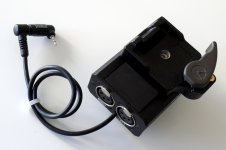
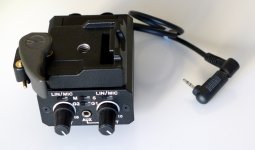
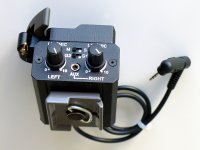
*** Pictures of the BeachTek DXA-2s with HOSA adapter and Manfrotto QuickRelease attached. This unit can be snapped in below my GH-2 camera when needed ***
Here are the basic steps I follow to connect everything:
1- Attach BeachTek DXA-2s to the tripod head, then attach GH-2 to BeachTek unit ( I am using Manfrotto QR mounts, see pictures at bottom )
2- Plug BeackTek 3.5mm input to the GH-2 using a HOSA 3.5mm to 2.5mm adapter
3- Attach XLR cable from MixPre XLR OUT to the BeachTek XLR IN ( this is LINE LEVEL audio )
4- Set BeachTek input switch to LINE IN LEVEL
5- Attach Sony M10 to the MixPre mixer via the TAPE OUT connection ( requires a small cable )
6- Attach MIC XLR cable to one of the MixPre XLR INPUT connectors.
6- Turn everything on
7- Turn on the 1 Khz TEST TONE on the MixPre mixer ( this tone is used to set the correct recording levels )
8- Adjust the Sony M10 recording level until the meter is showing -12 dB
9- Adjust the GH-2 AGC circuit to setting 1
10- Adjust the BeachTek input POTs until the GH-2 meters are flickering at the RED level
11- Turn off the 1 Khz TEST TONE on the MixPre
12- Plug in Sony 7506 headphones and set appropriate sound level ( it's usually pretty low as the MixPre headphone amp is very loud )
13- Have your talent speak in to your mic and adjust the MixPre GAIN to an appropriate level
- Slate all of your takes ( either with a real slate or clap your hands together on camera )
- I let the Sony M10 run continuously, so it records everything. ( there's tons of recording time, and this eliminates the hassle of turning the Sony M10 ON and OFF for every take )
*** Pictures of the BeachTek DXA-2s with HOSA adapter and Manfrotto QuickRelease attached. This unit can be snapped in below my GH-2 camera when needed ***
He's right, the newer mix pre d has a dedicated Mic level output that can interface directly with dslr's. It's on a ta3 male connector so you need a female ta3 to stereo mini (or sub-mini for the gh2) cable. Sound Devices also makes a bracket for it that allows it to be mounted to the bottom of the camera with a tripod screw hole on the opposite side. Cool piece of gear and sounds great.
I'm no audio guy, but I believe the mixpre-D has an output that can cable directly to the mic in eliminating the need for beachtek.
...You still need to run XLR cable from the mixer to the GH-2, which means you need an balanced XLR to un-balanced mini-plug adapter before connecting to the GH-2.
I like the BeachTek unit as my XLR to mini-plug adapter because it's fairly small but still solid, and allows you to take LINE-IN signal right at the camera. All of the cable strain is taken by the BeachTek unit, and none by the GH-2 MIC input.
Also, there have been many times where I had to take a signal from a sound person's mixer board, and found that the MIC level from their board was too weak for the distance to the camera, so I had them supply me with a LINE level instead and used my BeachTek unit to correct the input.
Yeah, I was actually wondering why we need the mixer, recorder AND amp.
There is NO AMP. The BeachTek unit is simply a passive balanced XLR to unbalanced mini-plug adapter. It requires NO power and has NO AMP. It also has very good POTs that allow you to adjust the strength of the signal ( it can only reduce it ) before being fed to the camera.
Thanks, Dingo. This helps a lot. I actually own a nice slate which I use on every shoot regardless of format. That, along with good logging of takes in the field, has saved me a huge amount of time in editing. I'm going to check into the Sony recorders. I was originally considering a Tascam DR-40 with something like a Behringer or Mackie 2 to 4 channel tabletop mixer. But only the Behringer can be run on battery power. I knew I couldn't afford a Sound Devices 702 or 302 but hadn't considered either of the Mix-Pre units.
With an original mix-pre or any other mixer that only outputs a line level signal you need to pad down the audio level before hitting the camera that only wants to see a Mic level (lower) signal. That's what it seems like he is using the beachtek box to do. With the newer mix-pre d you wouldn't need the beachtek as the mixer outputs a stereo Mic level signal that you can run straight into the camera.
A couple of other items to mention...
You can find used BeachTek DXA-2s units on eBay for as little as $50, and some appear to be pretty much brand new.
Also, the older Sound Devices MixPre can be bought for $500 or less. ( I suspect it's people selling the old model to upgrade to the newer MixPre D )
You can find used BeachTek DXA-2s units on eBay for as little as $50, and some appear to be pretty much brand new.
Also, the older Sound Devices MixPre can be bought for $500 or less. ( I suspect it's people selling the old model to upgrade to the newer MixPre D )
Sound Devices have many fans and is a solid choice. Consider also Tascam Dr-680 recorder as part of your options for audiophile sound in a single box solution with built in digital mixer. Inexpensive and sounds great. Headphones are subjective, I use the AT M50s, you will find Sony, Sennheiser and many others that have their fans and many of these are good, this is a try before buy item.
Fresno Bob
Well-known member
I was planning on just using a Zoom H4n connected to a boom and record my sound that way.
I'm a bit of a noob - can someone explain why I would need all this extra equipment (mixers etc)?
I'm a bit of a noob - can someone explain why I would need all this extra equipment (mixers etc)?
Can someone explain why I would need all this extra equipment (mixers etc)?
Here are a few differences between a good low cost digital recorder ( like the Zoom H4n ) and a good low cost field mixer ( like the Sound Devices MixPre )
- The mixer has MUCH quieter and better sounding mic preamplifiers
- The mixer has very good 2 stage audio limiters that help to prevent clipping when recording
- The mixer has a calibrated 1 Khz test tone which allows you to properly set your audio recording levels
- The mixer has a MUCH louder and better sounding headphone amplifier
- The mixer provides both 12 and 48 volt phantom power, allowing you to power almost any professional mic available
- The mixer uses XLR outputs, so running a 25+ foot LINE level signal to the camera or another recorder is a reliable connection
- The mixer has much better build quality and will physically last longer than a plastic digital recorder will
Fresno Bob
Well-known member
Thanks mate
It's interesting. I've seen a lot of hate for the Zoom recorders and others who love them. But three colleagues of mine have said they really like it in the past few days. One is a longtime radio news manager. One is an audio engineer/composer/performer and the last is a Ph.D. sound designer.
I'm a shooter and editor. I usually leave the sound gear up to the sound team. But after speaking with them and getting some info here I think I'm leaning toward the Zoom as the actual recording component. They all spoke highly of the sound quality but also pointed out the importance of a good microphone on the other end. I've got an ME66/K6 and I'm really partial to the way dialogue sounds through it.
The good news about not being able to afford a Scarlet is that some of the money I saved for it can now be used to buy other gear. The bad news is that now I have to spend time trying out all that gear. Or is that another good thing?