Liam Hall
Veteran
Do tell.
I studied economics at college. Boring as f*** but an important subject and an easy one to get your head round as long as you remove your political bias. HTH.

Follow along with the video below to see how to install our site as a web app on your home screen.
Note: This feature may not be available in some browsers.
Do tell.


In an alternate universe, Adam Smith and Ludwig von Mises are giving Keynes crap for his Blackmagic Pocket 4k, while Marx tries to convince everyone the new AJA camera is really cinematic.
sorry, I'm not familiar with von Mises
Among the groups that saw the highest rise in pay included retail employees at 5.9 percent compared to last year and hotel, restaurant and bar employees at 8.1 percent, according to the AP.

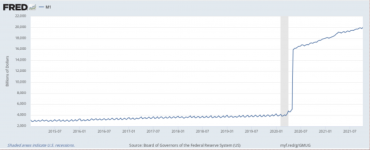
Before May 2020, M1 consists of (1) currency outside the U.S. Treasury, Federal Reserve Banks, and the vaults of depository institutions; (2) demand deposits at commercial banks (excluding those amounts held by depository institutions, the U.S. government, and foreign banks and official institutions) less cash items in the process of collection and Federal Reserve float; and (3) other checkable deposits (OCDs), consisting of negotiable order of withdrawal, or NOW, and automatic transfer service, or ATS, accounts at depository institutions, share draft accounts at credit unions, and demand deposits at thrift institutions.
Beginning May 2020, M1 consists of (1) currency outside the U.S. Treasury, Federal Reserve Banks, and the vaults of depository institutions; (2) demand deposits at commercial banks (excluding those amounts held by depository institutions, the U.S. government, and foreign banks and official institutions) less cash items in the process of collection and Federal Reserve float; and (3) other liquid deposits, consisting of OCDs and savings deposits (including money market deposit accounts). Seasonally adjusted M1 is constructed by summing currency, demand deposits, and OCDs (before May 2020) or other liquid deposits (beginning May 2020), each seasonally adjusted separately.
- Inflation can occur when prices rise due to increases in production costs, such as raw materials and wages.
- A surge in demand for products and services can cause inflation as consumers are willing to pay more for the product.
I'm having trouble finding alternative inflation estimates from other institutions or think tanks
But on the subject of what causes inflation, I looked and confirmed what I remember from econ classes:
[/LIST] https://www.investopedia.com/ask/answers/111314/what-causes-inflation-and-does-anyone-gain-it.asp
No mention of the monetary supply
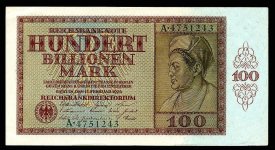
You may want to take a look at the Weimar Republic and how Germans after World War 1 would roll a wheelbarrow of money to the store in order to purchase a loaf of bread.
"In the U.S., the central bank does not pay debt with the money it creates. Rather, it lends money at its targeted interest rate and the private sector employs that capital more productively. The money created is paid back, which is a crucial reason this monetary policy doesn't produce hyperinflation."
According to this article, the practices of the US are unlike the Weimar Republic because the US doesn't pay its debts or finance its government with printed money.
Which is, I suppose, why it's called the monetary "supply" rather than simply money.
The US makes up the difference between revenues and outlays by issuing bonds
https://www.investopedia.com/are-we-...lation-5093627
You may want to take a look at the Weimar Republic and how Germans after World War 1 would roll a wheelbarrow of money to the store in order to purchase a loaf of bread.