Article about global product shortage

In an alternate universe, Adam Smith and Ludwig von Mises are giving Keynes crap for his Blackmagic Pocket 4k, while Marx tries to convince everyone the new AJA camera is really cinematic.
 
In an alternate universe, Adam Smith and Ludwig von Mises are giving Keynes crap for his Blackmagic Pocket 4k, while Marx tries to convince everyone the new AJA camera is really cinematic.

Bizarro Marx is an iPhone booster because it lets (almost) everyone have the same shitty cinematic video

Adam Smith is into RED because he wants to back domestic production (and I'm pretending he's American)

Keynes didn't buy anything while camera shipments were high, but he just picked up an S1H because he wants to give Panasonic a lift

Friedman is into the Mavo EDGE because he likes free trade and doesn't want patent law to prevent internal prores raw from coming to america

sorry, I'm not familiar with von Mises
 
Wages had the highest quarterly jump in 20 years this September.

Among the groups that saw the highest rise in pay included retail employees at 5.9 percent compared to last year and hotel, restaurant and bar employees at 8.1 percent, according to the AP.

5.9% is close to the current estimate of inflation. Are the wage jumps a driver of inflation or a reaction to it? Either way, I'm glad to see those groups keeping pace with rising costs
https://thehill.com/policy/finance/579140-wages-see-biggest-three-month-jump-in-20-years

Btw I never linked the articles but some people say the supply shortages are due to incredible demand by consumers. Possibly the savings from not being able to travel and eat out have been converted into online shopping. I don't remember the exact figures, but this year's US purchases and imports have been very high
 
Inflation is a tax on stored wealth.

Wages will go up. Skilled faster than unskilled.
Any wealth you have stored in dollars will be sucked away by rising prices/decreased purchasing power.
 
Don't store your wealth in dollars. Store it in assets.

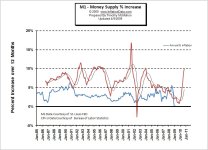
M1 unrelated to inflation. M1 in red, inflation in blue:

Final_Shifted_M1_and_CPI.jpeg
 

There's something strange in that chart. They start tabulating M1 differently beginning in May 2020 for some reason

Before May 2020, M1 consists of (1) currency outside the U.S. Treasury, Federal Reserve Banks, and the vaults of depository institutions; (2) demand deposits at commercial banks (excluding those amounts held by depository institutions, the U.S. government, and foreign banks and official institutions) less cash items in the process of collection and Federal Reserve float; and (3) other checkable deposits (OCDs), consisting of negotiable order of withdrawal, or NOW, and automatic transfer service, or ATS, accounts at depository institutions, share draft accounts at credit unions, and demand deposits at thrift institutions.

Beginning May 2020, M1 consists of (1) currency outside the U.S. Treasury, Federal Reserve Banks, and the vaults of depository institutions; (2) demand deposits at commercial banks (excluding those amounts held by depository institutions, the U.S. government, and foreign banks and official institutions) less cash items in the process of collection and Federal Reserve float; and (3) other liquid deposits, consisting of OCDs and savings deposits (including money market deposit accounts). Seasonally adjusted M1 is constructed by summing currency, demand deposits, and OCDs (before May 2020) or other liquid deposits (beginning May 2020), each seasonally adjusted separately.
 
These days there's a vast amount of credit in the US denominated currency, i.e., dollar. Back in the 00's, I argued the existence of the real estate bubble with some prominent 1980s economists, who assured me that the bubble was entirely in my imagination. I invited them to take a walk along the Collins avenue. They refused to believe me - Miami real estate prices tripled in about five years in prices per foot - because the "official CPI numbers were low". Naturally, both subprime and prime exploded in 2006-2008.

PS. On an economic think tank page, a poster claiming experience of having worked for the Bureau of Labor and Statistics asserted that each department backtracks their formulas to achieve the CPI they need to show. And that they do it again if the CPI shows to be too high. Wikipedia actually has a pretty good page showing various means of how the CPI could be massaged. On the surface, it's a highfalutin economic theory but, in essence, it was the result of the aforementioned 1980's economists figuring out how to attain flexibility in achieving certain results. Which are then repeated by the organs of mass information.

And for those who are curious - https://www.youtube.com/watch?v=gRlyuksgFJA
 
I'm having trouble finding alternative inflation estimates from other institutions or think tanks

But on the subject of what causes inflation, I looked and confirmed what I remember from econ classes:

  • Inflation can occur when prices rise due to increases in production costs, such as raw materials and wages.
  • A surge in demand for products and services can cause inflation as consumers are willing to pay more for the product.
https://www.investopedia.com/ask/answers/111314/what-causes-inflation-and-does-anyone-gain-it.asp

No mention of the monetary supply
 
It's a Keynesian reply from my econ classes, off books written by Paul Samuelson. Technically, they hide the money supply within their arguments because it definitely results in a temporary jump in demand (while killing savings and investment) and the left leaning Keynesians are the "demand siders" rather than the "supply siders (the "supply siders are also Keynesians and thus also wrong, even if they tend to drift toward freer markets).

Did I mention that I argued with the supply siders?

BTW, Paul Samuelson was a genius. A genius who wrote this in 1989, “The Soviet economy is proof that, contrary to what many skeptics had earlier believed, a socialist command economy can function and even thrive.”

For the record, in 1989, the Soviet economy was in complete shambles.
 
I don't know about money supply component, but the chain reaction from wage or demand increases makes sense to me

I don't know all about keynesianism. But the countercyclical government spending to stave off a demand shock makes a tremendous amount of sense to me. They're the deep pocket, the one who can splash cash and get things moving again. They just need to save for a rainy day when times are good
 
I'm having trouble finding alternative inflation estimates from other institutions or think tanks

But on the subject of what causes inflation, I looked and confirmed what I remember from econ classes:
[/LIST] https://www.investopedia.com/ask/answers/111314/what-causes-inflation-and-does-anyone-gain-it.asp

No mention of the monetary supply

You may want to take a look at the Weimar Republic and how Germans after World War 1 would roll a wheelbarrow of money to the store in order to purchase a loaf of bread.
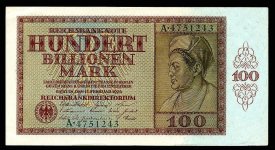
 
You may want to take a look at the Weimar Republic and how Germans after World War 1 would roll a wheelbarrow of money to the store in order to purchase a loaf of bread.

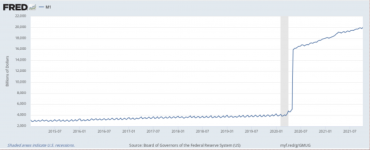
According to this article, the practices of the US are unlike the Weimar Republic because the US doesn't pay its debts or finance its government with printed money.

"In the U.S., the central bank does not pay debt with the money it creates. Rather, it lends money at its targeted interest rate and the private sector employs that capital more productively. The money created is paid back, which is a crucial reason this monetary policy doesn't produce hyperinflation."

Which is, I suppose, why it's called the monetary "supply" rather than simply money.

The US makes up the difference between revenues and outlays by issuing bonds

https://www.investopedia.com/are-we-in-for-a-hyperinflation-5093627
 
According to this article, the practices of the US are unlike the Weimar Republic because the US doesn't pay its debts or finance its government with printed money.


Which is, I suppose, why it's called the monetary "supply" rather than simply money.

The US makes up the difference between revenues and outlays by issuing bonds

https://www.investopedia.com/are-we-...lation-5093627

issuing bonds that the entire world continues to - almost exclusively- judge as the safest place to park enormous amounts of their wealth in. (not commenting on any particular person's politics on here) conservatives love fiat currency when it bails out banks, feeds the endless black hole of military spending & subsidizes giant corporations; but when it's used to provide a safety net for working people during a global pandemic magically the only result is looming apocalyptic economic collapse.

most of what we hear re inflation reads to me as just an extension of (intensly magnified with covid) of a very old corporate media narrative when liberal administrations deficit spend..but curiously this stuff is never nearly as consequential when conservatives ones do
 
Last edited:
You may want to take a look at the Weimar Republic and how Germans after World War 1 would roll a wheelbarrow of money to the store in order to purchase a loaf of bread.
Issued October, 1923. One could buy a lot of Apfelstrudels with this. But only for breakfast. By lunch, it was already worthless.

y14h4jyirge01.jpg
 
Back
Top