C300: All Five Oscar Nominated Films Were Shot Primarily on Canon cameras

The irony is that the C series of Canons are notable weak from an ergonomic standpoint, unless you are shooting with a bare EF lens and no accessories so the camera weighs little enough to be pushed against the shoulder. Once cine lenses or accessories come into play, it's awkward at best.

It is unfathomable to me that nearly fifty years after the Eclair (and later Aaton) defined balanced handheld cameras for documentary shooting, we are still struggling to get back to that sweet spot of low mass centered on the shoulder.

Couldn't agree more. I have a C200/300 MKII full Franken Rig and with a decent weight lens on the front, you have to put the camera so far back on your shoulder to center its gravity that you have lost all possibility to intuitively access the controls while the camera is on your shulder, meaning you end up taking the camera down from your shoulder to find the button to enable or disable peaking, zebras and waveform. EVA 1 is no better. FS7 MKII, slightly better but still clunky. I miss the ergonomics of the DSR-500 DVCAM we had and my Arri SR2 back in the day. The C-Series cameras are okay for brief handheld shooting while cradled, but that quickly becomes fatiguing, even with just a lens and battery and it's too low to shoot standups, you end up looking up your talent's nose, not very flattering. Terrible shoulder mounted and not that great cradled, I agree. My real hope for the C200 before we saw it was that Canon would make it look and feel like a 2/3 sized C700, which is too long and heavy but overall has a semi-good shoulder mounted form factor. The manufacturers are somehow brainwashed that they think EVERYONE wants to mount their A camera C300 MKII to a drone, gimbal or slider, which couldn't be further than the truth.
 
I considered the EasyRig-like systems, then couldn't get past the dork-factor and limited movement, then considered arm+vest solutions: still too much gear/limited movement & attention-drawing, so sold the big camera* and gimbal**. My old handycams (Sony, Panasonic) had (still have!) decent IBIS, as does the 'old' Olympus mirrorless. All we really need is decent IBIS and we can shed all this complex+heavy gear.

Compact, lightweight shoulder mount with usable VF (1080p+ resolution + accurate peaking etc.) so we can easily and accurately judge 4K focus would be cool too.

* + other factors, mainly smaller cameras are producing better looks for less cost, size, and weight (vs C300 II).
** was a challenge to sell since both 'used once' (one battery was probably never used) batteries died (common issue with DJI) and had to buy a new battery in order to sell it.

I've said this before an easyrig is "uncool" to the public but "cool" on sets.

An easyrig is often used with a 5-7 inch director/client monitor, and/or with wireless video systems. The easyrig is used more for taking weight than stability so I don't think amazing IBIS replaces an easyrig.

A monitor the weight of a postcard and built in wireless is more of an easyrig eliminator IMO.
 
Couldn't agree more. I have a C200/300 MKII full Franken Rig and with a decent weight lens on the front, you have to put the camera so far back on your shoulder to center its gravity that you have lost all possibility to intuitively access the controls while the camera is on your shulder, meaning you end up taking the camera down from your shoulder to find the button to enable or disable peaking, zebras and waveform. EVA 1 is no better. FS7 MKII, slightly better but still clunky. I miss the ergonomics of the DSR-500 DVCAM we had and my Arri SR2 back in the day. The C-Series cameras are okay for brief handheld shooting while cradled, but that quickly becomes fatiguing, even with just a lens and battery and it's too low to shoot standups, you end up looking up your talent's nose, not very flattering. Terrible shoulder mounted and not that great cradled, I agree. My real hope for the C200 before we saw it was that Canon would make it look and feel like a 2/3 sized C700, which is too long and heavy but overall has a semi-good shoulder mounted form factor. The manufacturers are somehow brainwashed that they think EVERYONE wants to mount their A camera C300 MKII to a drone, gimbal or slider, which couldn't be further than the truth.

What's more fun to shoot with, the X-T3 or C200? What produces higher quality results- e.g. 4K detail, color fidelity, skin tones, slomo? (figure raw has one advantage: highlight recovery?)

I used the C300 II on tripod 99% of the time for all the reasons you guys mentioned. Really the only way to effect change is with your wallet (since they obviously don't listen to internet forums or YouTube videos lol).

Thinking of selling all my Canon bodies and lenses. Will take another look at the X-T3 and A7 III. I do extensive Photoshop with raw stills and found the A7S II was close, but not quite there. If the X-T3 or A7 III can do solid skin tones for raw stills, might not wait for the A7S III.
 
I've said this before an easyrig is "uncool" to the public but "cool" on sets.

An easyrig is often used with a 5-7 inch director/client monitor, and/or with wireless video systems. The easyrig is used more for taking weight than stability so I don't think amazing IBIS replaces an easyrig.

A monitor the weight of a postcard and built in wireless is more of an easyrig eliminator IMO.

Yeah that makes sense. Featherweight OLED and/or quantum dot displays are possible today, especially if getting power from the camera- perhaps cost+fragility keeps them from being introduced? If wireless systems can send to multiple receivers in real-time... Looks like they can! https://teradek.com/collections/beam-family . Then is it necessary to put a monitor on the camera operator?
If not, there's the EasyRig delete (unless it's a cost issue... Another receiver is $2.5K, (not the baby) EasyRigs are a lot more... reliability issue?).
 
The irony is that the C series of Canons are notable weak from an ergonomic standpoint, unless you are shooting with a bare EF lens and no accessories so the camera weighs little enough to be pushed against the shoulder. Once cine lenses or accessories come into play, it's awkward at best.
But the thing is, I'd imagine the majority of C300 users do shoot bare with an EF lens. Matt Porwol shot that way for Cartel Land, for example. That's my experience of working with fellow C300 owners. While I own cinema zooms, AB batteries and mounts, shoulder rig, etc., to fully rig a C300, 90% of the time it's bare bones with an L-series lens and for that I love the ergonomics, particularly since adding the C200 monitor setup. If I'm using cinema zooms, Teradek, etc., more often I'll shoot with the Amira. But because of the size I find the Amira much more unwieldy for one-man-band shooting than a stripped down C300.

If people want a more rectangle format C300 camera like the F55 or Amira, there's always the C700 which will probably sell for peanuts (as in, similar price to a C300 Mark II) before long due to it's lack of popularity. In fact...here...https://www.ebay.com/itm/Canon-Cine...d:g:jhIAAOSwrYNbUKM8:rk:1:pf:1&frcectupt=true

$11,779.00 for a used C700 PL mount, pretty close to the $10k new price of a C300. I still wouldn't buy it, though I'm tempted to buy a fourth C300 Mark II.


The Easy Rig is so much more comfortable for long duration shoots (as in, heavy camera on your shoulder with absolutely no break for hours) than going bare shoulder.
 
Last edited:
Eric Coughlin-
But the thing is, I'd imagine the majority of C300 users do shoot bare with an EF lens. Matt Porwol shot that way for Cartel Land, for example.


That’s really the power alley for the C300, be small very nimble. If you have seen Cartel Land there is no F’ing way that film would have been shot with a rigged out camera.
My first real extended shoot with the 300 MK1 was on a ship at sea for almost a month. There was a second crew with a Varicam 2/3rds “ camera on board and they were constantly banging into door frames, passage ways, ceilings with thier rigged out panasonic, meanwhile I could maneuver easily and find angle.
If Canon built a HPX 3100 style camera with the latest sensor and some form of raw recording to be a level above the XFavc, EF mount - that would be a killer camera form factor for docs and other more scripted forms of shooting.
 
The irony is that the C series of Canons are notable weak from an ergonomic standpoint, unless you are shooting with a bare EF lens and no accessories so the camera weighs little enough to be pushed against the shoulder. Once cine lenses or accessories come into play, it's awkward at best.

It is unfathomable to me that nearly fifty years after the Eclair (and later Aaton) defined balanced handheld cameras for documentary shooting, we are still struggling to get back to that sweet spot of low mass centered on the shoulder.

My first sound camera was an Eclair NPR. At some point I owned an Aaton- modified for S16(not the XTR Prod!). The Aaton was great because it had an onboard battery mount! The cameras were (relatively) cheap by the time I bought them, but how the clock ticks...
 
Charles Papert:
It is unfathomable to me that nearly fifty years after the Eclair (and later Aaton) defined balanced handheld cameras for documentary shooting, we are still struggling to get back to that sweet spot of low mass centered on the shoulder.

THose cameras were the were the essence of from & function. They had to incorporate this 400 foot roll of physical stuff, move it throught the camera in a very controlled way and make it easy to switch mags all the while keeping the film safe from extraneous light. There were some physical design rquirements that dictated where things should go, what the shape should be to get to an optimium form.
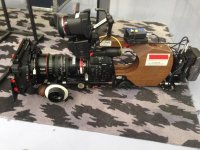
Now the camera is a sensor in a box , with holes for electricity to get in and out and some buttons on the outside we push to make the box do what we want. Think of Red, Alexa Mini, Canon C 700, a little less so the C300. Once I have it, will post a supporting pic.
 
IMO the best form factor Canon video camera was the Canon XL2. It sat beautifully on your shoulder and had great ergonomics. Now if they could put the C300 MKII guts into the XL2 body...
 
For me, if I could get a Sony DSR-500WS body with the imager and guts of my C200, that would pretty much set me up with the best camera possible.
 
Technically no, the camera hasn't mattered nearly as much as story (script), talent, crew, etc etc.

As I have said time and time again...it's the story damnit!

I've seen some darn good movies that were rough at best but the story was compelling and while the photography didn't necessarily enhance the project, it didn't get in the way of the words either.

Allen Facemire
Atlanta
 
"I thought the C300 II was the so called perfect video camera- 5D3 color with DPAF. Over the years I learned the C300 II doesn't do very good 4K, has aliasing+moire, plastic skin tones (still too much NR even at -1), the built-in NDs can cause major color shifts (even stated in the manual! (which most people don't read))"...

I know this is a Canon love fest so I'll not weigh-in on quality of the video the C-300 makes. My problem with the C-300 and all the Canon C-series cameras in general, is they are pretty much ergonomically illiterate. Having to deal with a VF that's aft is my first deal breaker. It's like shooting with bowling ball. You need lots of braketry to attain any sort of usability, which of course increases the footprint. My second issue is trying to use the Iris control on the camera itself. While it's in a very intuitive place on the handle making it convenient to use your thumb to ride the iris, it's also set up like still camera in that the iris is click based so you can't make a smooth iris change. It jumps from stop to stop, more like what would expect of a still cameras. You'd never see a cinema camera or lens that has click stops. As a matter of fact there are companies that "de-click" older still lenses for just that reason. It wouldn't take much to have a little slide lever that allowed one to have a smooth roll iris or a click based iris.

My 3 -cents!
 
Almost off-topic (sorry), but regarding the Fujifilm X-T3, I don't think you'll find better skin tones. Fujifilm makes film...it's in their name! It's a real winner, and has all the tech required, to shoot incredible footage. Alas, it's form factor is still dSLR, which is great and small, but not perfect for active verité.

As far as ergonomics goes, referring to the Canons, I've found that the Sony FS5 is a great camera...small-enough to be handled like a camcorder, but great chip and DR. Apply your own LUT for your own colors. Perfect for verité, which is what it was built for. Rig it out for work on sticks. Great picture with an IS lens, though I feel essentially a manual-focus camera. The Fuji X-T3 AF is incredible for motion footage.
 
The X-T3 isn't off topic- there are pros and cons to Canon and every other camera on the market. Canon used to have the edge on skin tones- now many feel Fuji is right there (or better). Since the 5D3, I've modified stock looks (including radical custom picture styles/profiles) and spent the most time trying to improve the C300 II's skin tones (to get into Alexa territory). Now I just want a camera that looks pretty good stock (again, what Alexa's provide), but smaller, lighter, usable AF, etc. The X-T3 and A7 III look to be the best combo stills/video cameras right now (at any price, surprisingly).

The 1DX II is pretty good (current A camera); really want to go smaller and lighter. However, the X-T3 has worms and the A7 III is blind haha. I found some X-T3 raw files and used the latest PS ACR to process and sure enough, there be worms. When not pixel peeping you can't see them, and at medium zoom, it looks like an oil painting. Also noticed that highlight recovery doesn't seem as good as Sony or Canon- would need to shoot same shots with the 1DX II to better understand what is going on. For raw stills processing, I'm still finding Canon (1DX II) has more pleasing skin tones and color. Again would need to test both cameras at the same time on the same subjects in the same light.

The A7 III disables DPAF in 4K when using HDMI monitoring- so it's either blind (no monitoring) or you can monitor but no internal recording in 4K with DPAF (can do both only when using an external recorder). I use an HDTV in the studio to monitor and talent demands to see what they look like live, so that's unfortunate. This will likely be 'fixed' when the next model comes out to prompt an upgrade purchase lol. This has motivated me to go into the 'museum closet' and start selling old cameras and gear instead of buying/switching new gear. I tried out the good 'ol Panasonic TM700- I used to think it had decent image quality- holy moley it's kind of comical now (could be used for an effect/look haha). What I do love about the TM700 is it's got a fancy Leica lens.. no not really haha (not any more than the old Sony camcorders with Zeiss lenses (have three)), it's the ability to hold in one hand and get super smooth video, even when zoomed in (which is 12x- a pretty useful range). If there was a modern handycam with S35 (or better: FF) sensor and interchangeable lenses and DPAF level (better: AI AF) with excellent IBIS- wow, that would be an excellent camera. Too bad Canon/Sony/Panasonic don't read the forums so we'll never see something like that any time soon lol + would wipe out up-line camera sales in their minds. They might as well go for it, camera sales are plummeting due to cell phone cameras getting better every year- which will never be as ergonomic as a handycam form factor.
 
Last edited:
"I thought the C300 II was the so called perfect video camera- 5D3 color with DPAF. Over the years I learned the C300 II doesn't do very good 4K, has aliasing+moire, plastic skin tones (still too much NR even at -1), the built-in NDs can cause major color shifts (even stated in the manual! (which most people don't read))"...

I know this is a Canon love fest so I'll not weigh-in on quality of the video the C-300 makes. My problem with the C-300 and all the Canon C-series cameras in general, is they are pretty much ergonomically illiterate. Having to deal with a VF that's aft is my first deal breaker. It's like shooting with bowling ball. You need lots of braketry to attain any sort of usability, which of course increases the footprint. My second issue is trying to use the Iris control on the camera itself. While it's in a very intuitive place on the handle making it convenient to use your thumb to ride the iris, it's also set up like still camera in that the iris is click based so you can't make a smooth iris change. It jumps from stop to stop, more like what would expect of a still cameras. You'd never see a cinema camera or lens that has click stops. As a matter of fact there are companies that "de-click" older still lenses for just that reason. It wouldn't take much to have a little slide lever that allowed one to have a smooth roll iris or a click based iris.

My 3 -cents!

You can use de-clicked F mount lenses or a PL mount c-series camera.
 
You can use any declicked lens PL, EF, or whatever mount. It's more a lens limitation than a camera limitation. allenfacemire's comment didn't make sense to me. I'm not aware of L-series lenses having the capability to do perfectly smooth electronic iris transitions if placed on a camera that has that feature (if such a camera with that feature exists). It's like saying you don't like Canon because the tripod moves aren't smooth when the tripod move is not dependent on the camera, it's dependent on the tripod.
 
You can use any declicked lens PL, EF, or whatever mount. It's more a lens limitation than a camera limitation. allenfacemire's comment didn't make sense to me. I'm not aware of L-series lenses having the capability to do perfectly smooth electronic iris transitions if placed on a camera that has that feature (if such a camera with that feature exists). It's like saying you don't like Canon because the tripod moves aren't smooth when the tripod move is not dependent on the camera, it's dependent on the tripod.

While it's not known if Canon lenses can step iris smoothly electronically, it raises an interesting possibility- it would be pretty cool for lenses (and cameras to control them) to have this feature (it can most certainly be created with today's technology). Think of a dolly zoom concept applied to iris where bokeh/DOF changes and ISO ramps the other way smoothly- could be pretty cool (can be done now with manual iris and fix exposure in post (with raw, etc.)). Maybe it's a common thing to do with manual iris lenses- haven't noticed this before, will look for it.

EDIT: Folks thought of this concept before (2013) using a variable ND (could also be done with an electronic variND) and was apparently used for a green screen movie as an effect: http://www.cinematography.com/index.php?showtopic=61471
 
Last edited:
You can use any declicked lens PL, EF, or whatever mount. It's more a lens limitation than a camera limitation. allenfacemire's comment didn't make sense to me. I'm not aware of L-series lenses having the capability to do perfectly smooth electronic iris transitions if placed on a camera that has that feature (if such a camera with that feature exists). It's like saying you don't like Canon because the tripod moves aren't smooth when the tripod move is not dependent on the camera, it's dependent on the tripod.

While it's not known if Canon lenses can step iris smoothly electronically, it raises an interesting possibility- it would be pretty cool for lenses (and cameras to control them) to have this feature (it can most certainly be created with today's technology). Think of a dolly zoom concept applied to iris where bokeh/DOF changes and ISO ramps the other way smoothly- could be pretty cool (can be done now with manual iris and fix exposure in post (with raw, etc.)). Maybe it's a common thing to do with manual iris lenses- haven't noticed this before, will look for it.

EDIT: Folks thought of this concept before (2013) using a variable ND (could also be done with an electronic variND) and was apparently used for a green screen movie as an effect: http://www.cinematography.com/index.php?showtopic=61471

Yes, the stepping iris is more of a lens(design) limitation. (Most) still lenses were never designed/intended to operate, or need to operate, that way. BUT there are certain Canon still lenses that can provide “stepless”/smooth iris operation via electronic control with certain cameras. One combination being the Canon 70-200 2.8 IS L II on the Panasonic VariCam LT. I was very surprised at just how smooth it is. I’d still much rather have an actual physical, mechanical, dampened iris ring to turn, but it was still very smooth, none-the-less.
 
  • Like
Reactions: jcs
Speaking of smooth iris adjustments, we just added the DJI focus handwheel 2 to the drone package. Along with focus, it can actually be used to smoothly adjust the iris on the x7 lenses. I think iris pulls are much more rare in the film and TV world but think it'll be pretty useful for drone work e.g. going from inside to outside a tunnel, warehouse etc. For some of the most non-manual lenses I can think of, it's pretty amazing you can make such controlled, smooth changes.

I still think it looks cool in documentaries when they include the adjustments the operator makes as they go from interior to exterior or vice versa. It's like nuclear white and you really feel for the shooter, hoping the adjustment comes quickly!
 
Back
Top